Trough anticoagulant levels of high-dose versus standard-dose intravenous enoxaparin in patients undergoing trans-radial coronary angiography alone
Lun Wang, Qian Chen, Liang Wang, Dingding Zhang, Jingyi Li, Ran Tian, Hao Qian, Xueqing Zhu, Lihong Xu, Xinglin Yang, Tengyue Zhang, Yifan Liu, Zhenyu Liu, Wei Wu

TL;DR
This study found that a higher dose of enoxaparin provides better anticoagulation 90 minutes after administration in patients undergoing trans-radial coronary angiography.
Contribution
The study directly compares high-dose and standard-dose enoxaparin for anticoagulation in trans-radial coronary angiography patients.
Findings
High-dose enoxaparin (0.75 mg/kg) resulted in significantly higher anti-Xa activity at 90 minutes compared to standard-dose (0.5 mg/kg).
The high-dose group achieved a 100% target anticoagulation rate at 90 minutes, compared to 72.7% in the standard-dose group.
Abstract
It was presumed that enoxaparin 0.5 mg/kg, the guideline-recommended anticoagulant regimen for percutaneous coronary intervention (PCI), could achieve target anticoagulation for 90 min, which, however, was based on the results of pharmacokinetic simulation. This study aimed to directly assess the trough anticoagulant levels (anti-Xa activities at 90 min after administration) of enoxaparin 0.75 mg/kg versus 0.5 mg/kg in patients undergoing trans-radial coronary angiography (CAG) alone. Before CAG, eligible patients were randomly assigned to receive enoxaparin 0.75 mg/kg (High-dose group) or 0.5 mg/kg (Standard-dose group). After CAG, patients undergoing both CAG and PCI were excluded from each group according to the study protocol. Anti-Xa activities were assessed at 0 min, 10 min, and 90 min after enoxaparin was administered. The primary endpoint was anti-Xa activity at 90 min. Target…
Genes, proteins, chemicals, diseases, species, mutations and cell lines named across the full text — each resolved to its canonical identifier and authoritative record.
Click any figure to enlarge with its caption.
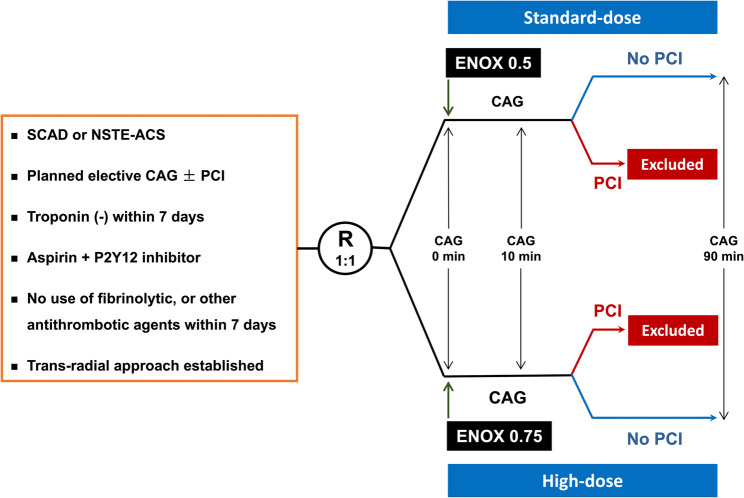 Figure 1
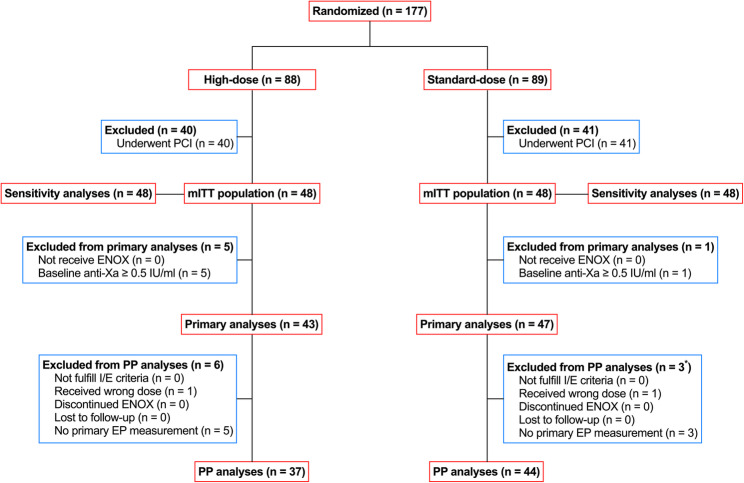 Figure 2
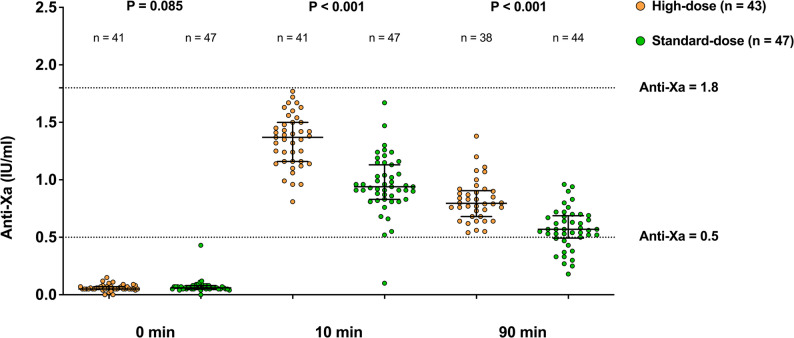 Figure 3
Peer Reviews
No public reviews on file for this paper yet. If you reviewed it on a platform where reviews are public (OpenReview, ICLR, NeurIPS, ICML), you can paste yours below so the community can read it here.
Videos
No videos yet. Explain this paper in a talk, walkthrough, or lecture? Add one.
Taxonomy
TopicsAcute Myocardial Infarction Research · Atrial Fibrillation Management and Outcomes · Coronary Interventions and Diagnostics