Cryptosporidium within a One health framework: a comprehensive review of public health impact, environmental concerns, and emerging strategies for prevention and treatment
Refaat Ras, Adel Abdelkhalek, Enrique Raya-Álvarez, Rawan Muhammad Shady, Qwait AlGabbani, Abdelbaset E. Abdelbaset, Ali S. A. Saleem, Mustafa Shukry, Ahmed Agil, Ehab Kotb Elmahallawy

TL;DR
This paper reviews the public health impact of Cryptosporidium, a waterborne parasite, and highlights the need for better treatments, diagnostics, and a One Health approach to control its spread.
Contribution
The paper provides a comprehensive review of Cryptosporidium's impact and outlines emerging strategies for prevention, treatment, and future research priorities.
Findings
Cryptosporidium is a major cause of diarrheal disease, particularly affecting immunocompromised individuals and children in low-resource areas.
Current treatments like nitazoxanide are ineffective in vulnerable populations, and there is a lack of standardized drug evaluation methods and reliable vaccine surrogates.
Emerging technologies like next-generation sequencing offer improved detection but need integration into clinical workflows for broader impact.
Abstract
Cryptosporidium species are globally distributed parasites and are a major cause of cryptosporidiosis, a diarrheal disease that disproportionately affects immunocompromised individuals and young children in low-resource settings. Cryptosporidium is widely regarded as a critical contaminant of drinking water and is strongly associated with an increased risk of waterborne disease, posing a serious threat to public health. Furthermore, agricultural environments can serve as sources of contamination with Cryptosporidium oocysts through fecal material originating from both humans and animals. Despite their major zoonotic relevance, critical gaps remain in understanding their true public health burden, transmission pathways, and ways to effectively translate emerging knowledge into prevention and treatment strategies. Currently, nitazoxanide is the only FDA-approved treatment for…
Genes, proteins, chemicals, diseases, species, mutations and cell lines named across the full text — each resolved to its canonical identifier and authoritative record.
Click any figure to enlarge with its caption.
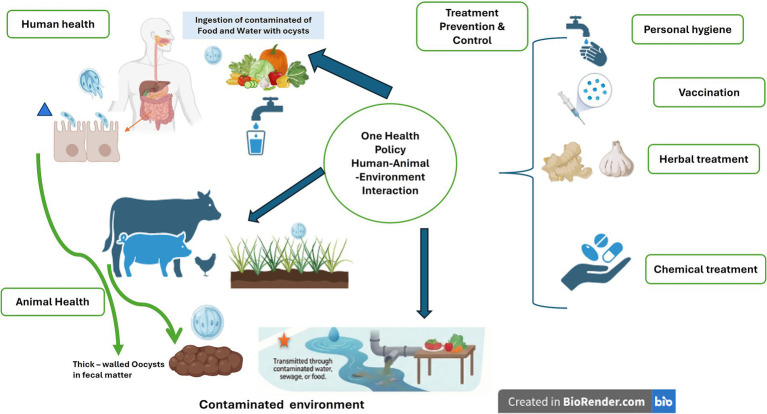 Figure 1
 Figure 2
 Figure 3
Peer Reviews
No public reviews on file for this paper yet. If you reviewed it on a platform where reviews are public (OpenReview, ICLR, NeurIPS, ICML), you can paste yours below so the community can read it here.
Videos
No videos yet. Explain this paper in a talk, walkthrough, or lecture? Add one.
Taxonomy
TopicsParasitic Infections and Diagnostics · Amoebic Infections and Treatments · Parasites and Host Interactions