A feasibility RCT protocol of the MATILDA intervention to support older adults with intellectual disability to improve their health and social networks
Laurence Taggart, Angela Hassiotis, Assumpta Ryan, Brendan Bunting, Carian O’Neill, Mike Clarke, Roger Stancliffe, Haleemah Ahmed, Elle Kim, Lindsay Armstrong, Andrew Hanna, Susie Willis, Brendan Leahy, Janet Schofield, Allison Campbell

TL;DR
This study tests a community-based intervention to improve health and social connections for older adults with intellectual disabilities.
Contribution
The MATILDA intervention is a novel, low-cost approach to reduce social isolation in older adults with intellectual disabilities.
Findings
The study will assess feasibility outcomes like recruitment and retention in a randomized controlled trial.
A process evaluation will identify challenges and solutions for implementing the MATILDA intervention in community groups.
Abstract
Older adults with an intellectual disability are at greater risk of increased social isolation, loneliness, and poorer quality of life compared to their non-disabled ageing peers. The MATILDA study aims to improve health and social networks by facilitating older adults with an intellectual disability to engage in their local mainstream community group. The 30-month project is a 2-arm, single-blind, randomised feasibility RCT with 1:1 allocation, being conducted in Northern Ireland and London, England. We are aiming to recruit 64 older adults with an intellectual disability (aged 45 plus) who will be randomised to either the MATILDA intervention or an active control group alongside usual care. We will assess feasibility outcomes (i.e. recruitment, acceptability of intervention, retention, etc.). We will also conduct a process evaluation using the Normalisation Process Theory to identify…
Genes, proteins, chemicals, diseases, species, mutations and cell lines named across the full text — each resolved to its canonical identifier and authoritative record.
Click any figure to enlarge with its caption.
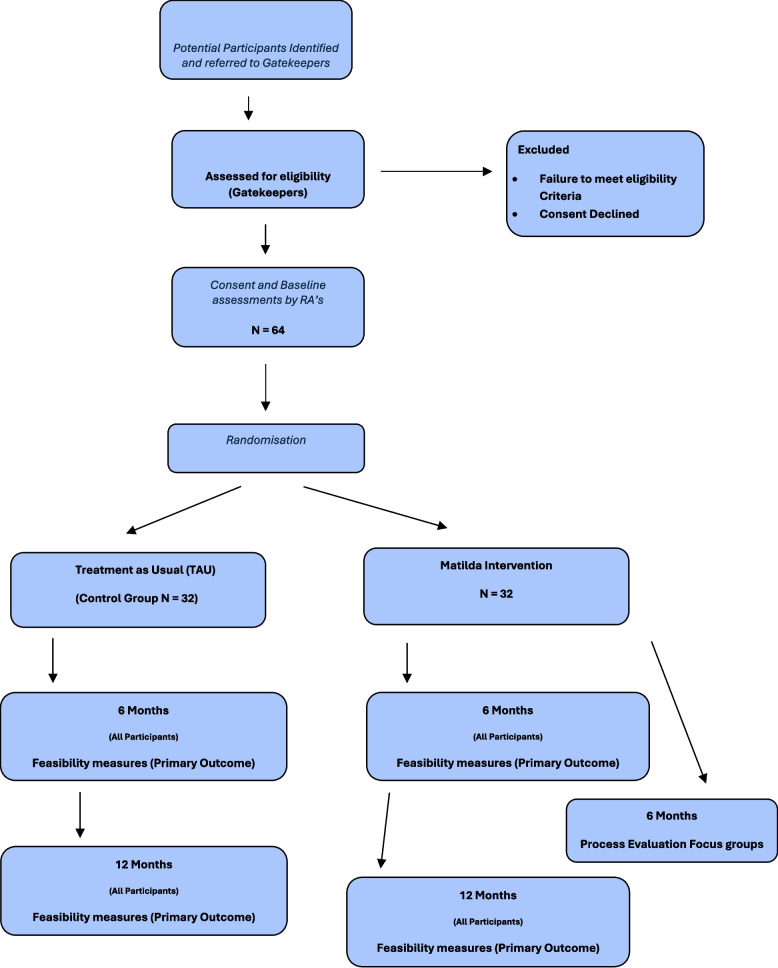 Figure 1
Peer Reviews
No public reviews on file for this paper yet. If you reviewed it on a platform where reviews are public (OpenReview, ICLR, NeurIPS, ICML), you can paste yours below so the community can read it here.
Videos
No videos yet. Explain this paper in a talk, walkthrough, or lecture? Add one.
Taxonomy
TopicsDown syndrome and intellectual disability research · Disability Rights and Representation · Mental Health and Patient Involvement