Prenatal Exposure to Mixtures of Nonpersistent Endocrine-Disrupting Chemicals and Angiogenic Biomarkers, Placental Function, and Fetal Growth
Bethany Knox, Nuria Güil-Oumrait, Vishal Midya, Hana Vespalcová, Maria Dolores Gómez-Roig, Elisa Llurba, Sandra Márquez, Zoraida García Ruiz, Toni Galmes, Claire Philippat, Amrit Kaur Sakhi, Cathrine Thomsen, Jose Urquiza, Maria Julia Zanini, Payam Dadvand, Mireia Gascon

TL;DR
This study explores how exposure to certain chemicals during pregnancy affects fetal growth and placental function, finding that specific chemical mixtures may reduce or increase birthweight.
Contribution
The study introduces a novel approach to assess the impact of nonpersistent endocrine-disrupting chemical mixtures on fetal growth and placental function using advanced statistical methods.
Findings
Low-molecular-weight phthalate mixtures were associated with decreased birthweight z-scores.
Organophosphate mixtures were linked to increased birthweight z-scores.
Angiogenic biomarkers partially mediated the relationship between chemical exposure and birthweight.
Abstract
Exposure to endocrine-disrupting chemicals (EDCs) during pregnancy may influence the placenta and fetal growth; however, evidence is scarce regarding EDC mixtures, newer chemicals, and the role of angiogenic biomarkers and fetoplacental hemodynamics. We aimed to examine the associations between nonpersistent EDC mixtures and fetal growth, fetoplacental hemodynamics, and angiogenic biomarkers. We included 734 pregnant participants from the Barcelona Life Study Cohort (BiSC), Spain (2018–2021). Metabolites of phthalates, DINCH, insecticides, polycyclic aromatic hydrocarbons, pesticides, flame retardants, and parent compounds of phenols and parabens were measured in pools of week-long maternal urine samples at 18 and 34 weeks’ gestation. Penalized LASSO-type multigroup Bayesian Weighted Quantile Sum Regression estimated associations with fetal growth, fetoplacental hemodynamics, and…
Genes, proteins, chemicals, diseases, species, mutations and cell lines named across the full text — each resolved to its canonical identifier and authoritative record.
Click any figure to enlarge with its caption.
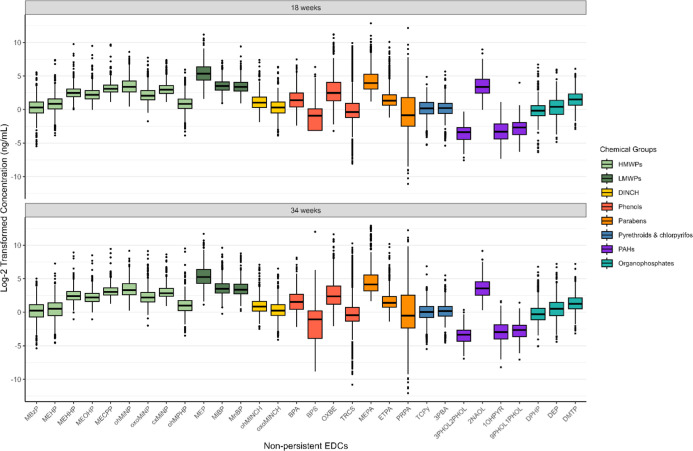 Figure 1
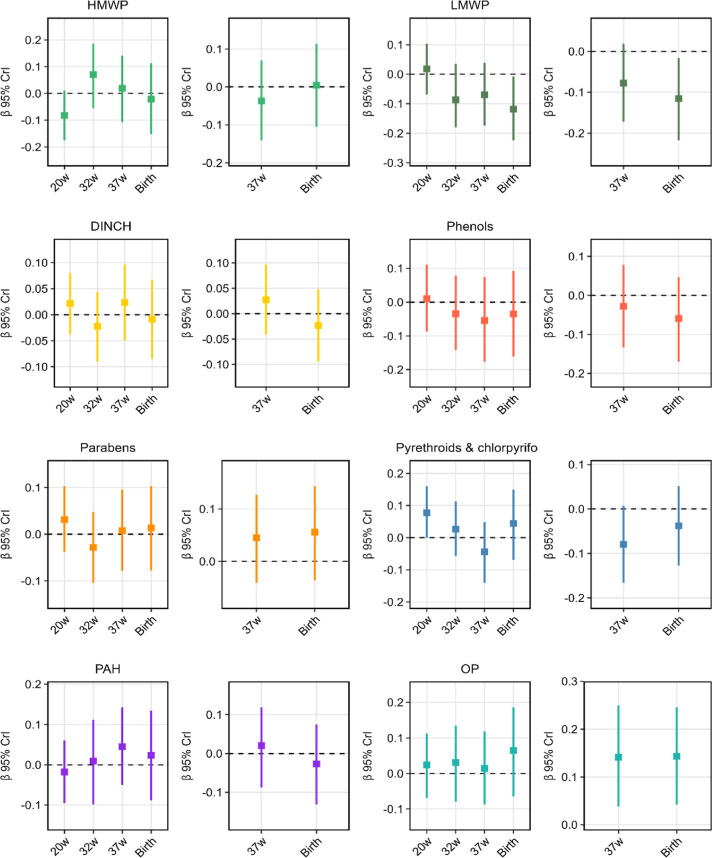 Figure 2
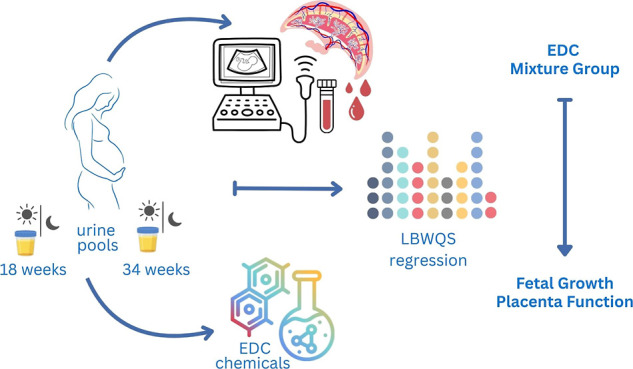 Figure 3
 Figure 4
Peer Reviews
No public reviews on file for this paper yet. If you reviewed it on a platform where reviews are public (OpenReview, ICLR, NeurIPS, ICML), you can paste yours below so the community can read it here.
Videos
No videos yet. Explain this paper in a talk, walkthrough, or lecture? Add one.
Taxonomy
TopicsEffects and risks of endocrine disrupting chemicals · Health, Environment, Cognitive Aging · Pregnancy and Medication Impact