Simulation of Charge Distribution and Microstructure in Semicrystalline Polymeric Ionic-Electronic Conductors Using Classical Simulation at Constant Electrochemical Potential
Zixuan Wei, Hesam Makki, Paola Carbone, Alessandro Troisi

TL;DR
This paper introduces a new simulation method to study how charge and structure change in polymer materials under constant electrochemical conditions.
Contribution
A novel classical simulation framework for studying charge distribution and microstructure in doped polymers under constant electrochemical potential.
Findings
The method reproduces minimal structural changes in semicrystalline polymers under varying electrochemical potentials.
Near the redox potential, charging levels fluctuate more and interlamellar angles vary significantly.
Local charge correlations between polymer chains are minimal except at extreme potentials.
Abstract
Understanding how charge distributions on aggregated chains change with microstructure under constant electrochemical potential is crucial for elucidating the behavior of polymeric organic mixed ionic–electronic conductors (OMEICs), yet it remains difficult to study. To address this challenge, we introduce a methodology to perform classical atomistic simulations of doped semiconductors at a constant electrochemical potential. The method allows individual polymer chains to be oxidized and reduced, taking into account their individual redox potentials and the externally tunable electrochemical potential. The implementation follows a grand-canonical molecular dynamics (GC-MD) scheme, with the local modulation of the redox potential being described by a QM/MM Hamiltonian. Applied to a semicrystalline polymer with ordered layered and lamellar structures, the method reproduces the…
Genes, proteins, chemicals, diseases, species, mutations and cell lines named across the full text — each resolved to its canonical identifier and authoritative record.
Click any figure to enlarge with its caption.
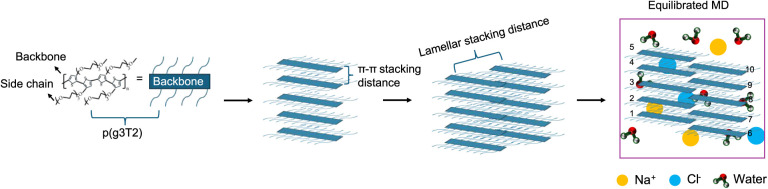 Figure 1
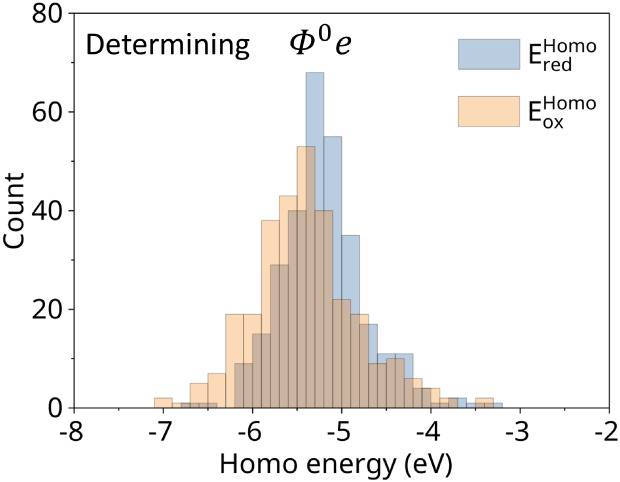 Figure 2
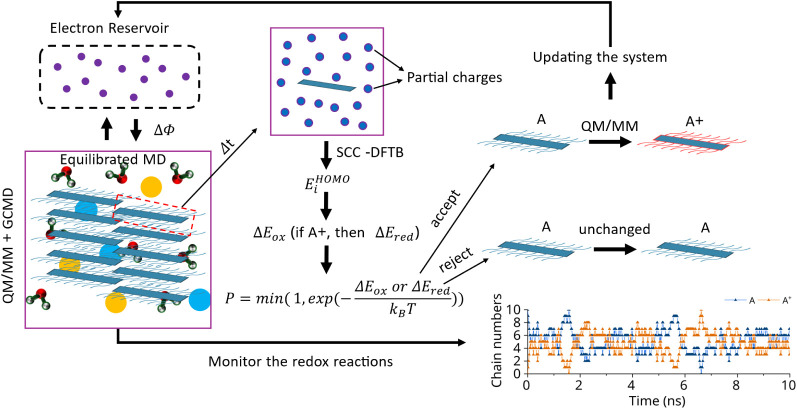 Figure 3
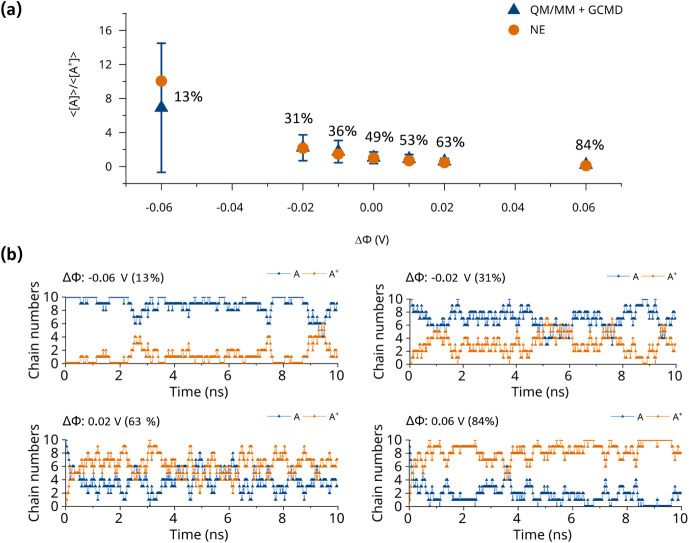 Figure 4
 Figure 5
 Figure 6
 Figure 7
 Figure 8
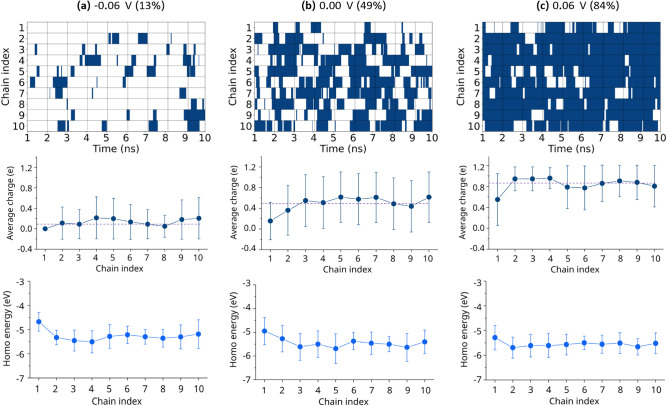 Figure 9
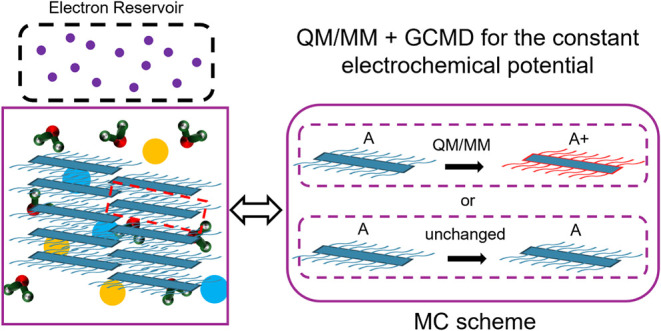 Figure 10
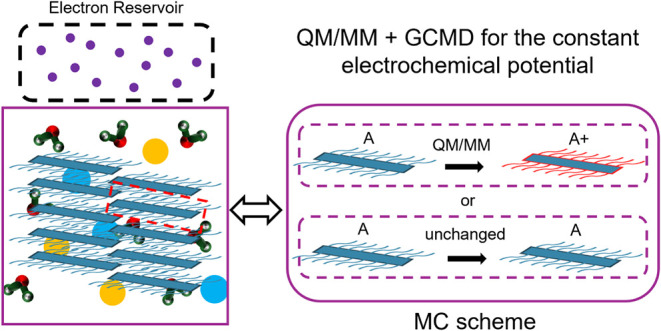 Figure 11
 Figure 12
 Figure 13
 Figure 14
 Figure 15
 Figure 16
 Figure 17
 Figure 18
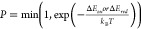 Figure 19
 Figure 20
 Figure 21
 Figure 22
 Figure 23
 Figure 24
 Figure 25
 Figure 26
 Figure 27
 Figure 28
 Figure 29
 Figure 30
 Figure 31
 Figure 32
 Figure 33
 Figure 34
 Figure 35
 Figure 36
 Figure 37
 Figure 38
 Figure 39
 Figure 40
 Figure 41
 Figure 42
 Figure 43
 Figure 44
 Figure 45
Peer Reviews
No public reviews on file for this paper yet. If you reviewed it on a platform where reviews are public (OpenReview, ICLR, NeurIPS, ICML), you can paste yours below so the community can read it here.
Videos
No videos yet. Explain this paper in a talk, walkthrough, or lecture? Add one.
Taxonomy
TopicsConducting polymers and applications · Organic Electronics and Photovoltaics · Dielectric materials and actuators