Understanding Solvent-Induced Glass Transition in Polymer Thin Films Using Absorption–Desorption Isotherms
Nayanathara Hendeniya, Sharif Tasnim Mahmud, Shaghayegh Abtahi, Boyce S Chang

TL;DR
This paper explores how solvents affect the glass transition in polymer thin films using absorption and desorption isotherms, revealing new insights into solvent-polymer interactions.
Contribution
The study identifies four distinct solvent-polymer interaction regimes and links solvent-induced glass transition to physical aging and plasticization effects.
Findings
Glass transition trends are more robust in absorption than desorption, contrary to prior reports.
Excess osmotic pressure analysis quantifies physical aging in thin films below the glass transition.
Solvent annealing effects are strongly influenced by solvent viscosity and mass transport.
Abstract
The fundamental thermodynamic and mechanical underpinnings of polymer thin films exposed to solvent vapor are critical for the development of advanced nanolithography and high-performance coatings. This work investigates the solvent–polymer interactions of glassy thin films by using the solvent absorption–desorption isotherms. An analogous relationship to the Flory–Fox equation was observed between solvent–induced glass transition, swelling, Flory–Huggins interaction parameter, and molecular weight. Isothermal swelling measurements revealed that the glass transition trends are more robust in the absorption curve compared to desorption, contrary to previous reports. Excess osmotic pressure analysis of the isotherm provides a measure of the degree of physical aging in thin films annealed below the glass transition. This is further validated in the ordering of block copolymer (BCP) films…
Genes, proteins, chemicals, diseases, species, mutations and cell lines named across the full text — each resolved to its canonical identifier and authoritative record.
Click any figure to enlarge with its caption.
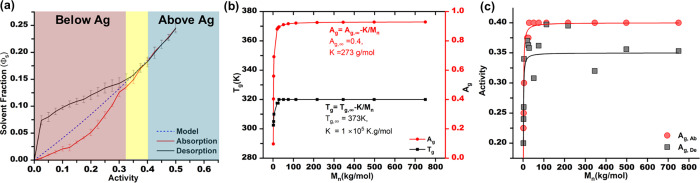 Figure 1
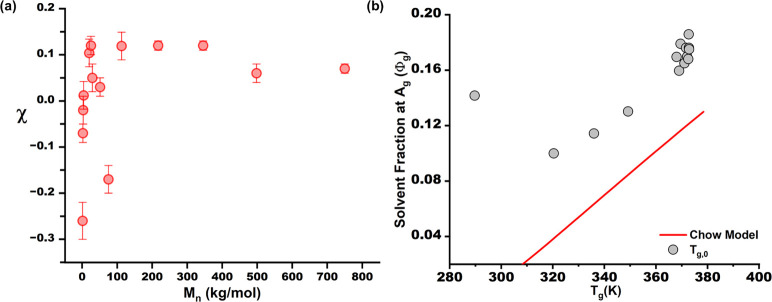 Figure 2
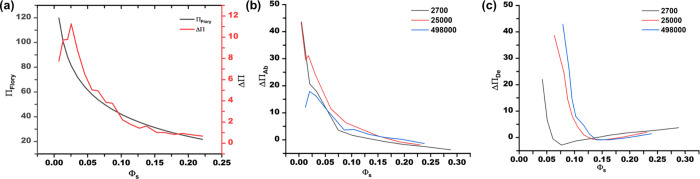 Figure 3
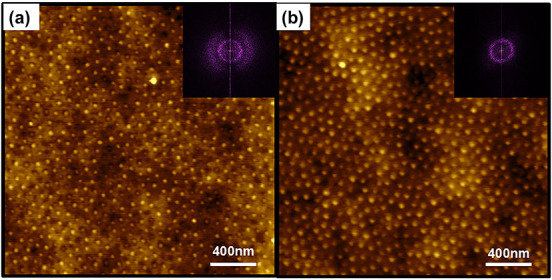 Figure 4
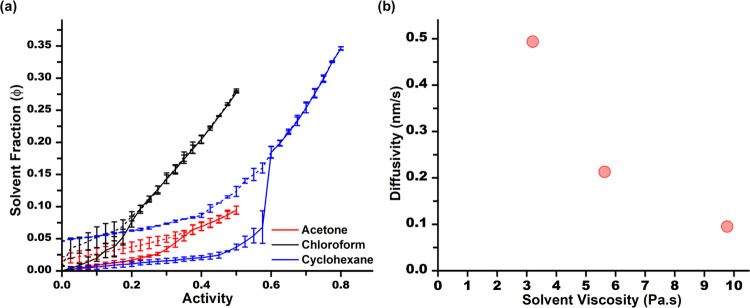 Figure 5
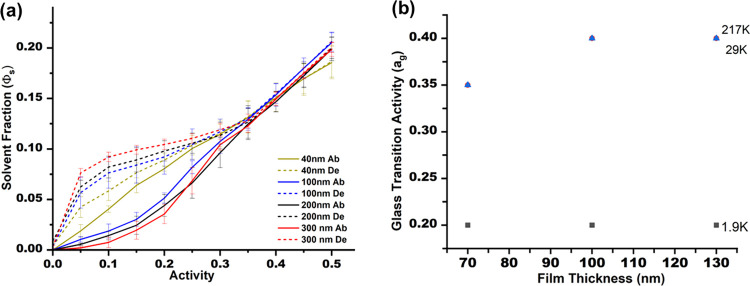 Figure 6
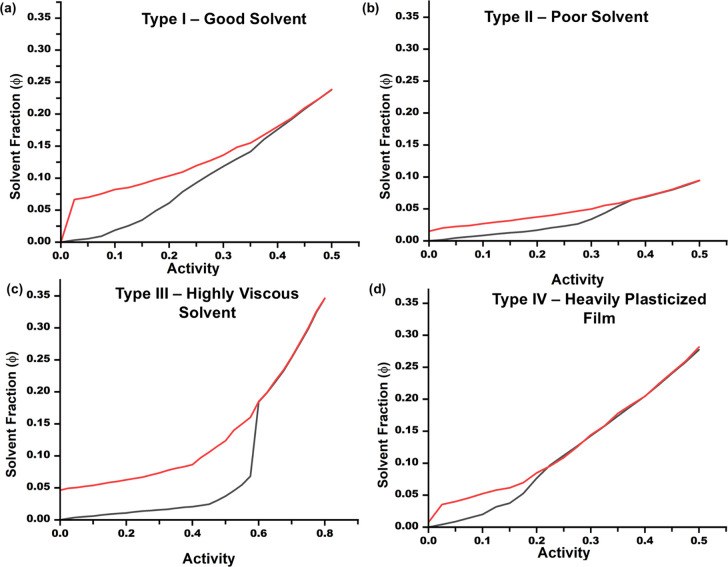 Figure 7
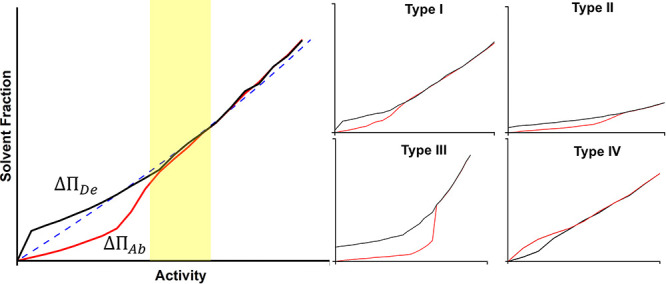 Figure 8
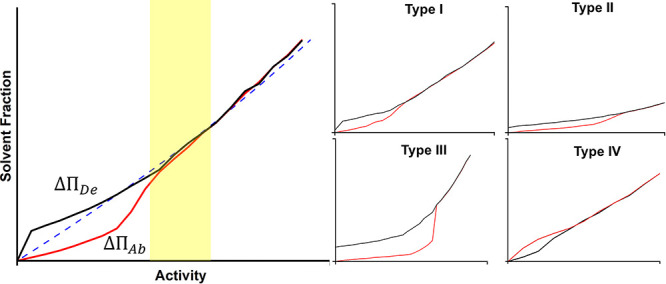 Figure 9
 Figure 10
 Figure 11
 Figure 12
 Figure 13
 Figure 14
 Figure 15
 Figure 16
 Figure 17
 Figure 18
Peer Reviews
No public reviews on file for this paper yet. If you reviewed it on a platform where reviews are public (OpenReview, ICLR, NeurIPS, ICML), you can paste yours below so the community can read it here.
Videos
No videos yet. Explain this paper in a talk, walkthrough, or lecture? Add one.
Taxonomy
TopicsMaterial Dynamics and Properties · Polymer crystallization and properties · Advanced Physical and Chemical Molecular Interactions