SGLT2 Inhibitors, Muscle Loss, and Creatinine-Based Estimated GFR: An Integrative Conceptual Review of Renoprotection
Dion Groothof, Naser B.N. Shehab, Adrian Post, Nicole S. Erler, Reinold O.B. Gans, Stephan J.L. Bakker

TL;DR
This paper reviews how SGLT2 inhibitors may appear to protect kidneys partly because they reduce muscle mass, which affects creatinine levels used to estimate kidney function.
Contribution
Highlights a methodological bias in interpreting kidney protection effects of SGLT2 inhibitors due to their impact on muscle mass and creatinine-based GFR estimates.
Findings
SGLT2 inhibitors may reduce muscle mass, affecting creatinine-based GFR estimates.
Observed kidney benefits could partly result from reduced creatinine generation, not true GFR preservation.
Future studies should use direct GFR measurements or cystatin C to avoid this bias.
Abstract
Diabetes mellitus profoundly affects the kidneys, driving many individuals to kidney failure. With the rising global incidence of diabetic kidney disease straining health care systems, effective interventions are imperative. Landmark trials have shown that sodium–glucose cotransporter 2 (SGLT2) inhibitors attenuate the decline in estimated glomerular filtration rate (GFR), even without diabetes. However, these trials largely relied on creatinine-based GFR estimates, which are only valid if an intervention does not alter muscle-derived creatinine generation. Because SGLT2 inhibitors reduce muscle mass, the observed attenuation in estimated GFR decline may partly reflect reduced creatinine generation rather than true preservation of GFR. This methodological bias could also skew hard endpoints such as dialysis initiation, transplantation, and mortality. Using representative data from a…
Genes, proteins, chemicals, diseases, species, mutations and cell lines named across the full text — each resolved to its canonical identifier and authoritative record.
Click any figure to enlarge with its caption.
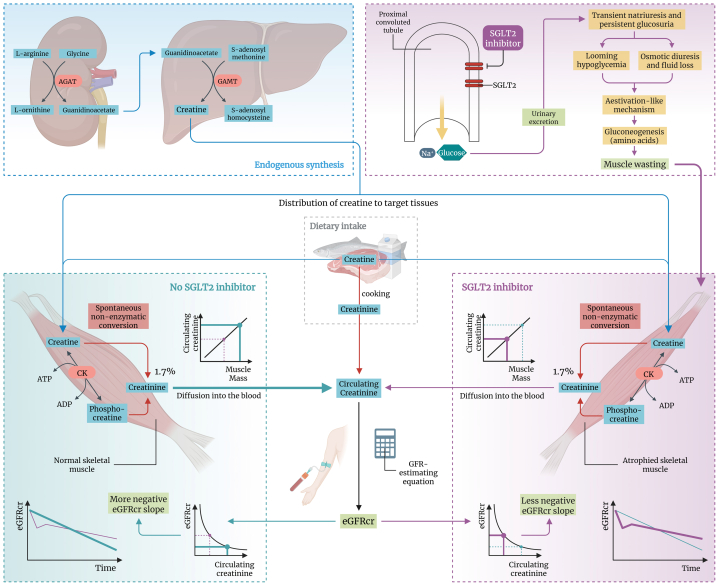 Figure 1
Peer Reviews
No public reviews on file for this paper yet. If you reviewed it on a platform where reviews are public (OpenReview, ICLR, NeurIPS, ICML), you can paste yours below so the community can read it here.
Videos
No videos yet. Explain this paper in a talk, walkthrough, or lecture? Add one.
Taxonomy
TopicsChronic Kidney Disease and Diabetes · Renin-Angiotensin System Studies · Diabetes Treatment and Management