Microwave-Assisted Deoxygenation of Substituted Aromatic Ketones over Commercial Pd/Al2O3 under Mild Conditions
Fabio Bucciol, Ignacio C. Vega, Emanuela Calcio Gaudino, Maela Manzoli, Silvia Tabasso, Giancarlo Cravotto

TL;DR
This paper presents a method for converting aromatic ketones into alcohols and alkyl chains using microwave-assisted reactions under mild conditions.
Contribution
The study introduces a novel microwave-enhanced deoxygenation method using commercial Pd/Al2O3 under mild conditions.
Findings
Microwave-assisted deoxygenation occurs under 120 °C and 5 bar H2 in 2 hours.
Ethanol is the optimal solvent for the reaction.
Keto–enol tautomerization and hydrogenolysis are key steps in the proposed mechanism.
Abstract
Herein, a study on the deoxygenation of substituted aromatic ketones over commercial Pd/Al2O3 (5 wt %) is reported. The reaction occurs under very mild conditions (120 °C, 5 bar H2) in just 2 h using microwaves to enhance the kinetics. Ethanol was found to be the best solvent, while the effect of the substituents was studied over different substrates. On the basis of experimental evidence, a mechanism is proposed in which keto–enol tautomerization enables deoxygenation to the corresponding alcohol followed by direct hydrogenolysis to the alkyl chain.
Genes, proteins, chemicals, diseases, species, mutations and cell lines named across the full text — each resolved to its canonical identifier and authoritative record.
Click any figure to enlarge with its caption.
 Figure 1
 Figure 2
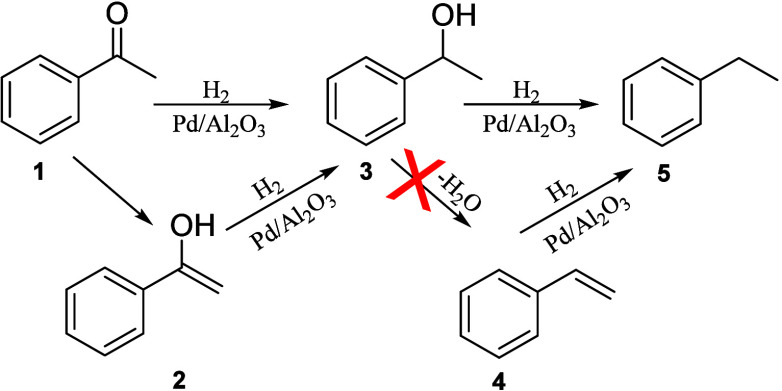 Figure 3
 Figure 4
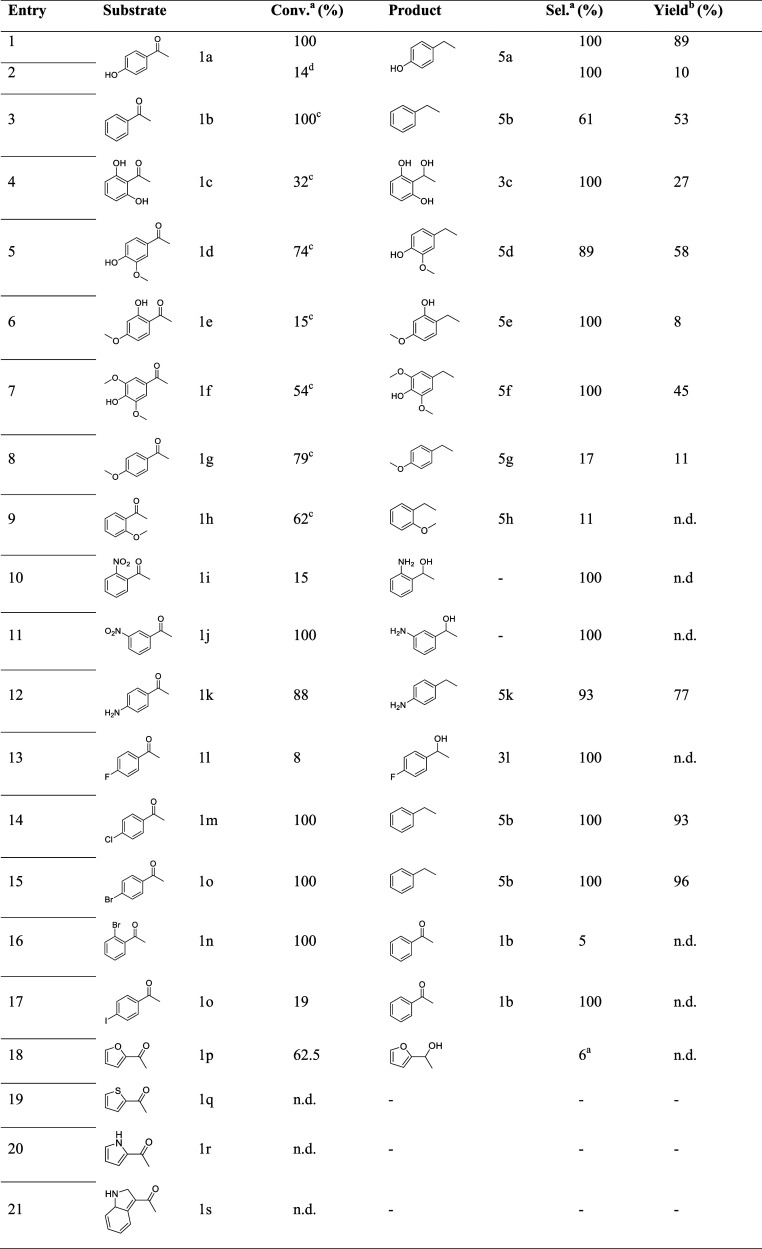 Figure 5
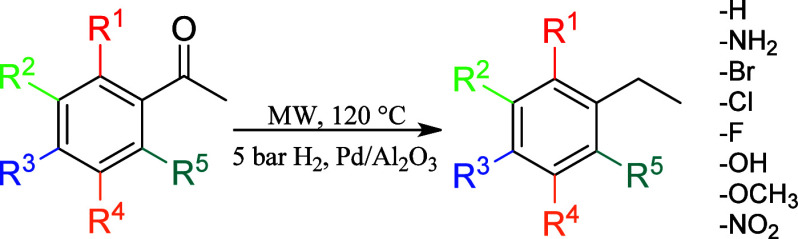 Figure 6
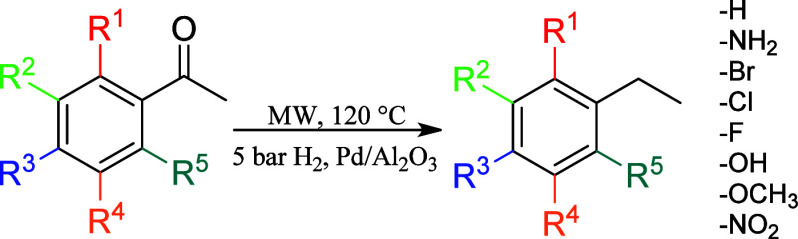 Figure 7
Peer Reviews
No public reviews on file for this paper yet. If you reviewed it on a platform where reviews are public (OpenReview, ICLR, NeurIPS, ICML), you can paste yours below so the community can read it here.
Videos
No videos yet. Explain this paper in a talk, walkthrough, or lecture? Add one.
Taxonomy
TopicsAsymmetric Hydrogenation and Catalysis · Environmental remediation with nanomaterials · Microwave-Assisted Synthesis and Applications