Identification and Characterization of Perampanel Degradation Products: Stability-Indicating HPLC and In Silico Toxicological Assessment
Jéssica Domingos da Silva, Gil Mendes Viana, Luana Gonçalves de Souza, Bárbara Abrahim-Vieira, Alessandra Mendonça Teles de Souza, Carina de Souza Anselmo, Henrique Marcelo Gualberto Pereira, Lucio Mendes Cabral, Valéria Pereira de Sousa

TL;DR
This study identifies and characterizes perampanel's degradation products under various stress conditions and assesses their toxicity using in silico methods.
Contribution
The study reports two previously unreported degradation products of perampanel and provides toxicological insights for formulation development.
Findings
Five degradation products of perampanel were identified and structurally characterized.
Two new degradation products were formed under alkaline conditions.
Toxicity assessment showed no mutagenic risk for the degradation products.
Abstract
A stability-indicating HPLC-UV method enabling the simultaneous separation and monitoring of perampanel (PER) and all degradation products was developed and applied, providing adequate resolution and peak purity. Forced degradation studies were conducted to define the degradation profile of PER under acidic, alkaline, oxidative, photolytic, and metal-ion stress conditions. Five degradation products (DP-1 to DP-5) were identified by HPLC–UV and structurally characterized by HRMS/MS, and 1D/2D NMR spectroscopy (1H, 13C, COSY, and HSQC). Acidic hydrolysis produced a benzamide derivative (DP-1) and a benzoic acid derivative (DP-2), oxidative stress generated a pyridine N-oxide derivative (DP-3), and alkaline conditions yielded two previously unreported products, a ring-cleavage derivative of perampanel (DP-4) and a hydroxylated pyridone derivative of perampanel (DP-5). DP-1 was also…
Genes, proteins, chemicals, diseases, species, mutations and cell lines named across the full text — each resolved to its canonical identifier and authoritative record.
Click any figure to enlarge with its caption.
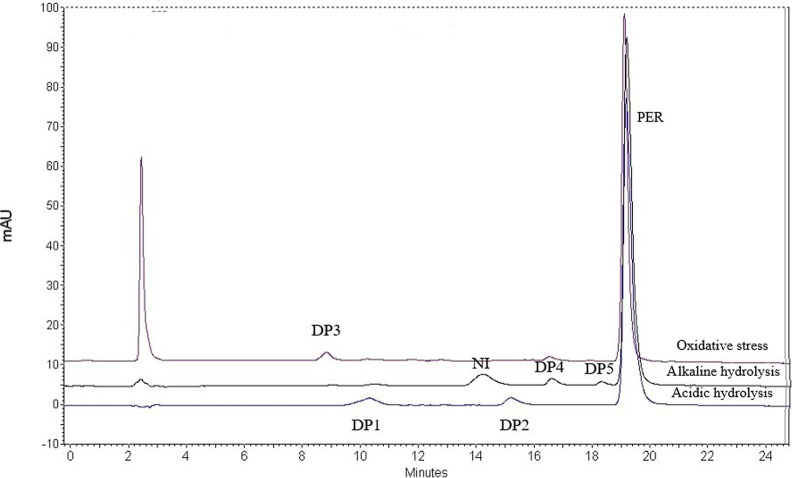 Figure 1
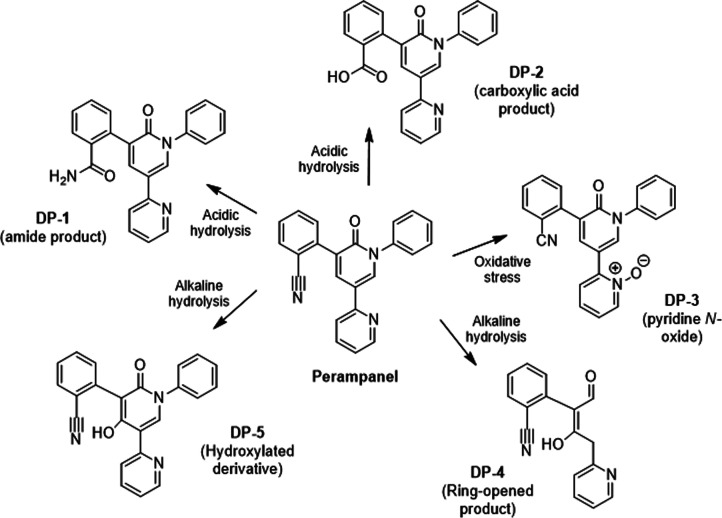 Figure 2
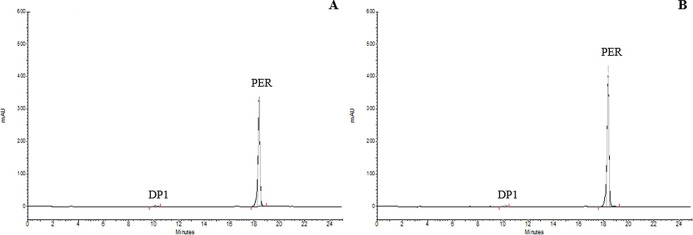 Figure 3
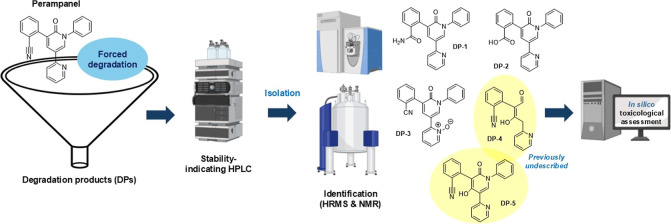 Figure 4
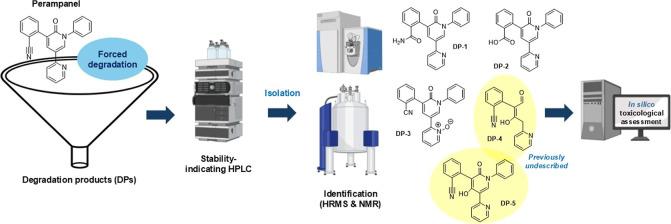 Figure 5
Peer Reviews
No public reviews on file for this paper yet. If you reviewed it on a platform where reviews are public (OpenReview, ICLR, NeurIPS, ICML), you can paste yours below so the community can read it here.
Videos
No videos yet. Explain this paper in a talk, walkthrough, or lecture? Add one.
Taxonomy
TopicsAnalytical Methods in Pharmaceuticals · Pesticide Residue Analysis and Safety · Pesticide Exposure and Toxicity