Sentinel lymph node detection in early-stage breast cancer - Are technetium-99m-nanocolloid and superparamagnetic iron oxide diagnostically equivalent procedures? A propensity score matched real world data analysis
Ina Shehaj, Katharina Stuppy, Amelie Löwe, Paul Löwe, Christian Ruckes, Pia-Elisabeth Baqué, Mathias Schreckenberger, Yaman Degirmenci, Anne-Sophie Heimes, Antje Lebrecht, Andrea Helisch, Helmut Reber, Kathrin Stewen, Marcus Schmidt, Annette Hasenburg, Slavomir Krajnak

TL;DR
This study compares two tracers used in sentinel lymph node biopsy for breast cancer and finds that one leads to shorter surgery times.
Contribution
A real-world data analysis using propensity score matching to compare surgery duration and sentinel node detection between two tracers in breast cancer patients.
Findings
Surgery time was significantly shorter with technetium-99m nanocolloid compared to superparamagnetic iron oxide.
Superparamagnetic iron oxide resulted in more sentinel nodes removed without increasing complications.
Detection rates of sentinel lymph nodes were similar for both tracers.
Abstract
Several studies have compared validated tracers, such as the radioactive tracer technetium-99m nanocolloid (99mTc-nanocolloid) and superparamagnetic iron oxide (SPIO), for sentinel node biopsy (SNB) in early-stage breast cancer (eBC). These studies mostly investigated the differences in detection rate and SNB-related adverse events. The aim of our study was to determine whether there are any crucial differences between the two procedures, including the duration of surgery and the number of detected sentinel lymph nodes (SN), which may affect patient treatment and the standard of care in eBC. All patients were treated at the University Medical Centre Mainz by certified breast surgeons. Two consecutive groups of patients were identified based on the injected tracer: Technetium Group (N = 517), patients treated from January 1, 2017 to December 31, 2019, with 99mTc-nanocolloid as tracer and…
Genes, proteins, chemicals, diseases, species, mutations and cell lines named across the full text — each resolved to its canonical identifier and authoritative record.
Click any figure to enlarge with its caption.
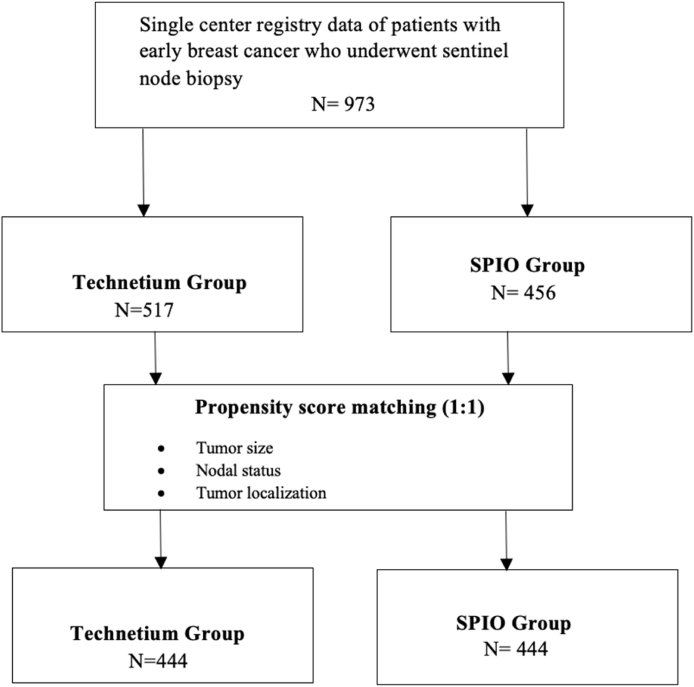 Figure 1
Peer Reviews
No public reviews on file for this paper yet. If you reviewed it on a platform where reviews are public (OpenReview, ICLR, NeurIPS, ICML), you can paste yours below so the community can read it here.
Videos
No videos yet. Explain this paper in a talk, walkthrough, or lecture? Add one.
Taxonomy
TopicsBreast Cancer Treatment Studies · Breast Lesions and Carcinomas · MRI in cancer diagnosis