Automated Inference of Social Anxiety From Behavior in Social Virtual Reality: Cross-Sectional Observational Study
Gayoung Son, Marius Rubo

TL;DR
This study shows that social anxiety behaviors, like avoiding eye contact and speaking softly, can be detected in virtual reality interactions, similar to real-life settings.
Contribution
The study is the first to comprehensively examine behavioral and physiological markers of social anxiety in avatar-based human-human interactions in social VR.
Findings
Social anxiety was linked to reduced eye gaze, quieter speech, and lower heart rate variability in VR interactions.
Patterns of social anxiety overlapped with those of psychopathology but were opposite to those of verticality.
VR setups can capture rich behavioral data naturally, enabling new ways to detect and address social stress.
Abstract
Social anxiety often manifests through behaviors such as reduced gaze to the eyes and lower speech volume. While these markers have been examined in face-to-face interactions, large-scale assessments remain challenging. Social virtual reality (VR) offers a promising alternative by enabling naturalistic interactions in which behavior can be captured at scale, but it remains unclear if people show naturalistic behavior in such artificial environments. We examined whether behavioral and physiological markers associated with social anxiety in real-life interactions similarly emerge in dyadic social VR. We additionally examined whether these patterns overlap with patterns linked to the broader constructs of psychopathology and verticality. In this cross-sectional study, 128 participants (105 females, 22 males, 1 diverse; age 18-51 years; mean age 22.60, SD 3.57 years), recruited from a…
Genes, proteins, chemicals, diseases, species, mutations and cell lines named across the full text — each resolved to its canonical identifier and authoritative record.
Click any figure to enlarge with its caption.
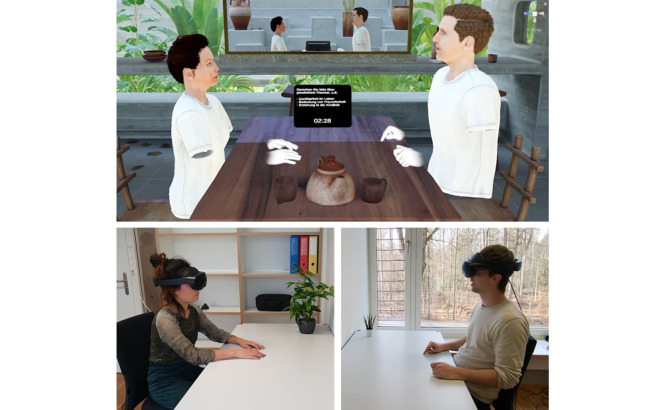 Figure 1
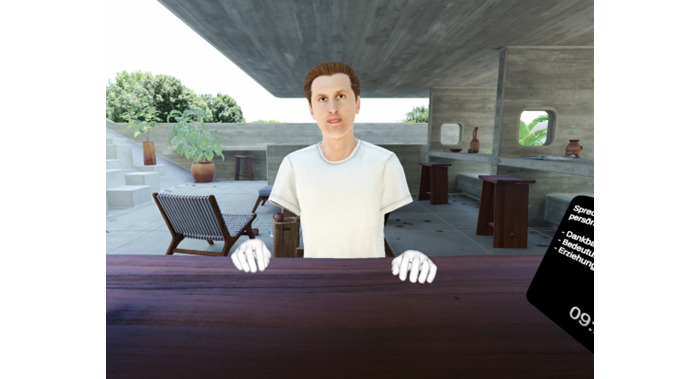 Figure 2
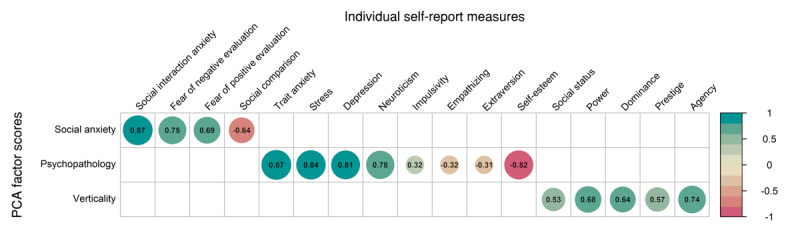 Figure 3
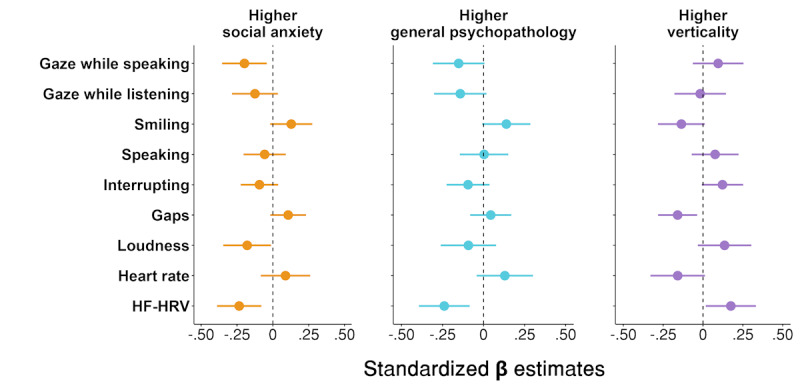 Figure 4
Peer Reviews
No public reviews on file for this paper yet. If you reviewed it on a platform where reviews are public (OpenReview, ICLR, NeurIPS, ICML), you can paste yours below so the community can read it here.
Videos
No videos yet. Explain this paper in a talk, walkthrough, or lecture? Add one.
Taxonomy
TopicsVirtual Reality Applications and Impacts · Emotion and Mood Recognition · Social Robot Interaction and HRI