Sonoluminescence from single cavitation bubbles near solid surfaces
Jaka Mur, Rok Petkovsek, Claus-Dieter Ohl

TL;DR
The study shows that light is emitted during bubble collapse near solid surfaces, but this light emission is not linked to surface erosion.
Contribution
This is the first observation of sonoluminescence during asymmetric bubble collapse near solid surfaces.
Findings
Light emission occurs at the most intense flow focusing sites during bubble collapse.
No correlation was found between sonoluminescence and surface erosion.
Energy focusing in bubbles and liquids follows distinct pathways.
Abstract
Sonoluminescence, the light emission from bubbles undergoing large volume oscillations, has traditionally been associated with near-spherical bubble collapses in free liquid. In contrast, highly asymmetric bubble collapses near solid boundaries are known to cause surface erosion from transient and extreme pressure build ups. While both phenomena are caused from energy focusing during bubble collapse, a connection between erosion and light emission has not been previously reported. Here, we for the first time observe the highly asymmetric toroidal cavitation bubble collapse leading to erosive effects on the nearby boundary emits light, too. Through multi-modal measurements of the bubble dynamics and the associated phenomena near solid surfaces, we find that light emission occurs exclusively at the sites and time of the most intense flow focusing. Yet, we find no correlation between the…
Genes, proteins, chemicals, diseases, species, mutations and cell lines named across the full text — each resolved to its canonical identifier and authoritative record.
Click any figure to enlarge with its caption.
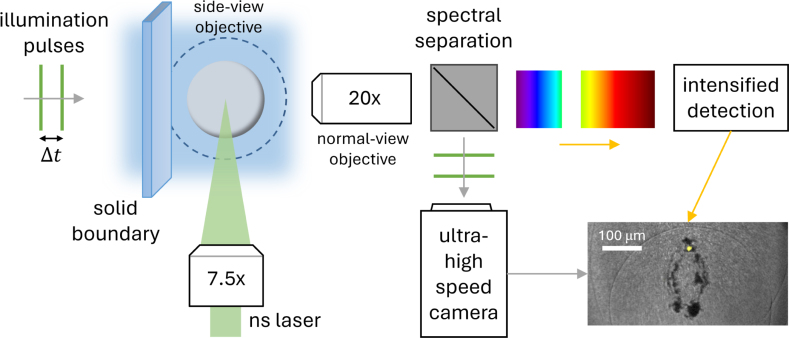 Figure 1
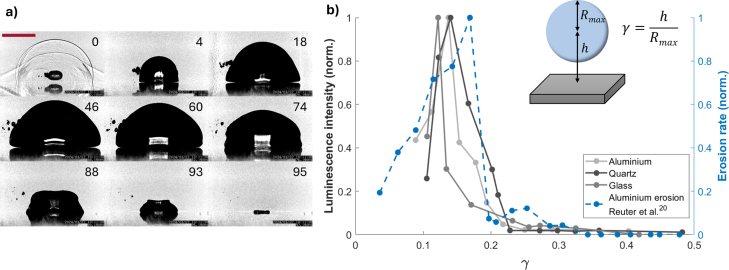 Figure 2
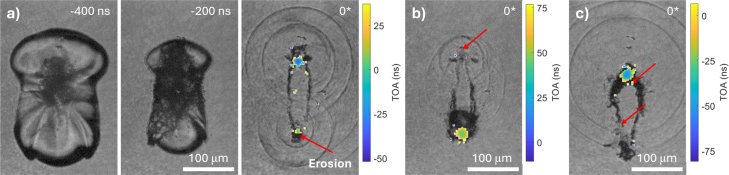 Figure 3
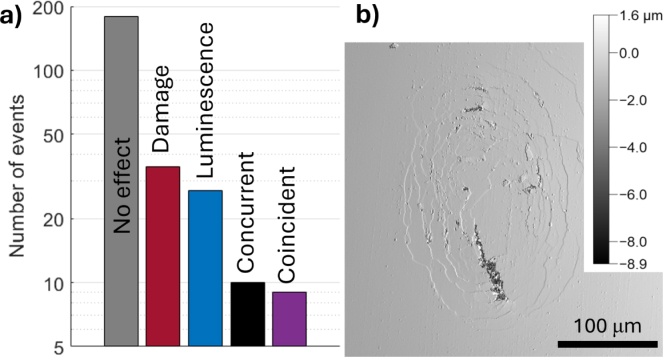 Figure 4
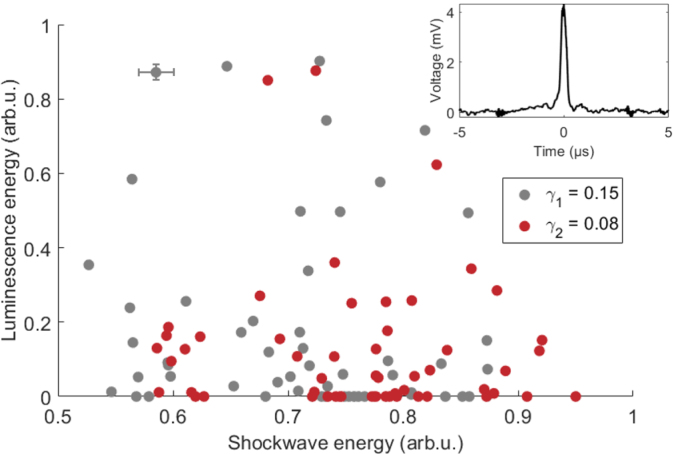 Figure 5
Peer Reviews
No public reviews on file for this paper yet. If you reviewed it on a platform where reviews are public (OpenReview, ICLR, NeurIPS, ICML), you can paste yours below so the community can read it here.
Videos
No videos yet. Explain this paper in a talk, walkthrough, or lecture? Add one.
Taxonomy
TopicsUltrasound and Cavitation Phenomena · Ultrasound and Hyperthermia Applications · Minerals Flotation and Separation Techniques