Relationship between triglyceride glucose-waist circumference and depressive symptoms in Chinese older adults: The China health and retirement longitudinal study
Yanyan Sun, Zhifang Wang, Tingxin He, Baile Ning

TL;DR
This study found that higher triglyceride glucose-waist circumference levels are linked to lower depression risk in older Chinese adults, with age and alcohol consumption playing key roles.
Contribution
The study reveals a nonlinear relationship between TyG-WC and depression in Chinese older adults, identifying age and alcohol consumption as significant interacting factors.
Findings
Higher TyG-WC levels are associated with lower risk of depression in Chinese older adults.
Age and alcohol consumption significantly interact with TyG-WC in relation to depression.
Multiple health and lifestyle factors are linked to depression risk, with alcohol consumption being a key independent variable.
Abstract
The aim of this study was to investigate the horizontal association between triglyceride glucose waist circumference (TyG-WC) and depressive symptoms, and the underlying mechanisms. A sample of 17,708 adults aged ≥45 years from the China Health and Retirement Longitudinal Survey (CHARLS) was analyzed. Logistic regression was used to assess the impact of adverse experiences. Subgroup analysis and quartile analysis were performed simultaneously. Boruta analyzed the correlations between age and alcohol consumption and TyG-WC and depression. Depressed group and non-depressed group showed considerable differences in age, education, marriage, sleep, platelet, hemoglobin, creatinine, uric acid, hypertension, heart disease, memory disorder, BMI, smoking, alcohol consumption, and stroke (P < 0.05). The results showed that the higher the TyG-WC level, the lower the risk of Depression. TyG-WC…
Genes, proteins, chemicals, diseases, species, mutations and cell lines named across the full text — each resolved to its canonical identifier and authoritative record.
Click any figure to enlarge with its caption.
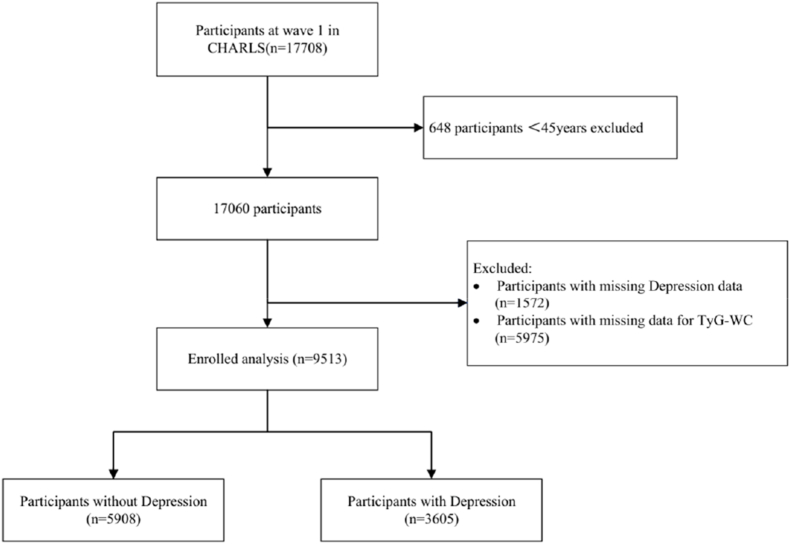 Figure 1
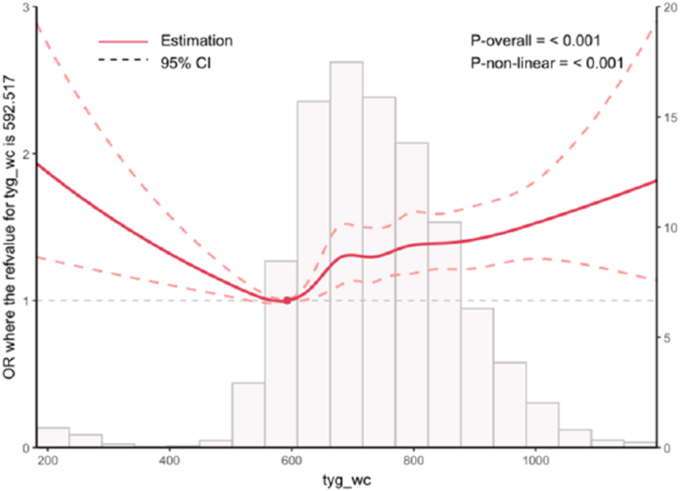 Figure 2
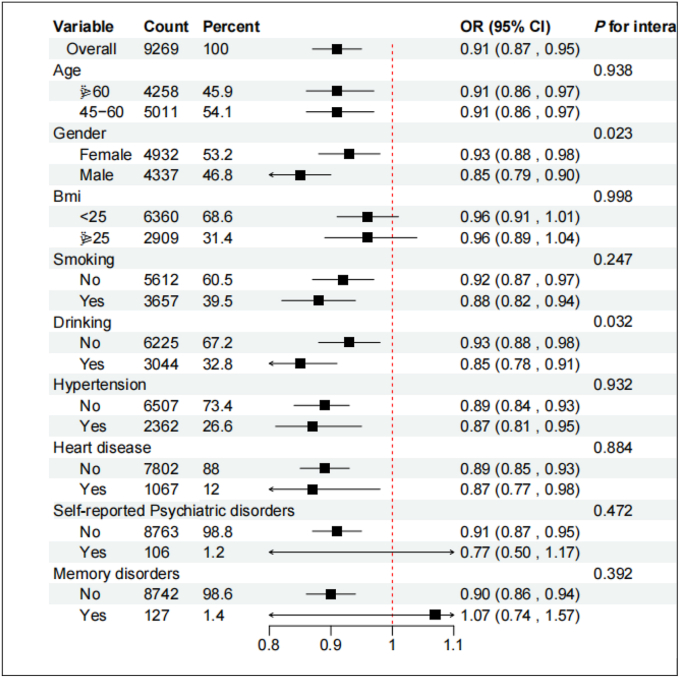 Figure 3
Peer Reviews
No public reviews on file for this paper yet. If you reviewed it on a platform where reviews are public (OpenReview, ICLR, NeurIPS, ICML), you can paste yours below so the community can read it here.
Videos
No videos yet. Explain this paper in a talk, walkthrough, or lecture? Add one.
Taxonomy
TopicsDiabetes, Cardiovascular Risks, and Lipoproteins · Diabetes Management and Education · Bariatric Surgery and Outcomes