Associations of adolescent social media use trajectories with spatial and verbal memory: a prospective cohort study
Jason M. Nagata, Jennifer H. Wong, Kristen E. Kim, Sahana Nayak, Elizabeth J. Li, Racquel A. Richardson, Andreas M. Rauschecker, Leo Sugrue, Kyle T. Ganson, Timothy Piatkowski, Jinbo He, Alexander Testa

TL;DR
This study found that increasing social media use in early adolescence is linked to worse memory performance two years later.
Contribution
The study identifies distinct social media use patterns and their associations with memory outcomes in a large, diverse adolescent cohort.
Findings
Low increasing social media use was linked to worse verbal memory performance on RAVLT tests.
High increasing social media use was associated with lower accuracy in spatial memory (LMT) and worse verbal memory outcomes.
These associations remained after adjusting for factors like socioeconomic status and baseline cognition.
Abstract
Evidence on screen time and cognition is mixed, with few longitudinal studies on social media patterns and memory. This study aimed to examine how social media trajectories relate to cognitive performance in early adolescence. We analyzed a prospective cohort (N = 7528, 51.1% male, mean age: 10 years (8–13 years), 41.8% non-White) from the Adolescent Brain Cognitive Development (ABCD) Study (baseline (2016–2018) to Year 2 (2018–2020)). Group-based trajectory modeling estimated patterns of daily social media use from baseline–Year 2. Three social media time trajectories: (1) no or very low use, (2) low but increasing use, and (3) high and increasing use were identified. Cognitive functioning was measured using the Little Man Task (LMT) and the Rey Auditory Verbal Learning Test (RAVLT). Linear regression models estimated the association between social media time trajectories and…
Genes, proteins, chemicals, diseases, species, mutations and cell lines named across the full text — each resolved to its canonical identifier and authoritative record.
Click any figure to enlarge with its caption.
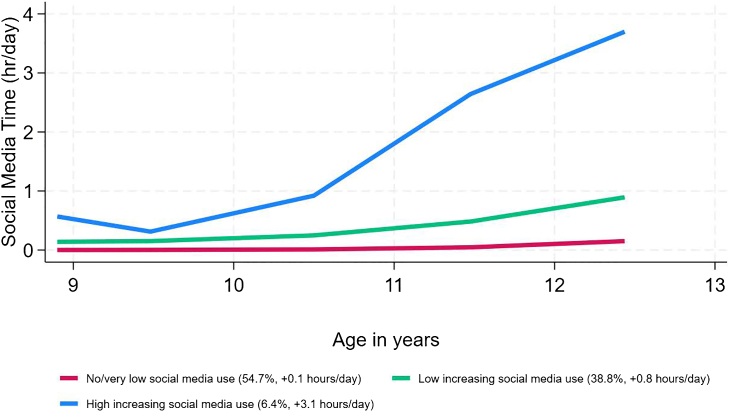 Figure 1
Peer Reviews
No public reviews on file for this paper yet. If you reviewed it on a platform where reviews are public (OpenReview, ICLR, NeurIPS, ICML), you can paste yours below so the community can read it here.
Videos
No videos yet. Explain this paper in a talk, walkthrough, or lecture? Add one.
Taxonomy
TopicsImpact of Technology on Adolescents · Child Development and Digital Technology · Media Influence and Health