Workshop report—Vulnerability in multi-hazard risks: Addressing its complexity and dynamics
Alexandre Pereira Santos, Silvia De Angeli, Franziska Stefanie Hanf, Mirbach Charlotta, van Maanen Nicole, Vitus Benson, de Ruiter Marleen Carolijn, Alexandre Dunant, Stefano Terzi, Pia-Johanna Schweizer, Taís Maria Nunes Carvalho, Mariana Madruga de Brito, Kelley De Polt

TL;DR
Researchers met to discuss how to better understand and address complex risks by integrating different fields and improving data sharing.
Contribution
The paper outlines three key areas for advancing vulnerability research through interdisciplinary integration and data interoperability.
Findings
Interdisciplinary integration is needed to bridge epistemological divides.
Data interoperability can enhance robustness and policy relevance.
Vulnerability assessments should balance complexity with local context.
Abstract
In November 2025, an interdisciplinary group of vulnerability researchers met in Munich and identified three challenge-opportunity clusters: first, overcoming epistemological divides to enable meaningful interdisciplinary integration. Second, the interoperability of data, methods, and evidence can strengthen robustness and policy relevance. Third, vulnerability assessments must adopt fit-for-purpose levels of complexity that preserve local context while enabling cross-scalar translation. This backstory is a call-to-action to accelerate the transition of the field toward robust, policy-salient, and socially legitimate integrative and interdisciplinary research.
Click any figure to enlarge with its caption.
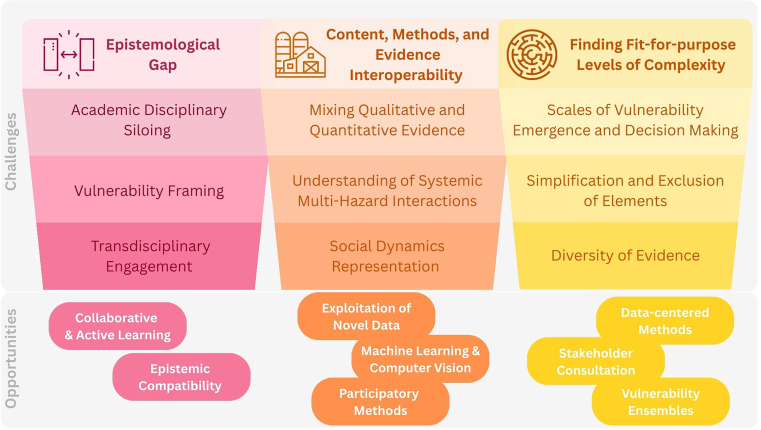 Figure 1
Peer Reviews
No public reviews on file for this paper yet. If you reviewed it on a platform where reviews are public (OpenReview, ICLR, NeurIPS, ICML), you can paste yours below so the community can read it here.
Videos
No videos yet. Explain this paper in a talk, walkthrough, or lecture? Add one.
Taxonomy
TopicsInfrastructure Resilience and Vulnerability Analysis · Risk and Safety Analysis · Disaster Management and Resilience