Survival and mortality rates in early onset dementia
Kasper Katisko, Mikko Aaltonen, Kalle Aho, Sami Heikkinen, Ave Kivisild, Adolfina Lehtonen, Laura Leppänen, Iina Rinnankoski, Helmi Soppela, Laura Tervonen, Noora Maria Suhonen, Annakaisa Haapasalo, Päivi Hartikainen, Johanna Krüger, Eino Solje

TL;DR
Early onset dementia significantly reduces survival, with frontotemporal dementia and alpha-synucleinopathy having the worst outcomes.
Contribution
This study provides population-based survival and mortality data for early onset dementia and its subtypes.
Findings
The median survival for early onset dementia was 8.7 years, with frontotemporal dementia and alpha-synucleinopathy having the shortest survival.
Early onset dementia patients had a significantly higher mortality risk compared to controls, especially those with frontotemporal dementia.
Male sex, older age, comorbidities, and lower education were associated with increased mortality in early onset dementia.
Abstract
The socioeconomic burden of early onset dementia (EOD) defined as disease onset before the age of 65 years, is substantial due to its widespread disabling effects in relatively young individuals. While dementia is widely recognised as a major contributor to mortality among the elderly, only a limited number of studies have assessed survival and factors associated with prognosis specifically in EOD. A population-based cohort study, encompassing all incident EOD cases from two defined regions in Finland. The survival and all-cause mortality rates in EOD and its subtypes were evaluated from January 2010 to December 2021. All visits at the dementia outpatient clinics were reviewed and manually re-assessed (n=12 490), resulting in 794 validated EOD cases of Alzheimer’s disease (AD), frontotemporal dementia (FTD), alpha-synucleinopathy (α-SYNU) and other EOD spectra. Region-, age- and…
Genes, proteins, chemicals, diseases, species, mutations and cell lines named across the full text — each resolved to its canonical identifier and authoritative record.
Click any figure to enlarge with its caption.
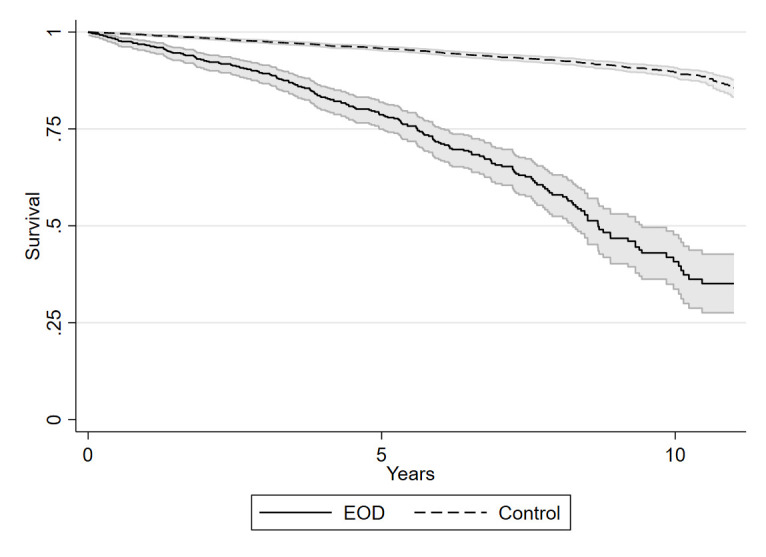 Figure 1
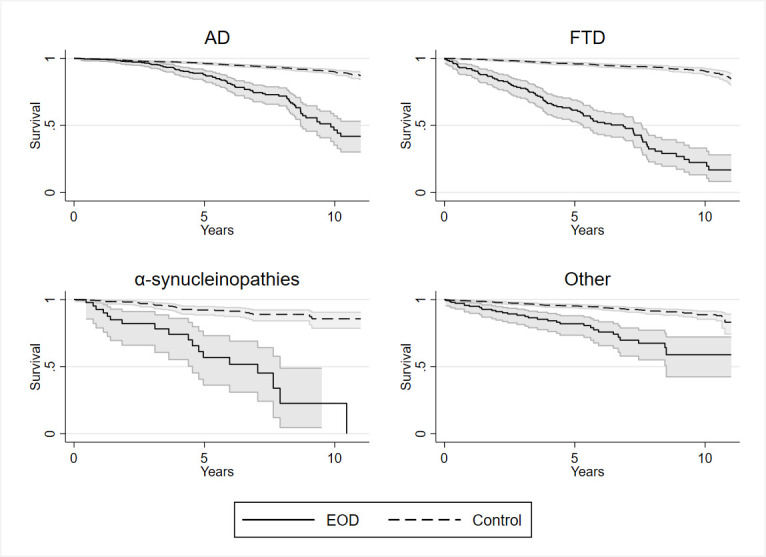 Figure 2
Peer Reviews
No public reviews on file for this paper yet. If you reviewed it on a platform where reviews are public (OpenReview, ICLR, NeurIPS, ICML), you can paste yours below so the community can read it here.
Videos
No videos yet. Explain this paper in a talk, walkthrough, or lecture? Add one.
Taxonomy
TopicsDementia and Cognitive Impairment Research · Frailty in Older Adults · Intensive Care Unit Cognitive Disorders