Application of Step-by-Step and Paediatric Emergency Care Applied Research Network (PECARN) Clinical Decision Aids in the management of young febrile infants in a UK cohort
Etimbuk Umana, Hannah Norman-Bruce, Clare Mills, Oenone Rodgers, Hannah Mitchell, Lisa McFetridge, Gareth McKeeman, Steve Foster, Michael Barrett, Damian Roland, Mark D Lyttle, Chris Watson, Thomas Waterfield, Phillipa Rawling

TL;DR
This study tested two clinical decision tools for identifying low-risk febrile infants in the UK, finding they correctly identified all infants with serious infections but missed many cases.
Contribution
Validated high-sensitivity clinical decision aids for febrile infants in a UK cohort using Procalcitonin data.
Findings
PECARN and Step-by-Step CDAs had 100% and 96% sensitivity respectively for detecting invasive bacterial infections.
Both tools had low specificity (14-15%), identifying only 14% of infants as low-risk.
Step-by-Step misclassified one infected infant as low-risk while PECARN did not.
Abstract
Young febrile infants are at high risk of invasive bacterial infections (IBIs). Clinical Decision Aids (CDA) such as the Step-by-Step and Paediatric Emergency Care Applied Research Network (PECARN) use Procalcitonin (PCT), limiting their application in settings without PCT access. This study aimed to test the performance of these CDAs in a UK cohort. This was a planned analysis of the Febrile Infant Diagnostic Assessment and Outcome Study, a large, prospective multicentre observational study conducted across over 30 sites in the UK. Febrile infants (0–90 days of age) with complete biomarker data, who also underwent PCT testing, were included. Two CDAs, PECARN and Step-by-Step, were applied to the cohort, using their recommended low-risk criteria. The diagnostic performance of the CDAs was analysed. Of the 1527 infants who completed biomarker testing in the main study, 442 had PCT…
Genes, proteins, chemicals, diseases, species, mutations and cell lines named across the full text — each resolved to its canonical identifier and authoritative record.
Click any figure to enlarge with its caption.
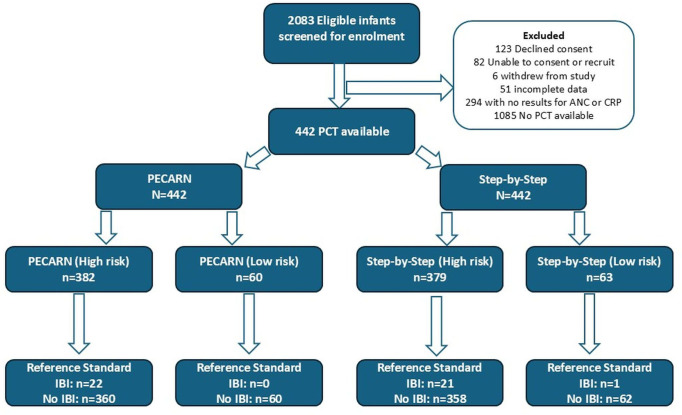 Figure 1
Peer Reviews
No public reviews on file for this paper yet. If you reviewed it on a platform where reviews are public (OpenReview, ICLR, NeurIPS, ICML), you can paste yours below so the community can read it here.
Videos
No videos yet. Explain this paper in a talk, walkthrough, or lecture? Add one.
Taxonomy
TopicsEmergency and Acute Care Studies · Sepsis Diagnosis and Treatment · Pediatric Urology and Nephrology Studies