From promise to pitfalls: immunological lessons from dengue vaccines and their implications
Cassia F. Estofolete, Marielena V. Saivish, Maurício L. Nogueira, Nikos Vasilakis

TL;DR
This paper reviews the challenges in developing effective dengue vaccines, focusing on immune responses and safety issues.
Contribution
The paper provides a critical evaluation of immunological factors affecting dengue vaccine development and offers insights for future strategies.
Findings
Licensed dengue vaccines show serostatus-dependent safety and protection issues.
Serotype imbalance and cross-reactivity complicate vaccine efficacy.
Vector-mediated immune modulation and orthoflavivirus interactions remain key obstacles.
Abstract
Dengue continues to pose a significant global health threat. However, the development of a safe and effective tetravalent vaccine is impeded by complex serotype-specific and cross-reactive immune responses. This review assesses licensed and advanced dengue vaccines, emphasizing serostatus-dependent safety, serotype imbalance, and the durability of protection. It also critically evaluates immunological correlates of protection and addresses remaining obstacles, such as vector-mediated immune modulation and orthoflavivirus cross-reactivity, to guide future dengue vaccine strategies.
Genes, proteins, chemicals, diseases, species, mutations and cell lines named across the full text — each resolved to its canonical identifier and authoritative record.
Click any figure to enlarge with its caption.
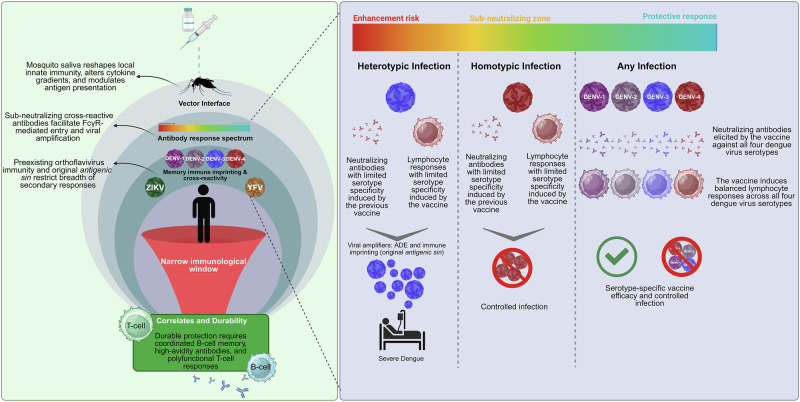 Figure 1
Peer Reviews
No public reviews on file for this paper yet. If you reviewed it on a platform where reviews are public (OpenReview, ICLR, NeurIPS, ICML), you can paste yours below so the community can read it here.
Videos
No videos yet. Explain this paper in a talk, walkthrough, or lecture? Add one.
Taxonomy
TopicsMosquito-borne diseases and control · Viral Infections and Outbreaks Research · Parasitic Diseases Research and Treatment