The untapped potential of ballistographic technology in behavioural sleep medicine
Yu-Hsuan Lin, Nicholas Meyer, Ta-Wei Guu

TL;DR
This paper explores how ballistographic technology can improve insomnia treatment by providing accurate sleep metrics to support CBT-I.
Contribution
The paper highlights ballistography as a novel tool for measuring sleep metrics with potential benefits for behavioral sleep medicine.
Findings
Ballistography shows strong timing accuracy for sleep metrics like sleep onset latency and sleep efficiency.
It offers acceptable sleep–wake classification with fewer limitations than existing methods.
Integration with CBT-I could enhance treatment outcomes and decision-making.
Abstract
Insomnia is the most prevalent sleep disorder globally, for which Cognitive Behavior Therapy for Insomnia (CBT-I) is the first-line treatment. We argue that under-mattress ballistography has the potential to enhance CBT-I delivery by providing treatment-relevant sleep metrics – sleep onset latency, wake after sleep onset, and sleep efficiency, with fewer limitations than polysomnography/actigraphy and consumer-wearable technologies. Validation studies show strong timing accuracy and acceptable sleep–wake classification. Integrating these metrics with CBT-I may improve decision-making, adherence, and outcomes. Future pragmatic trials and validation studies in psychiatric populations are needed.
Genes, proteins, chemicals, diseases, species, mutations and cell lines named across the full text — each resolved to its canonical identifier and authoritative record.
Click any figure to enlarge with its caption.
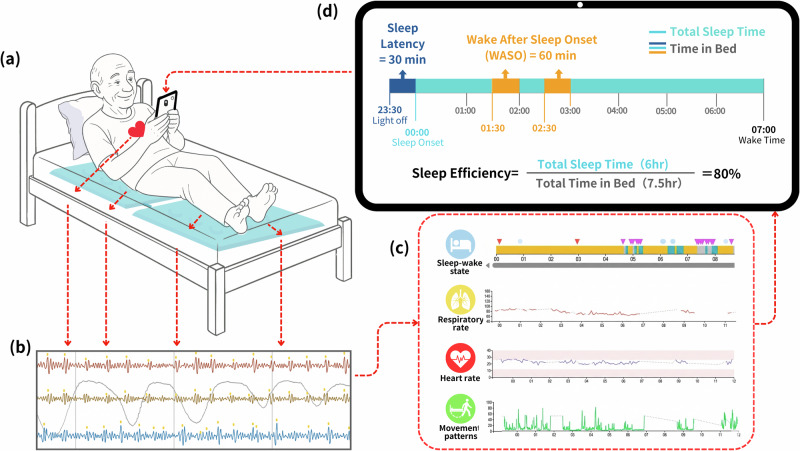 Figure 1
Peer Reviews
No public reviews on file for this paper yet. If you reviewed it on a platform where reviews are public (OpenReview, ICLR, NeurIPS, ICML), you can paste yours below so the community can read it here.
Videos
No videos yet. Explain this paper in a talk, walkthrough, or lecture? Add one.
Taxonomy
TopicsSleep and related disorders · Sleep and Wakefulness Research · Obstructive Sleep Apnea Research