The effects of mirror visual feedback involved network priming on embodiment perception in healthy subjects: a proof-of-concept study
Yongxin Luo, Lin Cai, Juan Li, Jianwei Lu, Li Ding

TL;DR
This study explores how priming with the rubber hand illusion and action observation affects embodiment perception during mirror visual feedback in healthy individuals.
Contribution
The study introduces a novel approach to enhancing embodiment perception using network priming with RHI and AO in MVF.
Findings
Priming with RHI and AO increased embodiment perception during MVF.
RHI showed a stronger predictive association with heightened embodiment than AO.
Objective-based tasks facilitated embodiment more than simple motor tasks.
Abstract
Mirror visual feedback (MVF) efficacy varies with individual embodiment perception. The study aimed to investigate the behavioral effects of priming via the rubber hand illusion (RHI) and action observation (AO) on embodiment perception during MVF. Twenty healthy participants were recruited. This experiment contained three rounds: MVF, RHI-MVF, and AO-MVF. At first, all the participants completed the round of MVF, and after 24 hours, they received the round of RHI-MVF or AO-MVF at a random order with an interval of 24 hours. Each round comprised two sessions, including session of simple motor tasks (SMT) and session of objective-based tasks (OBT). In addition, each session contained 5 tasks, which was repeated 10 times at a frequency of 2 seconds per time. The results showed that priming of networks overlapping with MVF through RHI/AO paradigms could enhance the intensity of…
Click any figure to enlarge with its caption.
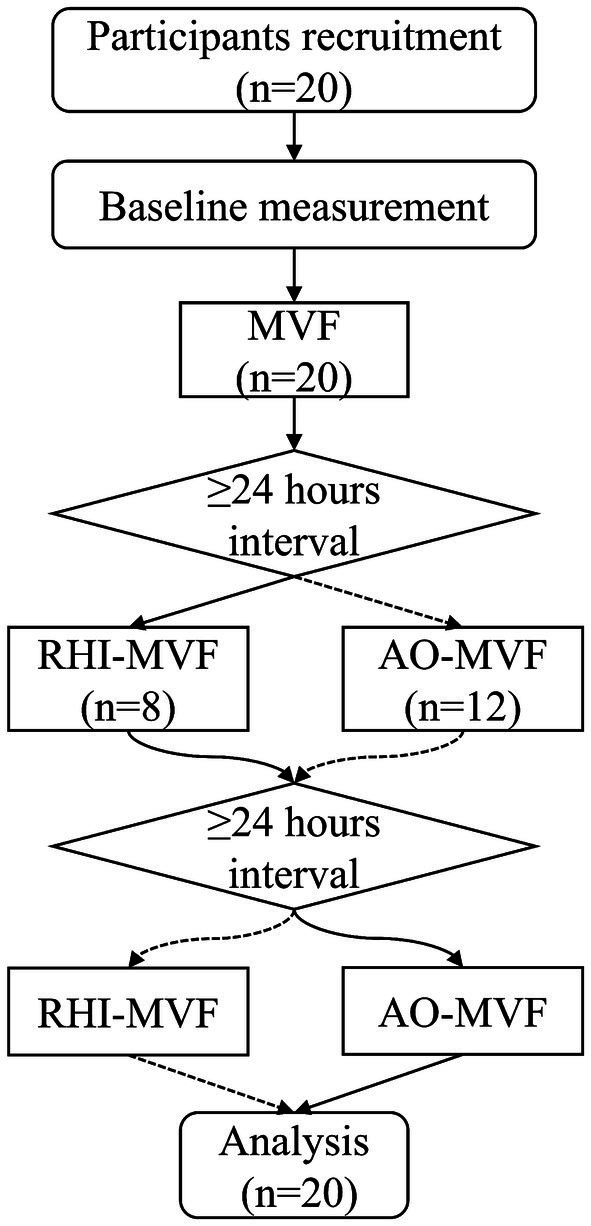 Figure 1
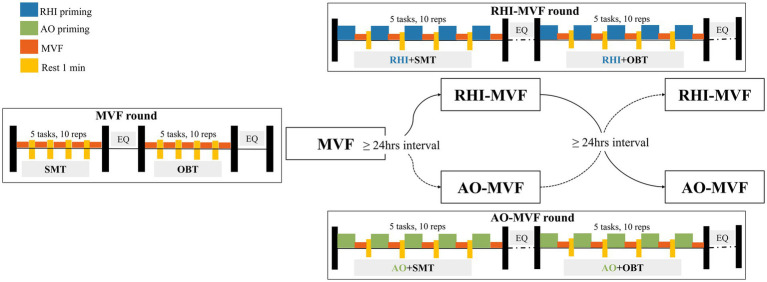 Figure 2
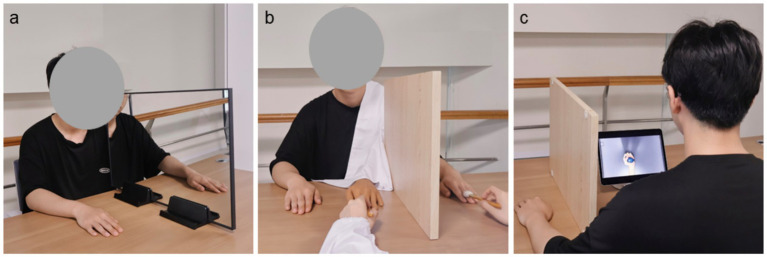 Figure 3
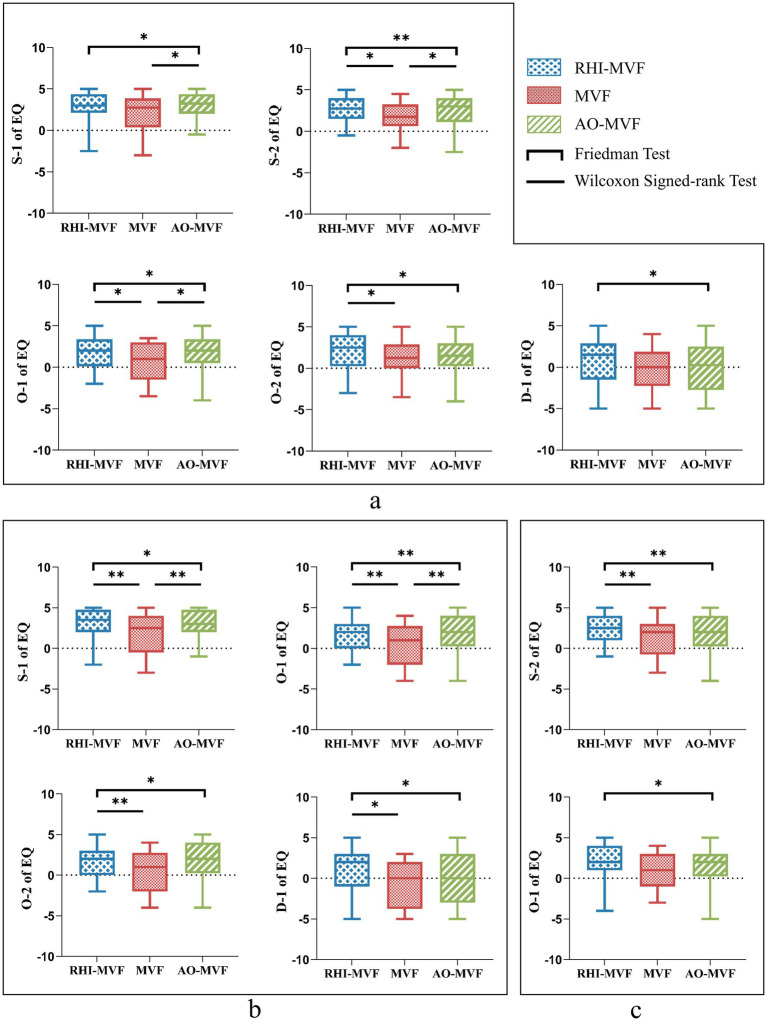 Figure 4
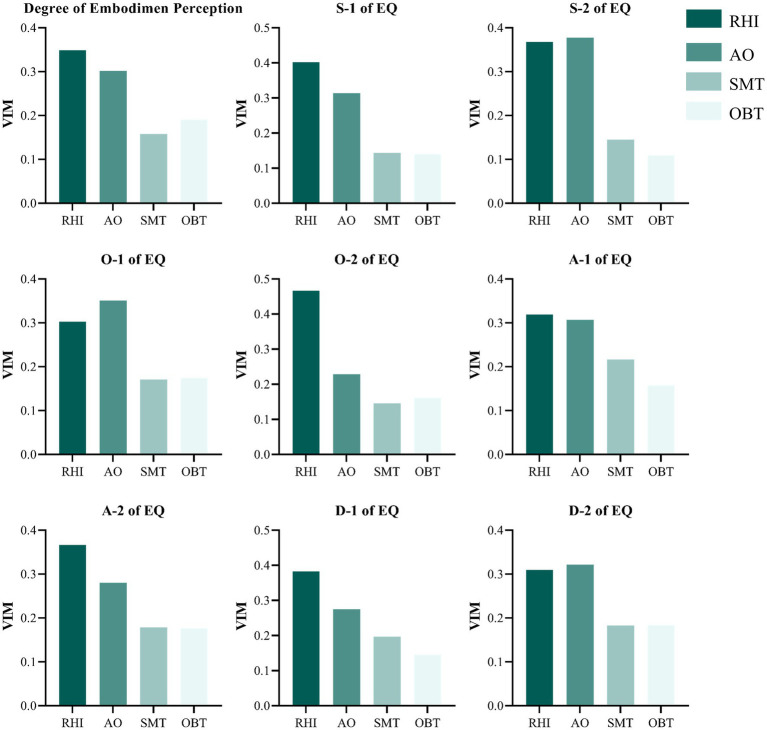 Figure 5
Peer Reviews
No public reviews on file for this paper yet. If you reviewed it on a platform where reviews are public (OpenReview, ICLR, NeurIPS, ICML), you can paste yours below so the community can read it here.
Videos
No videos yet. Explain this paper in a talk, walkthrough, or lecture? Add one.
Taxonomy
TopicsAction Observation and Synchronization · Virtual Reality Applications and Impacts · Motor Control and Adaptation