Women with suspected diagnosis of ovarian cancer in Ghana: how much do we know about them?
Kwabena Amo-Antwi, Yvonne Nartey, Ramatu Agambire, Lauren Davis-Rivera, Roxanna Haghighat, Bernard Worlasi Ocloo, Adu Appiah-Kubi, Philip Agyemang-Prempeh, George Osei Prempeh, Kofi Dekyi, Ama Yeboah Boakye, Edward Tieru Dassah, Elliot Koranteng Tannor, Mavis Bobie Ansah

TL;DR
This study in Ghana finds that most women with ovarian tumors are young and many have benign tumors, highlighting the need for better diagnostic tools and care.
Contribution
The study identifies demographic and clinical predictors of ovarian cancer in a Ghanaian population, emphasizing diagnostic challenges in sub-Saharan Africa.
Findings
Most women with ovarian tumors were young, with 74.4% diagnosed with ovarian cancer.
Predictors of ovarian cancer included age, comorbidities, and tumor characteristics like solid components and vascular flow.
Only a small proportion of benign tumors underwent genetic or immunohistochemical testing.
Abstract
Addressing disparities in ovarian cancer care between sub-Saharan Africa and other regions begins with the fundamental question, “Who gets ovarian cancer?” This study aimed to identify the demographic and clinical predictors of cancer among women with ovarian tumours. We conducted a cross-sectional analysis of women with histology-confirmed ovarian tumour discussed at a multidisciplinary tumour board in a tertiary hospital in Ghana between 2013 and 2024. Descriptive statistics were used to summarise the characteristics of the women, and logistic regression was performed to identify predictors of ovarian cancer. P≤0.05 was considered statistically significant. Of the 496 women whose data were analysed, 74.4% (n=369) had ovarian cancer. Women diagnosed with ovarian cancer were older than those without cancer (median age 50 years (36-60) vs 39 years (26-55), p<0.001). Most women (274,…
Genes, proteins, chemicals, diseases, species, mutations and cell lines named across the full text — each resolved to its canonical identifier and authoritative record.
Click any figure to enlarge with its caption.
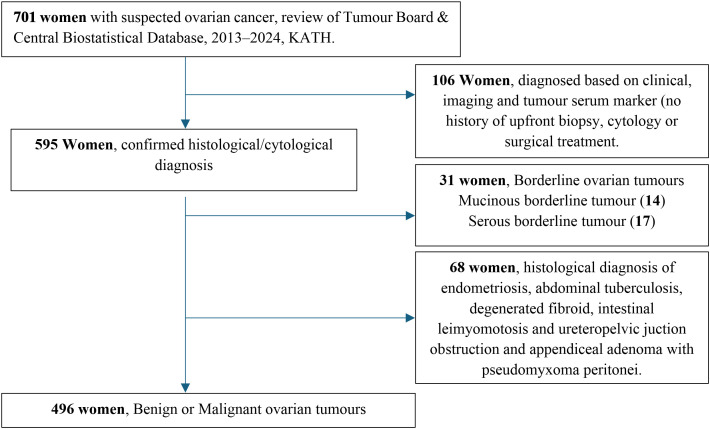 Figure 1
Peer Reviews
No public reviews on file for this paper yet. If you reviewed it on a platform where reviews are public (OpenReview, ICLR, NeurIPS, ICML), you can paste yours below so the community can read it here.
Videos
No videos yet. Explain this paper in a talk, walkthrough, or lecture? Add one.
Taxonomy
TopicsOvarian cancer diagnosis and treatment · Testicular diseases and treatments · PARP inhibition in cancer therapy