Pregnancy and delivery after surgical remission in women with prolactinomas desiring pregnancy: Refining surgical indications
Kosaku Amano, Yasufumi Seki, Yuichi Oda, Shihori Kimura, Kaoru Yamashita, Atsuhiro Ichihara, Takakazu Kawamata

TL;DR
Surgery for prolactinomas in women wanting pregnancy may lead to long-term remission and prevent recurrence if specific criteria are met.
Contribution
The study identifies refined surgical criteria and shows that pregnancy after surgery is linked to no recurrence in prolactinoma patients.
Findings
Surgical remission with postoperative prolactin <3 ng/mL was associated with a 4.3% recurrence rate, compared to 50% for 3–15 ng/mL.
Women who conceived and delivered after surgery had 0% recurrence, while 20% of those who did not conceive experienced recurrence.
Refined criteria led to remission in all 20 women who underwent surgery and met the selection criteria.
Abstract
Prolactinomas are usually managed with cabergoline, and surgery is reserved for strictly selected cases. Based on our surgical experience, we observed no recurrence in women who conceived and delivered after surgical remission. We therefore evaluated surgical outcomes and indications in pregnancy-seeking women. We retrospectively reviewed 57 women who underwent surgery in 1998–2008 (median age 28.0 years) and identified predictors of remission and recurrence. Refined criteria (desiring pregnancy, enclosed-type tumor, and Knosp grade ≤ 2 with anticipated complete resection) were then applied to 135 women treated in 2009–2022 (median age 35.0 years). In 1998–2008, remission was achieved in 73.8% of enclosed-type microadenomas and improved to 95.2% in the later period. Postoperative prolactin < 3 ng/mL predicted lower recurrence than 3–15 ng/mL (4.3% vs 50.0%, P = 0.0098). In 2009–2022,…
Genes, proteins, chemicals, diseases, species, mutations and cell lines named across the full text — each resolved to its canonical identifier and authoritative record.
Click any figure to enlarge with its caption.
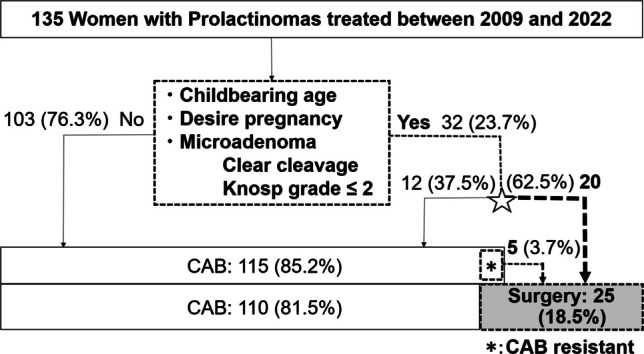 Figure 1
 Figure 2
Peer Reviews
No public reviews on file for this paper yet. If you reviewed it on a platform where reviews are public (OpenReview, ICLR, NeurIPS, ICML), you can paste yours below so the community can read it here.
Videos
No videos yet. Explain this paper in a talk, walkthrough, or lecture? Add one.
Taxonomy
TopicsPituitary Gland Disorders and Treatments · Growth Hormone and Insulin-like Growth Factors · Meningioma and schwannoma management