The myofibrillar myopathy–linked variant DES-p.T341P impairs desmin filament assembly
Alexander Lütkemeyer, Sabrina Voß, Franziska Klag, Joline Groß, Jonas Reckmann, Anna Gärtner, Dario Anselmetti, Jan Gummert, Volker Walhorn, Hendrik Milting, Andreas Brodehl

TL;DR
This study shows that a specific genetic variant in desmin disrupts its ability to form filaments, leading to myofibrillar myopathy and heart failure.
Contribution
The study identifies a novel pathogenic DES variant (p.T341P) by demonstrating its impact on desmin filament assembly using cell and in vitro experiments.
Findings
Desmin-p.T341P shows disrupted filament assembly in transfected cells and cardiomyocytes.
Atomic force microscopy reveals aberrant molecular structures in recombinant desmin-p.T341P.
The variant is classified as likely pathogenic due to intrinsic filament assembly defects.
Abstract
Desminopathies are clinical heterogenous and range from isolated skeletal myopathies to different cardiomyopathies or combinations of both. At the molecular level, an aberrant cytoplasmic desmin aggregation is a typical hallmark of pathogenic DES variants. Currently, it is difficult to predict an aberrant desmin aggregation of novel DES variants without functional analysis. Therefore, we investigate in this study the impact of an uncharacterized myofibrillar myopathy-associated desmin variant (p.T341P) on filament assembly in transfected cells and performed atomic force microscopy to characterize in vitro the filament assembly of recombinant desmin-p.T341P. Based on these cell transfection experiments using different cell lines and cardiomyocytes differentiated from induced pluripotent stem cells (iPSC) we present evidence that the filament assembly of desmin-p.T341P is disrupted. In…
Genes, proteins, chemicals, diseases, species, mutations and cell lines named across the full text — each resolved to its canonical identifier and authoritative record.
Click any figure to enlarge with its caption.
 Figure 1
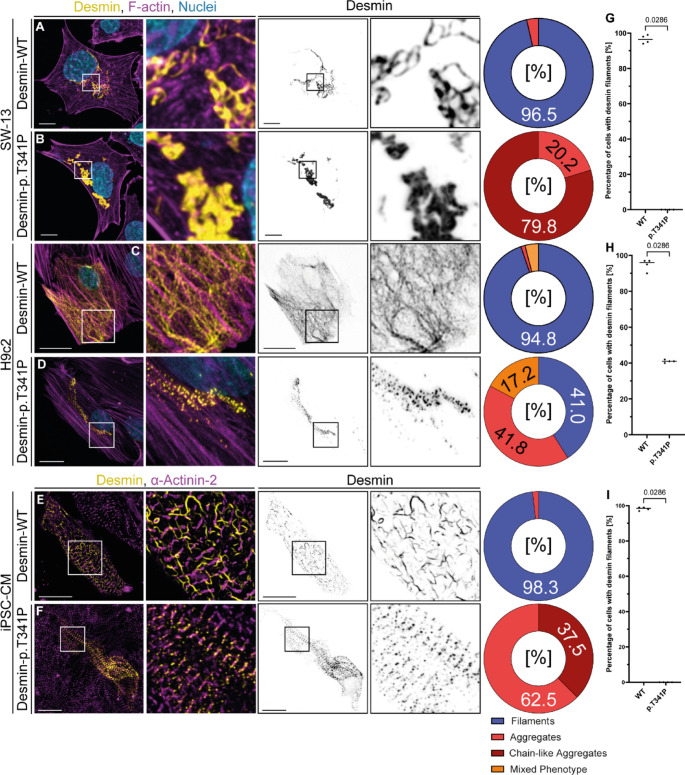 Figure 2
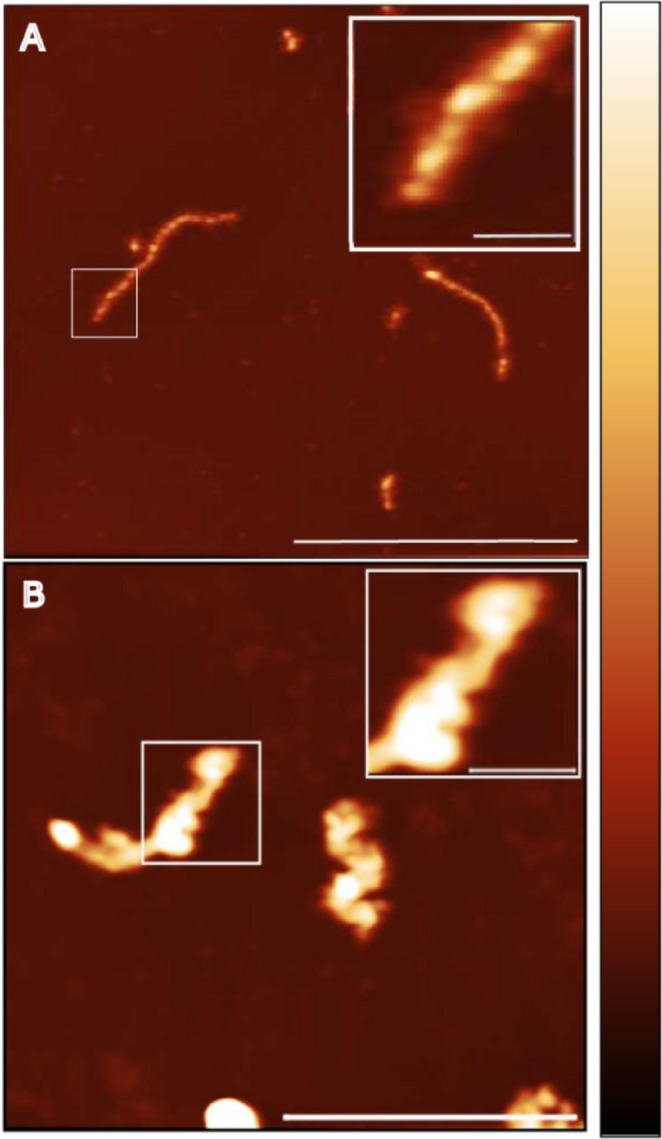 Figure 3
Peer Reviews
No public reviews on file for this paper yet. If you reviewed it on a platform where reviews are public (OpenReview, ICLR, NeurIPS, ICML), you can paste yours below so the community can read it here.
Videos
No videos yet. Explain this paper in a talk, walkthrough, or lecture? Add one.
Taxonomy
TopicsSkin and Cellular Biology Research · Systemic Sclerosis and Related Diseases · Nuclear Structure and Function