Long-term safety and efficacy of ponesimod in participants with relapsing multiple sclerosis: results from the phase 3 OPTIMUM 5-year long term extension study
Xavier Montalban, Reinhard Hohlfeld, Carlo Pozzilli, Mark S. Freedman, Till Sprenger, Robert J. Fox, Eva Kubala Havrdova, Fred Lublin, Dan Huang, Nandini Raghavan, Janice Wong, Andrea Vaclavkova, Jelena Dukovski, Philippe Linscheid, Michel Burcklen, Ludwig Kappos

TL;DR
A 5-year study found that ponesimod is safe and effective for treating relapsing multiple sclerosis without new safety concerns.
Contribution
The study provides long-term safety and efficacy data for ponesimod in RMS patients over five years.
Findings
Ponesimod showed sustained efficacy with no new safety signals over 5 years.
More participants on ponesimod achieved no evidence of disease activity compared to those who switched from teriflunomide.
Annualized relapse rates remained low throughout the long-term extension period.
Abstract
In phase 3 OPTIMUM study, ponesimod demonstrated superior efficacy and acceptable safety vs teriflunomide in participants with relapsing multiple sclerosis (RMS). This long-term extension (LTE) study was designed to assess the safety and efficacy of ponesimod 20 mg (P20 mg) during extended treatment. Participants who completed core OPTIMUM study entered OPTIMUM-LTE; Participants receiving P20 mg once daily (OD) in core continued with the same dose (P20 mg/P20 mg) and those receiving teriflunomide 14 mg OD switched to P20 mg (T14 mg/P20 mg) in the LTE study. Safety assessments included treatment-emergent adverse events (TEAE). Efficacy was assessed using annualized relapse rate (ARR), time to first confirmed relapse up to end of study (EOS), confirmed disability accumulation (CDA), and magnetic resonance imaging (MRI)-based endpoints. Of 1133 participants from core study, 877 were…
Genes, proteins, chemicals, diseases, species, mutations and cell lines named across the full text — each resolved to its canonical identifier and authoritative record.
Click any figure to enlarge with its caption.
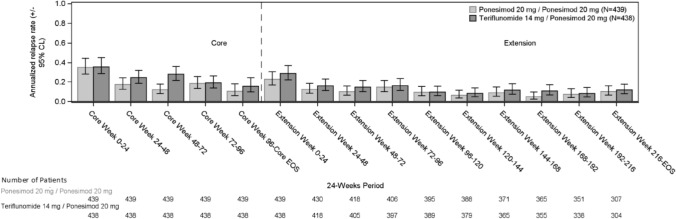 Figure 1
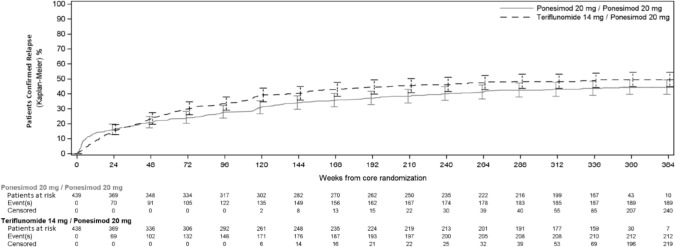 Figure 2
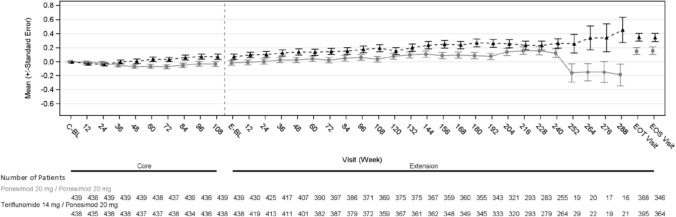 Figure 3
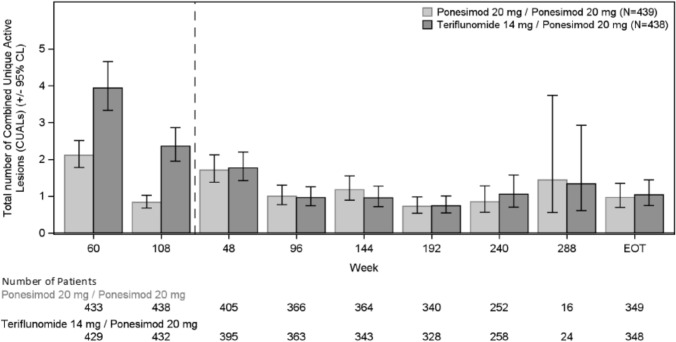 Figure 4
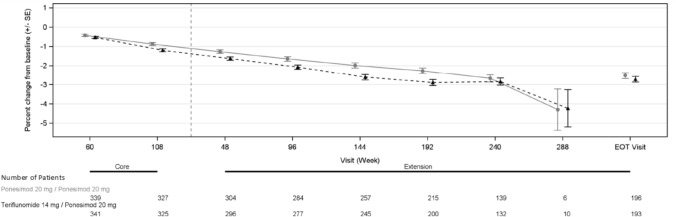 Figure 5
Peer Reviews
No public reviews on file for this paper yet. If you reviewed it on a platform where reviews are public (OpenReview, ICLR, NeurIPS, ICML), you can paste yours below so the community can read it here.
Videos
No videos yet. Explain this paper in a talk, walkthrough, or lecture? Add one.
Taxonomy
TopicsSphingolipid Metabolism and Signaling · Multiple Sclerosis Research Studies · Pharmacological Receptor Mechanisms and Effects