Long-term intelligence after high-dose radiotherapy to the primary site versus chemotherapy and whole-ventricle radiotherapy in patients with germinoma
Masayuki Kanamori, Yumi Sugawara, Yoshiteru Shimoda, Osamu Iizuka, Yoshinari Osada, Shota Yamashita, Ichiyo Shibahara, Rei Umezawa, Naoko Mori, Ryuta Saito, Yukihiko Sonoda, Toshihiro Kumabe, Keiichi Jingu, Shunji Mugikura, Kyoko Suzuki, Hidenori Endo

TL;DR
A study found that a treatment combining chemotherapy and lower-dose whole-brain radiation better preserves long-term intelligence in germinoma patients compared to older high-dose radiation methods.
Contribution
The study provides new evidence that chemotherapy plus 24 Gy whole-ventricle radiation better preserves long-term intelligence compared to high-dose primary site radiotherapy.
Findings
FSIQ scores declined in patients receiving high-dose primary site radiotherapy.
FSIQ scores were maintained in patients treated with chemotherapy followed by 24 Gy whole-ventricle radiation.
Long-term follow-up showed better cognitive outcomes with the newer treatment regimen.
Abstract
Until 1995, patients with newly diagnosed germinoma received 40–60 Gy of radiation to the primary site with or without chemotherapy (regimen A). After 2000, treatment shifted to chemotherapy followed by 24 Gy of whole-ventricle radiation therapy (WVRT) (regimen B). This study compares long-term intelligence outcomes between the two treatment regimens. This retrospective analysis included 151 patients diagnosed with germinoma between 1983 and 2021. Intelligence was assessed using the Wechsler Adult Intelligence Scale (revised or 3rd edition) and the Wechsler Intelligence Scale for Children (3rd edition). Patient backgrounds were also collected. A total of 55 and 69 patients were treated with regimens A and B, respectively. The number of patients who underwent at least one longitudinal neurocognitive assessment was 35 and 29 for regimen A and 53 and 22 for regimen B, respectively. The…
Genes, proteins, chemicals, diseases, species, mutations and cell lines named across the full text — each resolved to its canonical identifier and authoritative record.
Click any figure to enlarge with its caption.
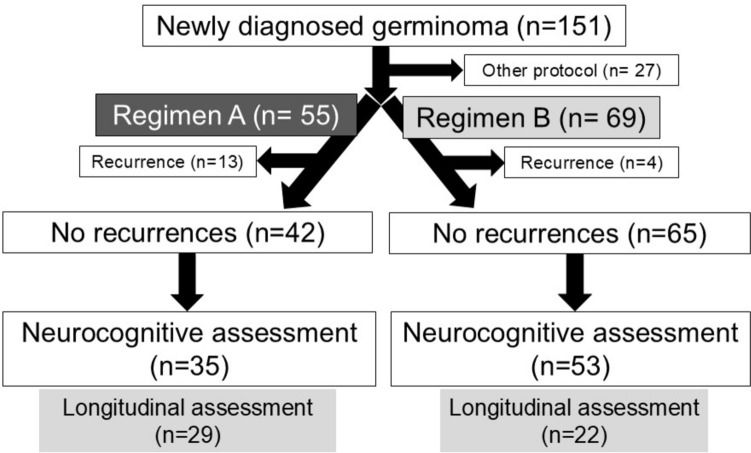 Figure 1
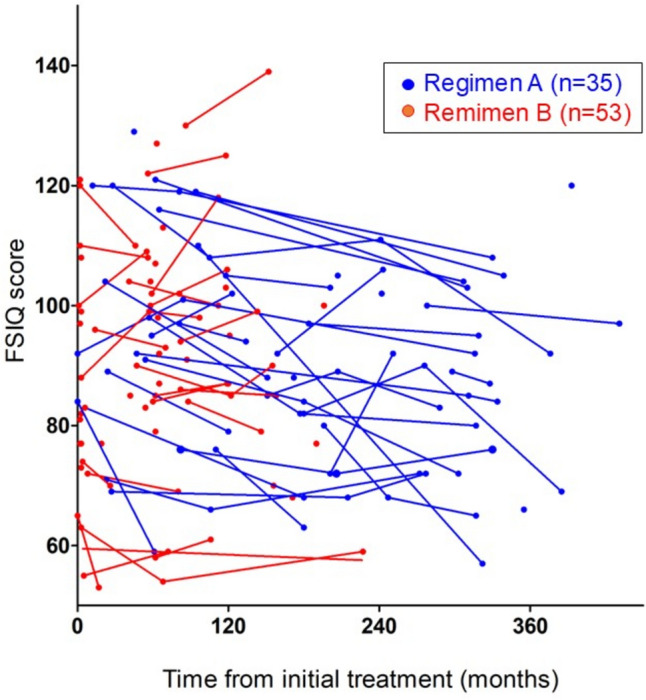 Figure 2
Peer Reviews
No public reviews on file for this paper yet. If you reviewed it on a platform where reviews are public (OpenReview, ICLR, NeurIPS, ICML), you can paste yours below so the community can read it here.
Videos
No videos yet. Explain this paper in a talk, walkthrough, or lecture? Add one.
Taxonomy
TopicsGlioma Diagnosis and Treatment · Brain Metastases and Treatment · Childhood Cancer Survivors' Quality of Life