RNA sequence analysis of differentially expressed genes in left atrial appendage thrombus
Junji Maeda, Motoki Furutani, Shunsuke Miyauchi, Mika Nakashima, Naoki Ishibashi, Takumi Sakai, Naoto Oguri, Shogo Miyamoto, Sho Okamura, Yousaku Okubo, Takehito Tokuyama, Noboru Oda, Taiichi Takasaki, Shinya Takahashi, Hidenori Aizawa, Daichi Shigemizu, Yukiko Nakano

TL;DR
This study identifies six genes linked to blood clot formation in the heart of patients with atrial fibrillation, offering insights into disease mechanisms and potential biomarkers.
Contribution
The study identifies six novel candidate genes associated with thrombus formation in atrial fibrillation patients.
Findings
RNA sequencing identified 27 differentially expressed genes in left atrial appendage tissue with and without thrombus.
DIRAS3 expression was positively associated with fibrosis and NT-proBNP levels, while CYP26B1 and TUBA3D showed distinct correlations with NT-proBNP.
Six key genes—DIRAS3, CYP26B1, PRG4, ITLN1, FKBP5, and TUBA3D—were identified as potentially involved in thrombus pathogenesis.
Abstract
Cardioembolic stroke is a major complication of atrial fibrillation (AF). We investigated differentially expressed genes (DEGs) in the left atrial appendage (LAA) with and without LAA thrombus (LAAT) using RNA sequencing (RNA-seq). LAA tissue samples were obtained during cardiac surgery. We analyzed samples with LAAT (n = 6) and without LAAT (n = 5). Differential gene expression analysis was conducted to identify significantly altered genes. RNA-seq identified 27 differentially expressed genes (false discovery rate < 0.05,|log2(fold change)| >2). Among these, four DEGs—DIRAS3, CYP26B1, PRG4, and ITLN1—exhibited particularly large fold changes. Protein-protein interaction network analysis revealed two hub genes, FKBP5 and TUBA3D, based on degree (≥ 30) and betweenness centrality (≥ 3000). Quantitative PCR confirmed consistent expression patterns for these genes. Furthermore, consistent…
Genes, proteins, chemicals, diseases, species, mutations and cell lines named across the full text — each resolved to its canonical identifier and authoritative record.
Click any figure to enlarge with its caption.
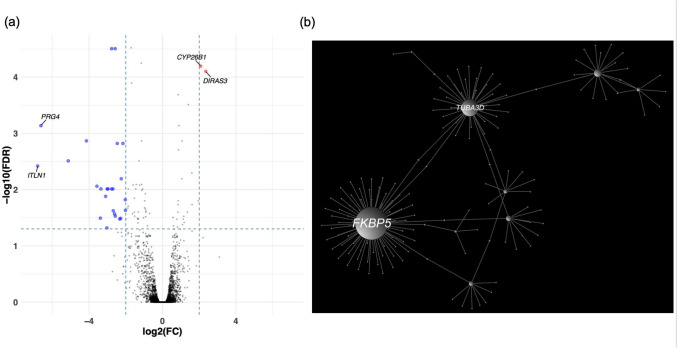 Figure 1
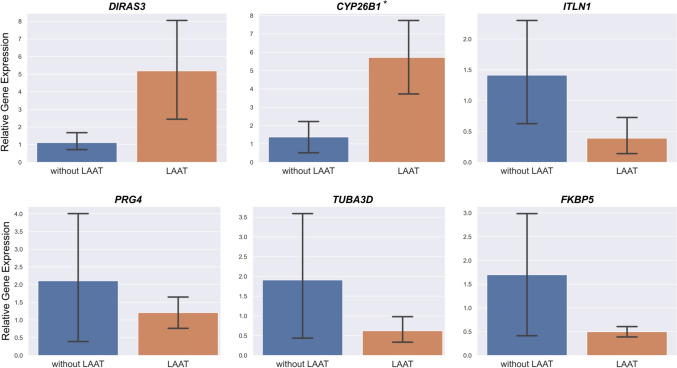 Figure 2
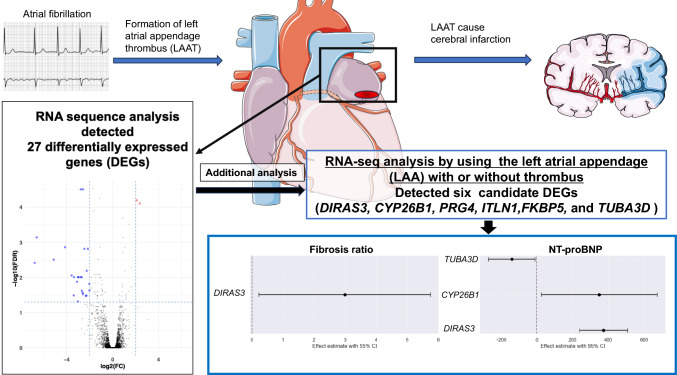 Figure 3
Peer Reviews
No public reviews on file for this paper yet. If you reviewed it on a platform where reviews are public (OpenReview, ICLR, NeurIPS, ICML), you can paste yours below so the community can read it here.
Videos
No videos yet. Explain this paper in a talk, walkthrough, or lecture? Add one.
Taxonomy
TopicsGalectins and Cancer Biology · Cardiac tumors and thrombi · RNA modifications and cancer