On dueling multi-act arithmetic: exploring the dynamics of goal-driven competition on engagement and cognition
Michael B. Steinborn, Lynn Huestegge

TL;DR
This study explores how competing against a co-actor in arithmetic tasks affects performance and engagement, finding increased speed with minimal accuracy loss.
Contribution
The novel contribution is demonstrating that competitive context improves task efficiency without significant accuracy trade-offs.
Findings
Participants solved arithmetic problems faster in a duel context.
Error rates increased slightly but remained below a 10% threshold.
The speed-up is attributed to improved efficiency rather than relaxed accuracy standards.
Abstract
Ludic design in mental chronometry seeks to enhance engagement through socio-interactive elements. The present study examined whether a co-actor duel context influences both performance and subjective experience. Participants completed speeded arithmetic at two difficulty levels (easy, hard) under two context conditions (alone, duel) in a mixed within-subject design. Self-reports of engagement, distress, and worry were obtained before and after tasks. In the duel context, participants completed problems more quickly, accompanied by a small rise in errors, which however, remained far below the 10% margin allowed by duel rules, indicating that the increase was not a deliberate sacrifice of accuracy for speed. We interpret the speed-up as improved efficiency with preserved engagement, where the modest error rise reflects the probabilistic cost of reduced checking time rather than relaxed…
Genes, proteins, chemicals, diseases, species, mutations and cell lines named across the full text — each resolved to its canonical identifier and authoritative record.
Click any figure to enlarge with its caption.
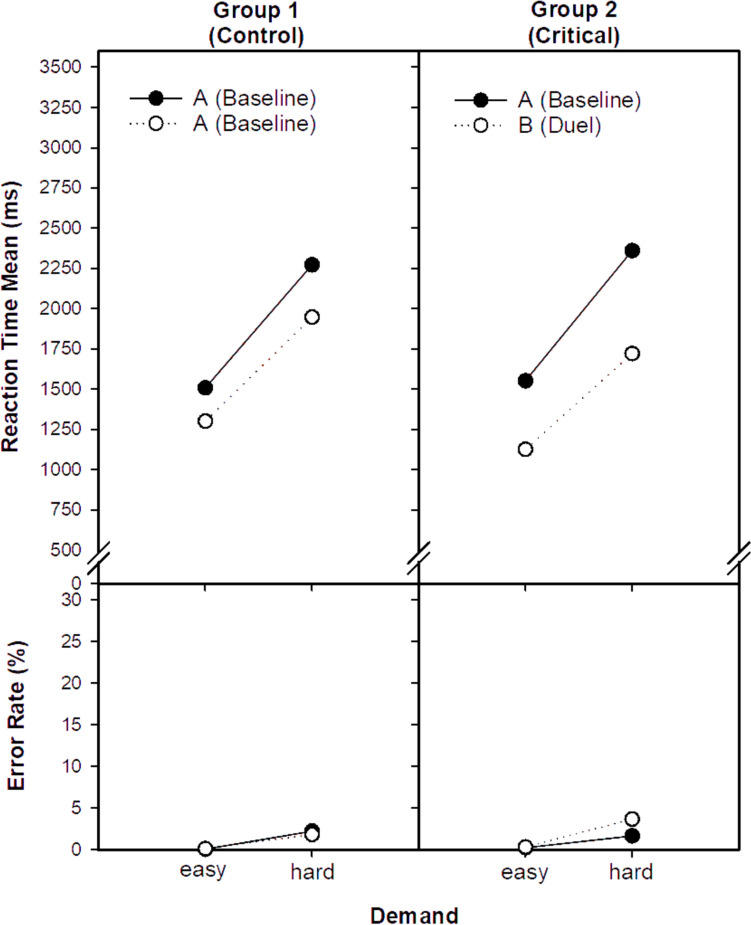 Figure 1
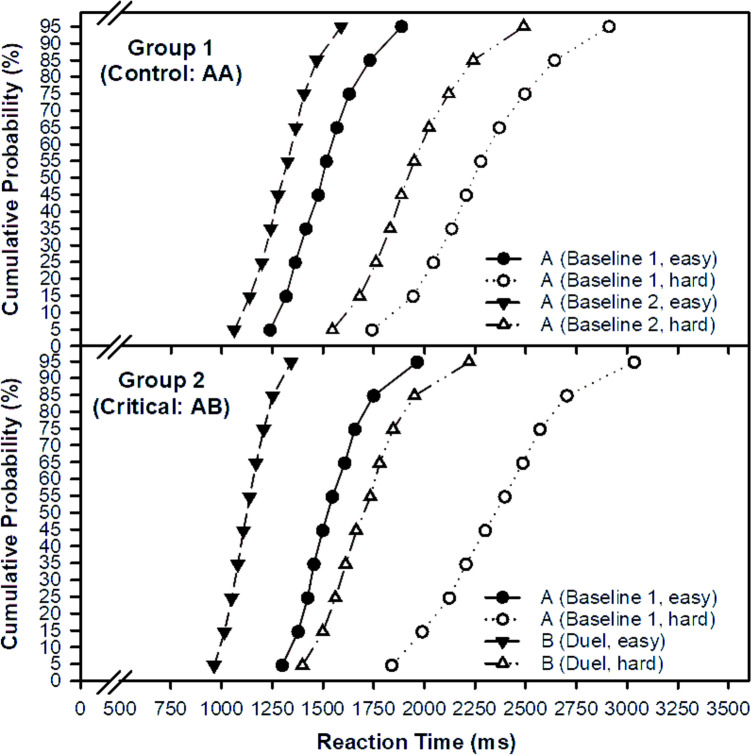 Figure 2
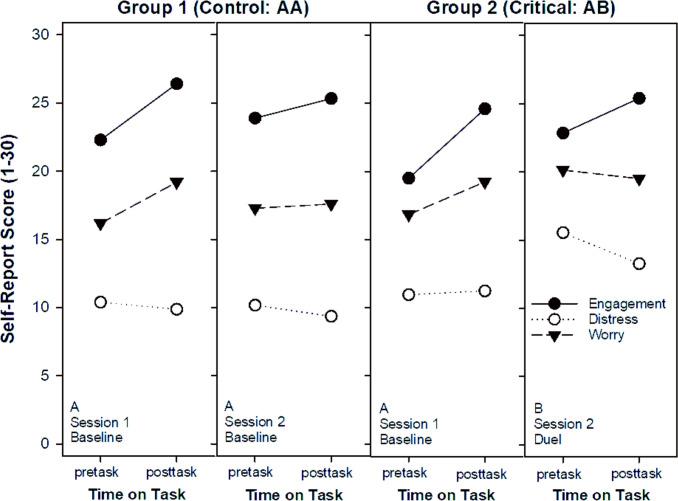 Figure 3
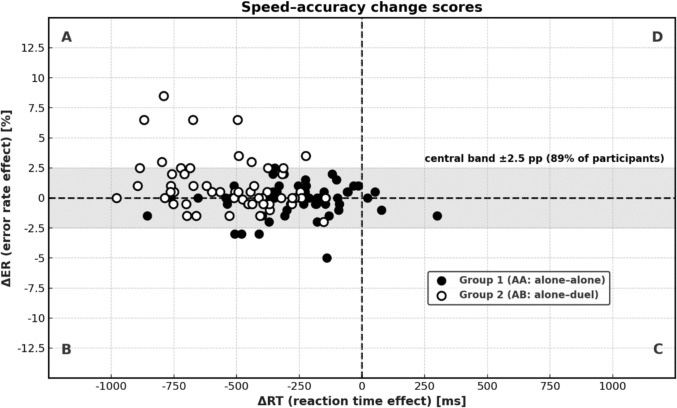 Figure 4
Peer Reviews
No public reviews on file for this paper yet. If you reviewed it on a platform where reviews are public (OpenReview, ICLR, NeurIPS, ICML), you can paste yours below so the community can read it here.
Videos
No videos yet. Explain this paper in a talk, walkthrough, or lecture? Add one.
Taxonomy
TopicsNeural and Behavioral Psychology Studies · Action Observation and Synchronization · Embodied and Extended Cognition