Opposite effects of interruption frequency on performance in interrupted and uninterrupted multistep task
Tara Radović, Patricia Hirsch, Iring Koch, Torsten Schubert

TL;DR
This study shows that frequent interruptions in multistep tasks improve performance during interruptions but reduce performance when tasks are uninterrupted.
Contribution
The study reveals a strategic shift in control mode due to high interruption frequency in multistep tasks.
Findings
High interruption frequency leads to faster and more accurate resumption after interruptions.
Participants in the highest-frequency group performed worse in uninterrupted tasks.
Strategic shifts in control mode occur due to frequent interruptions.
Abstract
We investigated the effects of interruption frequency on interrupted and uninterrupted performance in a serial multistep task. The multistep task consisted of five steps, which were memorized and executed consecutively in predefined order. This task was occasionally interrupted by a letter classification task. After completion of that interruption task, participants needed to resume the multistep task at the correct step. We measured response times and sequence errors (deviations from the prescribed order of steps) at the step after an interruption (resumption performance) and in the corresponding steps of uninterrupted tasks. Interruption frequency varied between subjects and was manipulated twofold as: (1) the percentage of interrupted tasks at all (global frequency: 25% vs. 75%); (2) the number of interruptions per task (local frequency: one or three interruptions), resulting in four…
Genes, proteins, chemicals, diseases, species, mutations and cell lines named across the full text — each resolved to its canonical identifier and authoritative record.
Click any figure to enlarge with its caption.
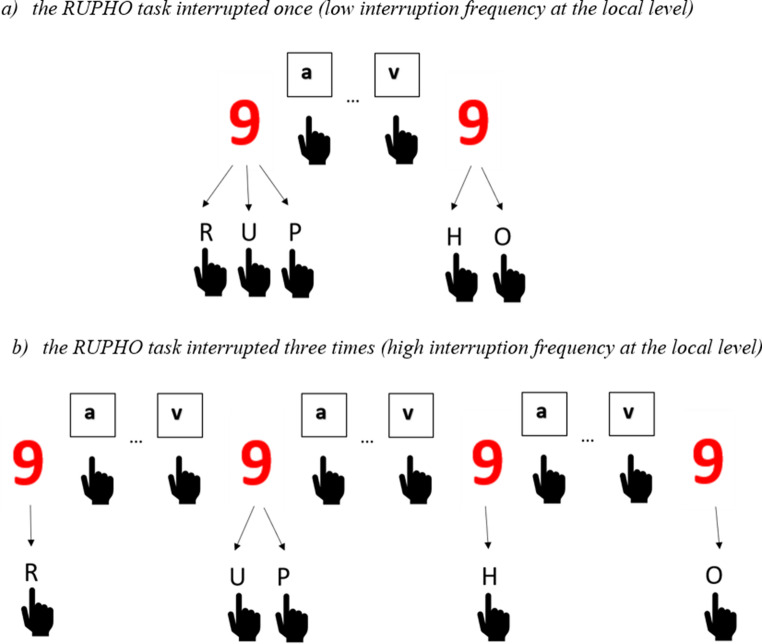 Figure 1
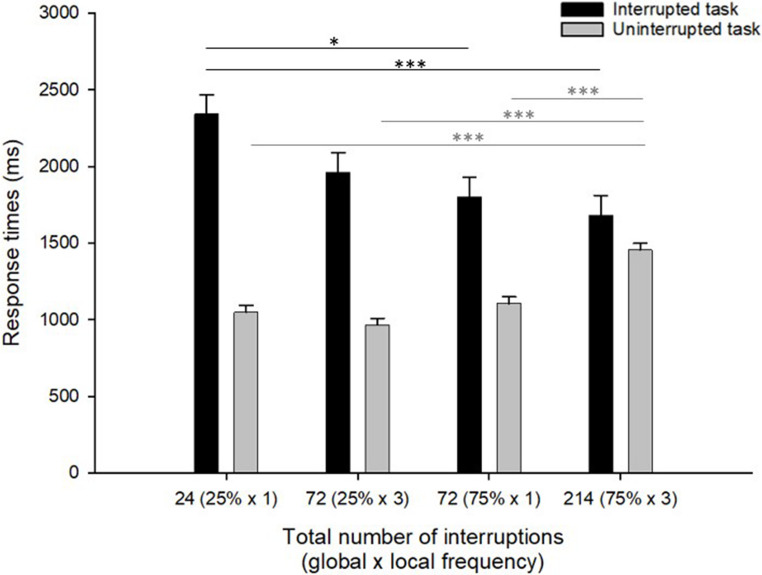 Figure 2
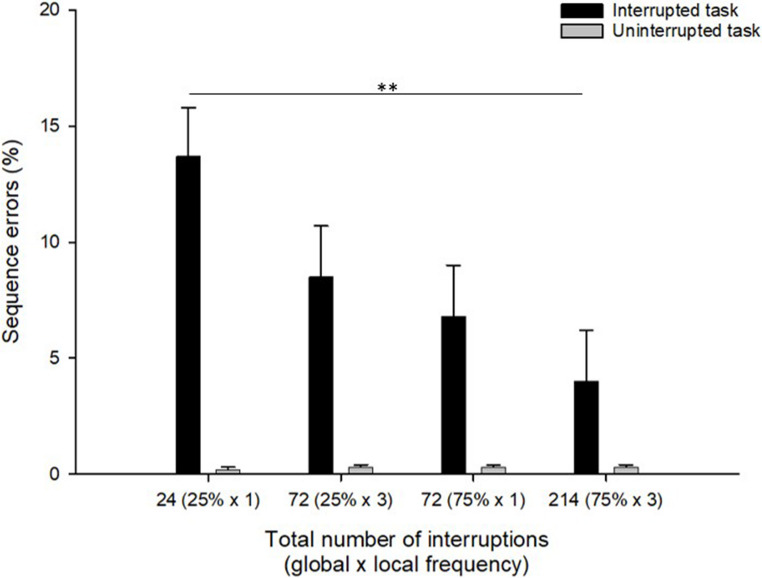 Figure 3
Peer Reviews
No public reviews on file for this paper yet. If you reviewed it on a platform where reviews are public (OpenReview, ICLR, NeurIPS, ICML), you can paste yours below so the community can read it here.
Videos
No videos yet. Explain this paper in a talk, walkthrough, or lecture? Add one.
Taxonomy
TopicsPersonal Information Management and User Behavior · Human-Automation Interaction and Safety · Usability and User Interface Design