The future of the Arctic flora under climate change
Jun Zhang, Huan-Wen Peng, Hai-Tao Ding, Guoke Chen, Andrey S Erst, Jin-Feng Li, Lian Lian, Fu-Cai Xia, Xiaoqi Zhou, Robert A Spicer, Jian Yang, Wei Wang

Abstract
Genes, proteins, chemicals, diseases, species, mutations and cell lines named across the full text — each resolved to its canonical identifier and authoritative record.
Click any figure to enlarge with its caption.
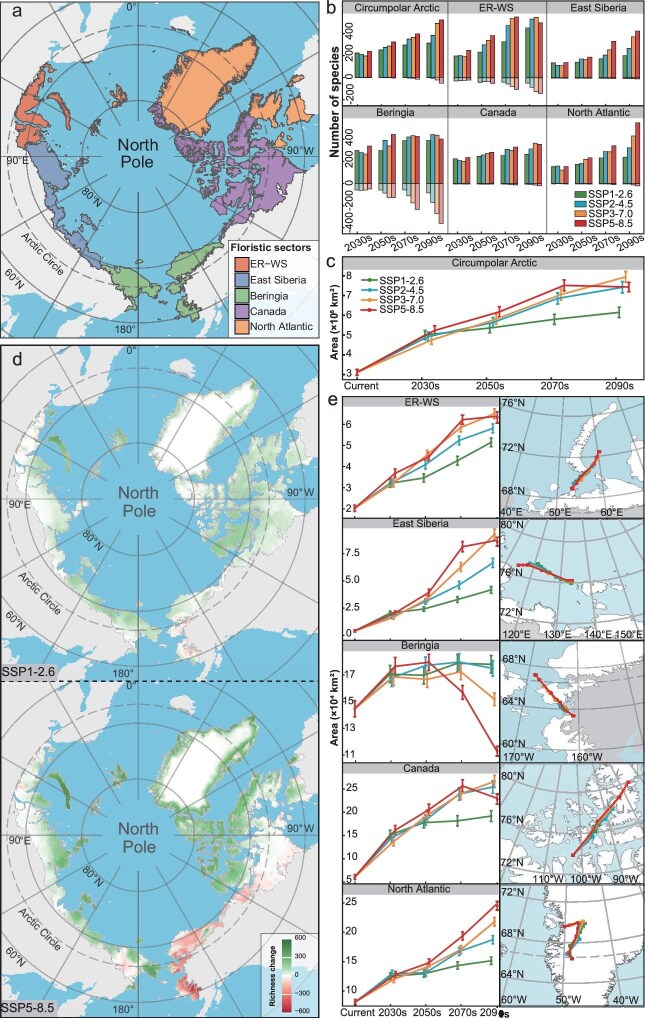 Figure 1
- —National Natural Science Foundation of China10.13039/501100001809
- —Russian Science Foundation10.13039/501100006769
Peer Reviews
No public reviews on file for this paper yet. If you reviewed it on a platform where reviews are public (OpenReview, ICLR, NeurIPS, ICML), you can paste yours below so the community can read it here.
Videos
No videos yet. Explain this paper in a talk, walkthrough, or lecture? Add one.
Taxonomy
TopicsClimate change and permafrost · Polar Research and Ecology · Species Distribution and Climate Change
The Arctic flora occupies a narrow zone between the natural tree line and the Arctic Ocean, and is highly sensitive to changes in global climate [1]. In recent decades, this region has been warming at rates 3–4 times the global average [2], a phenomenon known as Arctic amplification [3]. This rapid warming will cause permafrost thaw and methane release and alter atmospheric and oceanic circulation [4]. By the end of the 21st century, the mean surface temperature over the Arctic could be ∼2.8°C–10.4°C warmer than now depending on which greenhouse gas (GHG) emission scenarios play out (from SSP1-2.6 to SSP5-8.5) [5]. The magnitude and rate of this projected future climate change are unparalleled in the past several million years [6], underscoring the urgency of predicting potential changes in the Arctic flora under different emission scenarios. Climate change will cause species to shift, contract and/or expand their ranges [7], and consequently alter community composition, species richness patterns and thus ecosystem functioning [8]. The Arctic flora is home to 2041 vascular plant species that are tolerant of low temperatures, frozen soils, desiccation and short reproductive windows [9] (Fig. S1). To date, only small-scale species modelling limited to relatively few taxa has been conducted [10–12], which precludes broad understanding of the details and magnitude of that change, and responses of the Arctic flora as a whole.
Based on temporal and spatial differences in past glaciations, land bridges and north-south trending mountain ranges, the Arctic flora may be divided into five sectors: European Russia-West Siberia (ER-WSS), East Siberia (ESS), Beringia (BS), Canada (CS) and North Atlantic (NAS) sectors [13] (Fig. 1a). Spatial heterogeneity and complexity in Arctic vegetation responses to climate change are already being observed [14]. Modelling studies involving part sectors, such as northernmost Europe and northwestern North America [11,12], show the likely range loss among most of the studied species, but complex responses in terms of richness. Though poleward range shifts are most frequently reported [7,11], non-poleward shifts have also been detected in northernmost Europe [12]. We do not yet know whether, or how, responses in the five sectors will differ under future emission scenarios, hence this study.
To test the hypothesis of a heterogeneous spatial and temporal floral response to future Arctic warming, we assembled occurrence records of all 2041 Arctic vascular plant species and retained 1187 (∼58.2%) with more than 25 occurrences for subsequent analyses, which ensures higher model predictive power (Data S1). Our floristic-level modelling covers ∼94.5% (86/91) and ∼76.2% (325/426) of Arctic vascular plant families and genera, respectively (Fig. S2). We incorporate outcomes from five different modelling
techniques to predict the area of habitat (AOH) for each of the sampled species, and then generate species richness maps for the current and future (2030s, 2050s, 2070s and 2090s) conditions under four emission scenarios (from low to high: SSP1-2.6, SSP2-4.5, SSP3-7.0 and SSP5-8.5) for the entire Arctic, as well as each of the five sectors. To examine within-sector change, we calculate the direction and magnitude of the mean distributional centroid in each sector and compare the centroids for current and future binary distribution maps of all sampled species. Our results show widespread but heterogeneous changes in the Arctic flora throughout the 21st century, including surprising cases of southward migration and a halt in richness gains under high emissions. Importantly, future changes in the Arctic flora will be amplified over time as GHG emissions increase.
We generate 20 179 potential distribution maps for the 1187 sampled species with high area under the curve (AUC) values, indicating excellent predictive performance (Data S1). From these, potential species richness distribution maps, species AOH changes and spatiotemporal patterns of species richness changes in the Arctic are obtained (Fig. 1b–d, Figs S3–S20, Table S3), reflecting Arctic floristic responses to the different climate scenarios. Except for relatively stable species whose AOH changes are ≤5%, almost all Arctic species expand their AOHs (90.6%–99.3%) and between 0.7% and 9.4% of species’ AOHs contract, depending on the emission scenario (Fig. 1b, Table S1, Data S2). Across the Arctic, there is a mean AOH expansion of 3.04–4.83 × 10^5^ km^2^ (0.5–1.6 times) between now and the 2090s (Fig. 1c, Table S2). The Arctic potential mean
species richness (MSR) is currently 52.4 species per grid cell (spgc), with projections indicating an increase of 27.4–81.0 spgc (Fig. S20, Table S3). Potential MSR change trends follow those of the AOHs (Fig. 1c, Fig. S20), supporting a positive relationship between species richness and spatial range [15]. Species richness is expected to increase significantly in the northern Arctic, while decreasing in the south (Fig. 1d and Figs S21–S32), which may lead to site-specific changes in species composition.
The responses of five sectors to future climate change are heterogeneous (Fig. 1b, d and e, Figs S20–S32). Although most species are expected to expand their AOHs, the number of species with reduced AOHs is higher in the ER-WSS (21–142 species) and BS (49–361 species) (Fig. 1b, Table S4, Data S3). There are also some differences in mean AOH change across the five sectors (Fig. 1e, Table S5). Except for the BS (−0.2 to 0.2 times), the mean AOH in others will increase substantially (ER-WSS: 0.6–2.2 times, ESS: 3.1–21.8 times, CS: 1.3–3.4 times, and NAS: 0.5–2.0 times) (Fig. 1e, Table S5). Currently, the BS exhibits the highest potential MSR (190.1 spgc), followed by the ER-WSS (41.4 spgc), NAS (36.7 spgc), CS (34.4 spgc) and ESS (5.6 spgc) (Fig. S3, Table S6). In future, the MSR of the BS is projected to decline, while other sectors are generally expected to increase under all four emission scenarios (Figs S20–S32, Table S6). Compared to the NAS, the larger areas of the other four sectors will accommodate greater changes in species richness (Fig. 1d, Figs S33–S37). Although the total number of Arctic plant species will not decrease significantly, extinction risks within specific sectors will increase (Table S7). Compared to now, the mean northward migration distance for the five sectors will be 0.5°–3.5°(ER-WSS), −0.3° to 1.3°(ESS), 0.5°–3.8° (BS), 1.7°–6.0° (CS) and 0.4°–3.6° (NAS), and the longitudinal shifts also vary between different sectors and time periods (Fig. 1e, Table S8). Different landscapes, soil conditions, ecological disturbances and especially the direction and magnitude of climate change will likely produce heterogeneous responses among the five sectors [5]. When individual species are analyzed, we see significant differences in both the direction and magnitude of movement (Figs S38–S41, Table S8). Most Arctic species are projected to migrate northward (65.5%–93.8% in five sectors), but some undergo southward migration (6.2%–34.5%, Figs S38–S41, Table S9), demonstrating species-specific responses.
Potential changes of the Arctic flora will be amplified greatly in future as GHG emissions increase. Under the higher emission scenarios (SSP3-7.0 and SSP5-8.5), the Arctic flora will undergo more profound transformations (Fig. 1b–e). The mean AOH for species in some sectors will shrink, particularly in the BS (Fig. 1e, Table S5). Moreover, the increase in MSR and the northward shift evident in some sectors (i.e. the CS, ESS and NAS) are expected to slow or even stop (Fig. 1e, Tables S6 and S8). Importantly, our projections show that potential responses of the Arctic flora spanning lower and higher GHG emission scenarios are temporally displaced (Fig. 1, Tables S2, S3, S5, S6 and S8). Only if mean global warming is limited to below 2°C, a low-emission future (SSP1-2.6), will potential changes in the Arctic flora be manageable (Fig. 1b–e). Around the 2070s, possibly earlier, both species AOH and MSR decline, with northward migration decelerating in CS and potentially halting in the ESS and NAS (Fig. 1e, Fig. S20). While there are no major differences in potential changes in the short term (from now to the 2050s), the magnitudes of risks under the four emission scenarios will grow substantially over time (Fig. 1c and e). Continued GHG emissions, combined with other potential stressors (e.g. changes in sea ice and permafrost), will likely accelerate Arctic floral change.
Instead of the smaller-scale selective studies so far undertaken, our study predicts the likely future development of the Arctic flora by including almost all of the current taxa. The intrinsic uncertainties of species distribution models [16], and biotic (e.g. species-specific dispersal limitations and interspecific competition) and abiotic factors (e.g. permafrost, snow cover and topography) can influence the prediction accuracy [17], which future work needs to consider, but our comprehensive approach is flexible, scalable and can be applied to any regional flora. Our results show that the responses of the Arctic flora to climate change are heterogeneous, complex and will be amplified over time as GHG emissions increase. Arctic species currently occupying the northernmost regions of the continent will find themselves in a ‘nowhere-to-go’ situation and become extinct. Importantly, we demonstrate that a low-emission future (SSP1-2.6) could allow for effective conservation of the Arctic flora, albeit with much change already ‘baked in’ due to natural response times. The increasing risks to the Arctic flora inherent in other emission scenarios will have profound implications for global vegetation-atmosphere interactions and become an important source of uncertainty for carbon uptake in the terrestrial biosphere. This underscores the urgency of developing strategies to mitigate and minimize the impacts of GHG emissions, rapid implementations of which are crucial for promoting sustainable development in the Arctic.
MATERIALS AND METHODS
For Materials and methods, please refer to the Supplementary data.
Supplementary Material
nwag096_Supplemental_File
The reference list from the paper itself. Each links out to its DOI / PubMed record.
- 1Seddon AWR, Macias-Fauria M, Long PR et al. Nature 2016; 531: 229–32.10.1038/nature 1698626886790 · doi ↗ · pubmed ↗
- 2Zhou W, Leung LR, Lu J. Nat Geosci 2024; 17: 508–15.10.1038/s 41561-024-01441-1 · doi ↗
- 3Cohen J, Screen JA, Furtado JC et al. Nat Geosci 2014; 7: 627–37.10.1038/ngeo 2234 · doi ↗
- 4Schuur EAG, Abbott BW, Commane R et al. Annu Rev Environ Resour 2022; 47: 343–71.10.1146/annurev-environ-012220-011847 · doi ↗
- 5Masson-Delmotte V, Zhai P, Pirani A et al. IPCC, Climate Change 2021: the Physical Science Basis Contribution of Working Group I to the Sixth Assessment Report of the Intergovernmental Panel on Climate Change. Basel: Cambridge University Press, 2021, 583–4.
- 6Foster GL, Royer DL, Lunt DJ. Nat Commun 2017; 8: 14845.10.1038/ncomms 1484528375201 PMC 5382278 · doi ↗ · pubmed ↗
- 7Chen I-C, Hill JK, Ohlemüller R et al. Science 2011; 333: 1024–6.10.1126/science.120643221852500 · doi ↗ · pubmed ↗
- 8Scheffers BR, De Meester L, Bridge TCL et al. Science 2016; 354: aaf 7671.10.1126/science.aaf 767127846577 · doi ↗ · pubmed ↗