CONSTANS-LIKE 5: a key regulator of flower opening and scent emission in Nicotiana attenuata and Petunia axillaris
Hongwei Jing

Abstract
Genes, proteins, chemicals, diseases, species, mutations and cell lines named across the full text — each resolved to its canonical identifier and authoritative record.
Click any figure to enlarge with its caption.
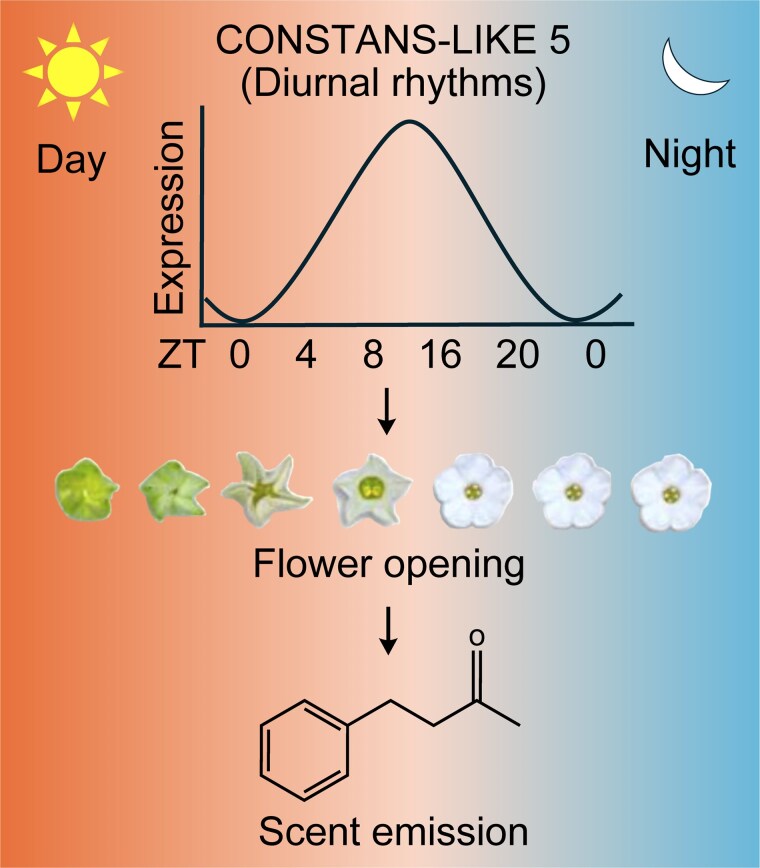 Figure 1
Peer Reviews
No public reviews on file for this paper yet. If you reviewed it on a platform where reviews are public (OpenReview, ICLR, NeurIPS, ICML), you can paste yours below so the community can read it here.
Videos
No videos yet. Explain this paper in a talk, walkthrough, or lecture? Add one.
Taxonomy
TopicsPlant and Biological Electrophysiology Studies · Plant Molecular Biology Research · Postharvest Quality and Shelf Life Management
Flowering is a critical developmental transition in the plant life cycle that determines reproductive success. To ensure successful reproduction, plants precisely regulate flowering time in response to seasonal cues, with photoperiod serving as a major determinant. Day length is perceived by the circadian clock in leaves and relayed to the shoot apical meristem to initiate the floral transition (Maple et al. 2024). In coyote tobacco (Nicotiana attenuata), flowers exhibit a tightly regulated nocturnal rhythm of opening, vertical reorientation, and scent emission that optimizes pollination by hawkmoths (Yon et al. 2016). The circadian clock components LATE ELONGATED HYPOCOTYL (LHY) and ZEITLUPE (ZTL) play key roles in regulating floral rhythms in N. attenuata (Yon et al. 2016). How these circadian signals are translated into coordinated cellular growth and metabolic outputs in flowers has remained largely unknown.
In recent work, Yuri Choi and colleagues (Choi et al. 2026) reveal that the transcription factor CONSTANS-LIKE 5 (COL5) functions as a key clock output regulator coordinating flower opening and scent emission in both N. attenuata and Petunia axillaris (Fig. 1). Building on earlier evidence that LHY and ZTL regulate floral rhythms, the authors sought to identify downstream transcriptional regulators govering flower opening. RNA-seq transcriptome analysis identified COL5 as a strong candidate regulator, as it exhibited a diurnal expression pattern and was primarily enriched in the corolla. The time-series expression analysis under both diurnal and continuous dark conditions confirmed that COL5 transcription is under circadian clock regulation in floral tissues. Furthermore, the authors created COL5 knockout mutants using a virus-induced gene editing (VIGE) system. These col5 mutants displayed a consistent phenotype of incomplete flower opening, suggesting that COL5 is crucial for promoting this process.
Flower opening is primarily driven by petal cell expansion and/or proliferation (Sun et al. 2021). To test whether COL5 mediates cell expansion in N. attenuata, the authors compared epidermal cell size and number in the corolla limbs. The results showed that COL5 is required for normal petal cell expansion, thereby promoting flower opening. To further identify downstream targets of COL5, the authors performed RNA sequencing on control lines and col5 mutants. This analysis discovered that transcript levels of genes involved in xyloglucan metabolism and aromatic amino acid biosynthesis were significantly altered in col5 mutants. In coyote tobacco, the floral volatile benzylacetone is synthesized from L-phenylalanine. Analysis of floral volatiles revealed that benzylacetone was undetectable in col5 mutants, indicating that COL5 is required for its biosynthesis. To determine whether COL5's function is conserved across the Solanaceae, the authors examined its ortholog in P. axillaris. Phylogenetic and protein sequence analyses confirmed that COL5 is a conserved ortholog. Consistent with this functional conservation, PaCOL5 showed circadian-regulated expression under constant dark conditions, and silencing PaCOL5 reduced the flower opening angle and impaired floral scent emission. Together, these findings demonstrate that COL5's role in coordinating flower opening and scent emission is conserved between N. attenuata and P. axillaris.
Overall, Choi et al. (2026) demonstrated that, unlike canonical CONSTANS proteins that control the timing of flowering, COL5 operates after floral induction to coordinate rhythmic floral traits in Solanaceae (Fig. 1). Although their study identifies COL5 as a central regulator of these processes, several key mechanistic questions remain unresolved. As a member of clade I of the CONSTANS-LIKE family, COL5 contains conserved N-terminal B-box domains and a C-terminal CCT domain, yet the specific functions of these domains in regulating floral development are still unknown. Additionally, while circadian genes such as LHY and ZTL influence floral opening rhythms, it remains unclear whether COL5 interacts with these core circadian components. At the cellular level, the molecular mechanism through which COL5 regulates the expansion of adaxial epidermal cells in the corolla limb has yet to be elucidated. Regarding scent biosynthesis, the molecular mechanism by which COL5 controls the production of specific volatile compounds, such as benzylacetone, is also unknown. Finally, how the circadian gatekeeping role of COL5 in synchronizing floral opening and volatile emission shapes pollinator behavior in N. attenuata and P. axillaris remains to be determined.
Recent related articles in The Plant Cell
Bednarczyk et al. (2025) showed that MADS-box homeotic genes DEFICIENS (PhDEF) acts as a master regulator of flower development and scent production, both of which are crucial for pollinator attraction in garden petunia (Petunia × hybrida). Skaliter et al. (2023) reported that the R2R3-MYB transcription factor EPIDERMIS VOLATILE EMISSION REGULATOR (EVER) modulates petunia floral volatile emission by fine-tuning petal epicuticular wax composition, thereby revealing an additional regulatory layer linking wax biosynthesis with floral scent emission in petunia flowers. Wu et al. (2025) discovered that the blue light receptor FLAVIN-BINDING KELCH REPEAT F-BOX 1a (ZmFKF1a) is a circadian-regulated gene that positively controls flowering time, offering important insights into the role of circadian regulation flowering during domestication in maize. Zhang et al. (2023) identified Early heading date 5 (Ehd5), a WD40 domain-containing protein that exhibits circadian rhythmic expression pattern and functions as a positive regulator of flowering time, implicating circadian regulation in the control of heading date in rice (Oryza sativa).
The reference list from the paper itself. Each links out to its DOI / PubMed record.
- 1Bednarczyk D et al 2025. The homeotic gene Ph DEF regulates production of volatiles in petunia flowers by activating EOBI and EOBII. Plant Cell. 37:koaf 027. 10.1093/plcell/koaf 027.PMC 1185030439913239 · doi ↗ · pubmed ↗
- 2Choi Y et al 2026. CONSTANS-LIKE 5 facilitates flower opening and scent biosynthesis in Solanaceae. Plant Cell. 38:1–13. 10.1093/plcell/koag 016.41605244 · doi ↗ · pubmed ↗
- 3Maple R, Zhu P, Hepworth J, Wang JW, Dean C. 2024. Flowering time: from physiology, through genetics to mechanism. Plant Physiol. 195:190–212. 10.1093/plphys/kiae 109.38417841 PMC 11060688 · doi ↗ · pubmed ↗
- 4Skaliter O et al 2023. The R 2R 3-MYB transcription factor EVER controls the emission of petunia floral volatiles by regulating epicuticular wax biosynthesis in the petal epidermis. Plant Cell. 36:174–193. 10.1093/plcell/koad 251.37818992 PMC 10734618 · doi ↗ · pubmed ↗
- 5Sun X et al 2021. Molecular understanding of postharvest flower opening and senescence. Mol Hortic. 1:7. 10.1186/s 43897-021-00015-8.37789453 PMC 10514961 · doi ↗ · pubmed ↗
- 6Wu F et al 2025. The blue light receptor Zm FKF 1a recruits Zm GI 1 to the nucleus to accelerate shoot apex development and flowering in maize. Plant Cell. 37:koaf 199. 10.1093/plcell/koaf 199.PMC 1244920940811583 · doi ↗ · pubmed ↗
- 7Yon F et al 2016. Silencing Nicotiana attenuata LHY and ZTL alters circadian rhythms in flowers. New Phytol. 209:1058–1066. 10.1111/nph.13681.26439540 PMC 5147715 · doi ↗ · pubmed ↗
- 8Zhang X et al 2023. The WD 40 domain-containing protein Ehd 5 positively regulates flowering in rice (Oryza sativa). Plant Cell. 35:4002–4019. 10.1093/plcell/koad 223.37648256 PMC 10615205 · doi ↗ · pubmed ↗