Data Resource Profile: Linking nationwide health and social registries in Estonia (BIG-HEART)
Laura Lõo, Nikita Umov, Marek Oja, Sulev Reisberg, Anneli Uusküla, Raivo Kolde, Taavi Tillmann

Abstract
Genes, proteins, chemicals, diseases, species, mutations and cell lines named across the full text — each resolved to its canonical identifier and authoritative record.
Click any figure to enlarge with its caption.
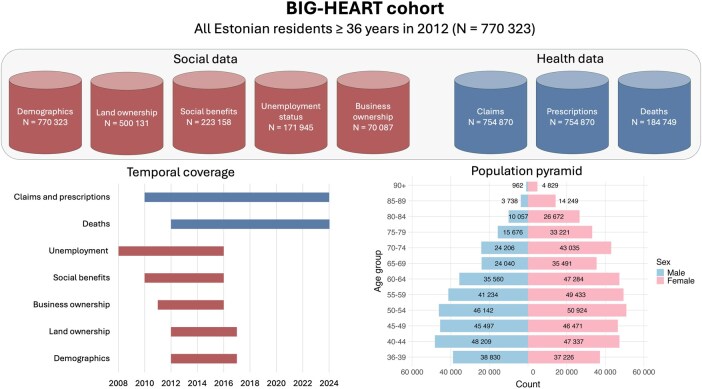 Figure 1
| Characteristic | Number of people | % |
|---|---|---|
| Age | ||
| Mean (SD, range) | 57.4 | 14, 36–108 |
| Median (IQR) | 56 | 46–68 |
| Male sex | 334 151 | 43.4 |
| Citizenship | ||
| Estonian | 608 990 | 79.1 |
| Russian | 79 847 | 10.4 |
| Stateless | 62 257 | 8.1 |
| Ukrainian | 4723 | 0.6 |
| Finnish | 4183 | 0.5 |
| Latvian | 1607 | 0.2 |
| Lithuanian | 1124 | 0.1 |
| Other | 7501 | 1.0 |
| Missing | 91 | 0.01 |
| Self-reported nationality | ||
| Estonian | 499 090 | 64.8 |
| Russian | 204 487 | 26.5 |
| Ukrainian | 20 563 | 2.7 |
| Finnish | 8055 | 1.0 |
| Latvian | 1679 | 0.2 |
| Lithuanian | 1468 | 0.2 |
| Other | 28 282 | 3.7 |
| Missing | 6699 | 0.9 |
| Education level | ||
| Less than primary | 3389 | 0.4 |
| Primary (age ∼11 years) | 34 198 | 4.4 |
| Lower secondary (age ∼15 years) | 94 820 | 12.3 |
| Lower secondary, vocational | 15 564 | 2.0 |
| Upper secondary (age ∼18 years) | 192 709 | 25.0 |
| Upper secondary, vocational | 73 164 | 9.5 |
| Upper secondary, specialized | 141 479 | 18.4 |
| Bachelor’s degree | 37 645 | 4.9 |
| Master’s degree | 126 368 | 16.4 |
| Doctorate | 4904 | 0.6 |
| Missing | 46 083 | 6.0 |
| Marital status | ||
| Married | 379 490 | 49.3 |
| Divorced | 155 869 | 20.2 |
| Widow/widower | 100 471 | 13.0 |
| Single | 111 964 | 14.5 |
| Missing | 22 529 | 2.9 |
| Diagnosis | ICD-10 code | Total (%) | Male (%) | Female (%) |
|---|---|---|---|---|
|
|
|
| ||
| Hypertensive heart disease | I10–15 | 497 689 (64.6) | 206 281 (61.7) | 291 408 (66.8) |
| Dorsalgia | M54 | 432 389 (56.1) | 168 473 (21.9) | 263 916 (60.5) |
| Dyslipidaemia | E78 | 337 548 (43.8) | 130 040 (38.9) | 207 548 (47.6) |
| Falls | W00–19 | 314 613 (40.8) | 127 337 (38.1) | 187 276 (42) |
| COVID-19 | U07 | 270 700 (35.1) | 105 582 (31.6) | 165 118 (37.9) |
| Virus identified | U07.1 | 176 531 (22.9) | 70 645 (21.1) | 105 886 (24.3) |
| Virus not identified | U07.2 | 139 851 (18.2) | 50 383 (15.1) | 89 468 (20.5) |
| Heart failure | I50 | 205 515 (26.7) | 81 051 (24.3) | 124 464 (28.5) |
| Ischaemic heart disease | I21–25 | 149 556 (19.4) | 69 703 (20.9) | 79 853 (18.3) |
| Type 2 diabetes | E11 | 131 648 (17.1) | 54 188 (16.2) | 77 460 (17.8) |
| Cerebrovascular disease | I60–69 | 129 454 (16.8) | 49 227 (14.7) | 80 227 (18.4) |
| Depression | F32–33 | 137 495 (17.8) | 38 018 (11.4) | 99 477 (22.8) |
| Anxiety | F41 | 104 126 (13.5) | 25 928 (7.8) | 78 198 (17.9) |
| Asthma | J45 | 83 794 (10.9) | 29 378 (8.8) | 54 415 (12.5) |
| Chronic obstructive pulmonary disease | J44 | 72 460 (9.4) | 39 687 (11.9) | 32 773 (7.5) |
| Chronic kidney disease | N18 | 64 148 (8.3) | 25 578 (7.7) | 38 570 (8.8) |
| Age-related hearing loss | H91 | 58 756 (7.6) | 21 564 (6.5) | 37 182 (8.5) |
| Prostate cancer | C61 | 22 946 (3.0) | 22 946 (6.9) | N/A |
| Migraine | G43 | 24 296 (3.2) | 3 554 (1.1) | 20 742 (4.8) |
| Colorectal cancer | C18–21 | 18 754 (2.4) | 8389 (2.5) | 10 365 (2.4) |
| Breast cancer | C50 | 17 208 (2.2) | N/A | 17 208 (3.9) |
| Psychotic disorders | F20–25, F28–29 | 15 366 (2.0) | 5490 (1.6) | 9876 (2.3) |
| Type 1 diabetes | E10 | 14 810 (1.9) | 6720 (2.0) | 8090 (1.8) |
| Lung cancer | C34 | 13 431 (1.7) | 9107 (2.7) | 4324 (1.0) |
| Alcohol addiction or use of specialist services | Z71.4, Z72.1, F10 | 46 548 (6.0) | 36 150 (10.8) | 10 398 (2.4) |
| Tobacco addiction or use of cessation services | Z71.6, Z72.0, F17 | 13 532 (1.8) | 8063 (2.4) | 5469 (1.3) |
| Other COVID-19 outcomes | U09 | 6237 (0.8) | 2171 (0.6) | 4066 (0.9) |
| Pancreatic cancer | C25 | 4799 (0.6) | 2155 (0.6) | 2644 (0.6) |
| Use of psychoactive substances | F11–16, F18–19 | 4472 (0.6) | 1836 (0.5) | 2636 (0.6) |
| Cervical cancer | C53 | 3747 (0.5) | N/A | 3747 (0.9) |
| Alzheimer’s disease | G30 | 3229 (0.4) | 896 (0.3) | 2333 (0.5) |
| Manic episode | F31 | 2577 (0.3) | 878 (0.3) | 1699 (0.4) |
| COVID-19 vaccine causing adverse effects | U12 | 807 (0.1) | 234 (0.1) | 573 (0.1) |
| Multisystem inflammatory syndrome associated with COVID-19 | U10 | 357 (0.05) | 132 (0.04) | 225 (0.1) |
| Bipolar affective disorder | F30 | 495 (0.1) | 186 (0.1) | 309 (0.1) |
| Data source and temporal coverage | Characteristic | Number of people (%) |
|---|---|---|
| Social Insurance Records Database 2010–16 | Receiving any social benefit at least once between 2010 and 2016 | 223 158 (29.0) |
| Benefit for having a disability | 164 940 (21.4) | |
| Lifelong pension for having no capacity to work | 105 951 (13.8) | |
| Victim of Soviet political repression during 1945–91 | 11 874 (1.5) | |
| Occupational injury/disease | 2363 (0.3) | |
| Forced to work during the Chernobyl clean-up in 1986–9 | 1464 (0.2) | |
| E-Business Register 2011–16 |
| |
| Number of companies owned by one participant, at baseline | ||
| 0 | 730 726 (94.9) | |
| 1 | 32 631 (4.2) | |
| 2 | 5057 (0.7) | |
| 3 | 1250 (0.2) | |
| > 3 | 659 (0.1) | |
|
| ||
| Number of companies based on their size | ||
| Micro-enterprises (0–9 employees) | 40 753 | |
| Small enterprises (10–49 employees) | 3142 | |
| Medium and large enterprises (≥50 employees) | 512 | |
| Missing | 34 | |
| Average company’s staff size | ||
| Median | 1 | |
| Mean | 5.6 | |
| Median profit (euros, €) | 742 | |
| Median accumulated profit prior to baseline (€) | 5894 | |
| Dividends paid (€) | ||
| Median | 5112 | |
| Mean | 35 389 | |
| Number of loss-making companies | 13 975 | |
| Number of companies with accumulated losses | 7374 | |
| E-Land Register 2012–17 | Property ownership | 500 131 (64.9) |
| Owners of only non-residential property | 96 826 (19.4) | |
| Owners of some residential property | 403 305 (52.4) | |
| Owners of residential property in a major city | 232 355 (30.2) | |
| Owners of residential property in the capital city | 153 156 (19.9) | |
| Unemployment Insurance Fund 2008–16 |
| |
| Unemployed at least once between 2008 and 2016 | 171 945 (22.3) | |
| Unemployed at least twice between 2008 and 2016 | 72 891 (9.5) | |
|
| ||
| Median unemployment period in days (IQR) per episode | 181 (76–337) | |
| Median time in days from finding a job until becoming unemployed again (IQR) | 149 (62–297) | |
| Reason for registering as ‘unemployed’, top 3 reasons | ||
| Redundancy | 41 781 (13.1) | |
| End of fixed-term contract | 35 059 (11.0) | |
| Employee’s initiative | 20 403 (6.4) | |
| Reason for terminating the ‘unemployed’ status, top 3 reasons | ||
| New employment | 189 006 (59.2) | |
| Breach of unemployment obligations | 80 085 (25.1) | |
| Requested by unemployed person | 39 454 (12.4) | |
| Estonian Health Insurance Fund 2010–24 | People covered by the national health insurance system | |
| Insured at least once between 2012 and 2023 | 754 870 (98.0) | |
| Insured at baseline (1 January 2012) | 703 433 (91.3) | |
| Individuals with ≥90 days of sick leave | 29 798 (3.9) | |
| Death Register 2012–24 | All-cause deaths between 2012 and 2023 | 184 749 (24.0) |
| CVD deaths (ICD-10 codes I00–99) between 2012 and 2023 | 95 019 (12.3) | |
| Atherosclerotic death (ICD-10 codes I21–25 + I60–69) between 2012 and 2023 | 45 771 (5.9) |
- —Estonian Research Council10.13039/501100002301
- —European Union through the European Regional Development Fund
- —Estonian Ministry of Education and Research
- —Estonian Centre of Excellence for Well-Being Sciences (EstWell)
Peer Reviews
No public reviews on file for this paper yet. If you reviewed it on a platform where reviews are public (OpenReview, ICLR, NeurIPS, ICML), you can paste yours below so the community can read it here.
Videos
No videos yet. Explain this paper in a talk, walkthrough, or lecture? Add one.
Taxonomy
TopicsHealthcare Systems and Reforms · Health disparities and outcomes · Food Security and Health in Diverse Populations
Data resource basics
The rationale for establishing BIG-HEART
Cardiovascular disease (CVD) remains a leading global public health concern despite being largely preventable [1, 2]. Sixty years of research has shown a strong association between socio-economic factors and CVD risk [3]. However, these insights have rarely been integrated into clinical practice. Primary and secondary prevention services can exacerbate health inequalities when attendance at screening programs, preventive medication use, and success with behaviour change services follow social gradients [4–6]. We propose that integrating multidimensional socio-economic and psychosocial data with electronic health records can, first, deepen our understanding of the drivers and patterns of health inequalities. Second, it can accelerate implementation by enabling the developers of risk-prediction algorithms and care services to directly incorporate socio-economic factors into their models and pathways. The existing CVD risk-prediction models recommended in clinical practice [7–9] typically incorporate at most one socio-economic indicator, despite emerging evidence suggesting that each additional layer may enhance both predictive performance and fairness [10, 11]. This lack of integration may worsen inequalities from the earliest stage of care—risk prediction—compounded by unequal uptake and adherence to recommended services [5, 12–14]. Estonia has among the highest CVD mortality rates in Europe—nearly twice the EU average—and modestly above the global average, which likely reflects a higher disease incidence rather than poorer outcomes after diagnosis [15–18]. This underscores both the statistical power and the public health potential of conducting CVD research in Estonia. BIG-HEART integrates health and social data to bridge basic epidemiological research with applied solutions, promoting more precise and equitable risk assessments and services.
Estonian health and social data
Estonia—a country in north-eastern Europe with a population of 1.3 million—has long led the way globally in building secure and efficient digital infrastructures for public services. Since 1989, every resident has been assigned an 11-digit personal identification code, facilitating data linkage across government systems. In 2001, Estonia launched ‘X-Road’—a secure data-exchange system enabling interoperability across governmental databases while maintaining strict security standards [19]. Managed by the Estonian Information System Authority, this infrastructure supports resilience to changes in underlying database architectures or digital services.
As of 2023, ∼95% of Estonia’s population was covered by the publicly funded Estonian Health Insurance Fund (EHIF) [20], which is similar to the UK’s National Health Service [21, 22]. Estonia’s healthcare system includes roughly 400 primary care centres [23] and 20 hospitals [24], each with its own information technology system. These local systems are not fully interoperable, allowing implementation flexibility. However, providers must submit claims, prescriptions, and discharge summaries to the national system, enabling comprehensive, standardized coverage. Estonia’s e-prescribing platform records all prescriptions and dispensing statuses, supporting the assessment of initiation, adherence, and persistence. Blockchain technology logs all clinician access to personal health data, enhancing transparency and trust. Residents can access their records via the national Health Portal [25], which is similar to systems in Finland and Iceland [26].
Secondary use of Estonian health data for research
As the collection and coding of electronic health data differ across countries, there is growing interest in harmonizing cleaned, research-ready datasets rather than raw data. The Observational Medical Outcomes Partnership (OMOP) Common Data Model (CDM) [27] has become a widely adopted standard for enabling cross-country comparisons and large-scale analyses. Estonia contributed early to this effort, first mapping a 10% random sample of national health data to OMOP CDM [28], followed by a sample that supported several international COVID-19 studies. These analyses provided valuable insights—e.g. they confirmed that post-acute COVID-19 symptoms defined by the World Health Organization were frequently reported, though with variation across healthcare settings and countries [29]. They also demonstrated that vaccination, particularly the first dose, reduced the risk of long Covid [30], and showed that serious adverse events such as thromboembolism and myocarditis were more common after SARS-CoV-2 infection than in historical cohorts [31].
BIG-HEART: advancing health and social data integration
Building on Estonia’s electronic health record infrastructure, BIG-HEART further integrates data by enriching health records with socio-economic data. BIG-HEART was established in 2024, covering all 770 323 Estonian residents aged ≥36 years who, as of 1 January 2012, were resident in Estonia according to the Population Register. This fixed cohort is tracked annually for health and mortality outcomes through to 2026. All health data have been transformed into the OMOP CDM, supporting harmonized, large-scale analyses and international collaborations. Further information on the data-transformation process and data-quality assessments are provided in the Supplementary materials.
Data collected
Data sources
BIG-HEART is both a longitudinal fixed cohort and a data resource, enabling the analysis of health and social exposures over time. It is based on routinely collected, secondary administrative data, structured as a register-based cohort with repeated annual updates. The cohort was constructed by using the Population Register, which defined the study population. Table 1 shows the baseline demographic characteristics. Data are grouped into (i) health and (ii) social domains. Eight national datasets were linked at the individual level by using project-specific anonymized patient identifiers. Figure 1 provides an overview of the linked data sources, coverage, and age distribution.
Data sources included in the data linkage, data timeliness, and population pyramid of the BIG-HEART cohort.
‘Health data’ are primarily derived from a national billing database managed by the EHIF [32]. This comprehensive dataset includes all reimbursed insurance claims submitted by primary and secondary healthcare providers, covering both in- and outpatient services. Each claim records the procedures performed and diagnoses—both incident and pre-existing—coded according to the International Statistical Classification of Diseases, 10th Revision (ICD-10), and the Nordic Medico-Statistical Committee (NOMESCO) Classification of Surgical Procedures, as well as local service codes used in the national health insurance system. Table 2 highlights key public health diseases by gender, based on the top 30 conditions ranked by disability-adjusted life years and other commonly reported cases from the BIG-HEART database.
The EHIF database contains comprehensive information on sick-leave episodes and health insurance coverage, including the start and end dates of coverage and the reasons behind changes in status. Our data suggest that 6%–8% of individuals may experience fluctuations in their insurance coverage, implying that stable coverage is closer to 91%, rather than the usually reported 95%. These fluctuations may be due to changes in employment or registration status and should be taken into account when interpreting analyses based on insurance data. In addition, the EHIF also maintains an extensive prescription records system, with detailed information on all dispensed medications—classified by using the Anatomical Therapeutic Chemical system—along with the prescribed dosage, prescribing provider, and both the date and location of dispensing. Metadata from packaging codes further enrich these records by identifying the drug manufacturer, strength, and pharmaceutical form (e.g. tablet, cream).
The Causes of Death Register [33] collects comprehensive mortality data. In the BIG-HEART cohort, we have full details on the cause of death when the underlying cause is circulatory (ICD-10 codes I00–I99) or sudden death of unknown cause (R96.0, R96.1). For all other causes, the date of death is recorded, which supports time-to-event analyses and the handling of competing non-cardiovascular outcomes. Should future research require detailed cause-of-death data beyond the circulatory domain, extended access can be requested to support scientifically justified hypotheses.
‘Social data’ are currently available from five registries. Table 3 presents the socio-economic and health-related characteristics of the BIG-HEART cohort across the study period. While the primary purpose of collecting social data was to characterize the baseline exposures, future extensions may incorporate variables such as occupation and income if supported by research hypotheses. Consequently, social data have shorter time coverage than health data. The Population Register [34] includes demographic variables such as sex, birth year, marital status, citizenship, self-reported nationality, county of residence, emigration date, and death date, as well as the most recently recorded educational attainment. Citizenship refers to a person’s legal citizenship as recognized by the state, whereas self-reported nationality reflects ethnic or cultural identity as declared by the individual. Citizenship categories include ‘Stateless’—a unique group of legally resident individuals without any state citizenship (see Table 1). As education data were provided as a 2023 snapshot rather than time-stamped records, we cannot determine participants’ education status at the baseline and assume no changes during follow-up.
The Social Insurance Records Database [35] covers social benefits—such as type, amount, and payment period—for various reasons, including having a disability, being a victim of severe violence, political repression during the Soviet Union from 1945 to 1991, being forced to work during the Chernobyl clean-up operation from 1986 to 1989, living alone as a pensioner, suffering health damage from an occupational disease or work accident, or receiving an incapacity pension. This data are available from 2010 to 2016.
The Unemployment Insurance Fund data source [36] provides longitudinal data on unemployment episodes, prior occupations, and reasons for entering and exiting unemployment. For the ∼25% of participants with at least one unemployment spell, it is possible to reconstruct the pre-unemployment income, enabling nuanced analyses of economic vulnerability. Occupations are coded by using the International Standard Classification of Occupations, allowing longitudinal tracking of employment stability and career disruption. Evidence suggests that the frequency of labour-market transitions may be more predictive of disease incidence than unemployment duration [37]. Among the 10% of participants with multiple unemployment episodes, employment and unemployment often alternate in 6-month cycles. The BIG-HEART cohort enables investigation of the contextual and personal factors influencing unemployment resolution—whether through re-employment, retirement, or other paths. Currently, the cohort includes 8 years of employment data, which could be extended to 16 years in future updates if needed.
Objective wealth indicators are available from two registries. The E-Land Register [38] records all landholdings—residential or commercial—owned by participants, down to the neighbourhood level (excluding street names). As shown in Table 2, ∼65% of the BIG-HEART cohort owns some form of land, enabling rare analyses of how real-estate wealth relates to life expectancy, healthcare use, and outcomes—supporting fairness assessments across socio-economic strata.
The E-Business Register [39] provides data on ∼40 000 individuals who co-own or operate a legal entity. It offers 6 years of detailed longitudinal information, including turnover, profitability, tax arrears, employee count, and sector classification using Nomenclature of Economic Activities codes. Among the broader population, a smaller share (∼5%) owns business assets, typically through micro-enterprises. This supports research on how financial stability or instability in business ownership affects physical and mental health, healthcare use, and outcomes. Wealth across property and business domains offers a multidimensional view of financial security, precarious employment, and health—especially relevant during external shocks such as the COVID-19 pandemic. The dataset could be extended to examine whether business disruptions led to differences in healthcare access, diagnoses, or medication use.
Secure data processing
To protect privacy, the Population Register assigned a unique, project-specific anonymized patient identifier to each person, replacing national personal identification numbers. These identifiers were shared with data providers to enable secure record linkage, but not with the University of Tartu, which never had access to identifiable information. Each data provider used the identifier to extract relevant records and returned anonymized datasets to a secure computing environment, ensuring that researchers only accessed de-identified data. More information on the secure computing environment can be found in the Supplementary materials.
Data resource use
The BIG-HEART dataset became available to us in mid-2024, making it a new and highly promising resource for studying the socio-economic dimensions of health and healthcare. Although no studies have yet been published, several have been initiated by our small team. Among the healthy participants at the baseline, we are investigating whether the registry-based measures of real-estate and business wealth, unemployment, and social benefits predict CVD incidence and improve CVD risk-prediction algorithms. We are also assessing whether machine-learning, artificial intelligence, and large language models can outperform conventional regression models in accuracy and fairness—questions that the BIG-HEART cohort is exceptionally well placed to evaluate, with its rich socio-economic detail and complete population representation. This work informs the design of future interventions, such as identifying persons most amenable to preventive care (e.g. statins, antihypertensives, or behavioural services) and evaluating their effectiveness.
For persons with established disease at the baseline, we are describing the socio-demographic differences in healthcare use, including screening attendance and medication adherence, and developing models to predict future non-adherence, with potential feedback to clinicians. Beyond these initial studies, BIG-HEART is well positioned to address broader public health questions spanning computer science, epidemiology, and social sciences. We welcome collaborations to either analyse the existing data (typically yielding results within 3–6 months) or add new data layers via Estonian regulators (which take ∼12 months).
Strengths and weaknesses
BIG-HEART has three core strengths. First, it includes a complete population sample: all Estonian residents aged ≥36 years were included via the Population Register. This eliminates sampling bias and sets BIG-HEART apart from biobanks and survey-based cohorts, in which participation is voluntary and often limited. Second, it offers complete healthcare service capture, due to Estonia’s national electronic infrastructure and OMOP-standardized data. These features support the accurate estimation of healthcare use and of conditions that usually result in clinical contact. Third, BIG-HEART integrates rich social data at the population level. These data, though not originally collected for research, are nearly complete and enable the rigorous analysis of social determinants. Social epidemiologists can evaluate how socio-economic factors affect disease, while data scientists can validate prediction models and assess fairness across subgroups.
Despite these strengths, BIG-HEART has limitations. First, some valuable data layers remain unlinked, including the Health Information System (with discharge summaries, clinical notes, and lab results), the Estonian Biobank (which has standardized its data to the OMOP CDM), Estonian Tax Board registries (with declared income and occupation for those never unemployed), and disease-specific registries for myocardial infarction and cancer. Second, the presented health needs may underestimate the true needs. Chronic conditions often precede care seeking and may go undocumented, particularly among disadvantaged groups, potentially biasing the risk estimates and fairness evaluations toward the null. Although official coverage is 95%, baseline data show that only 91% were insured at linkage and 6%–8% cycle in and out of coverage. If uninsured individuals have greater health needs, then the prevalence and fairness measures may be overly optimistic. Third, some individuals may have emigrated before the baseline or during follow-up without updating their residency status, leading to potential misclassification of exposure time. BIG-HEART is a fixed cohort and, while emigration data are available up to 2024, immigration data are not captured. Consequently, individuals who have left Estonia may remain classified as residents, whereas new immigrants after the baseline are not represented. Migration among adults in Estonia has been modest, suggesting that this limitation is unlikely to have substantially affected the representativeness. In addition, Estonia’s strong incentives to update residency information (e.g. for childcare and mortgage benefits) likely reduce the under-reporting of emigration. Future work may identify likely emigrants through disengagement from health and social systems.
Data resource access
Access to the BIG-HEART data can be obtained with approval from the Research Ethics Committee of the University of Tartu. Researchers can contact the principal investigator Taavi Tillmann through [email protected].
Ethics Approval
The BIG-HEART project has received approval from the Research Ethics Committee of the University of Tartu (no. 384/T-8, 20.11.2023).
Supplementary Material
dyag027_Supplementary_Data
The reference list from the paper itself. Each links out to its DOI / PubMed record.
- 1Mensah GA , Fuster V, Murray CJL et al; Global Burden of Cardiovascular Diseases and Risks Collaborators. Global burden of cardiovascular diseases and risks, 1990–2022. J Am Coll Cardiol 2023;82:2350–473. 10.1016/j.jacc.2023.11.00738092509 PMC 7615984 · doi ↗ · pubmed ↗
- 2Magnussen C , Ojeda FM, Leong DP et al; Global Cardiovascular Risk Consortium. Global effect of modifiable risk factors on cardiovascular disease and mortality. N Engl J Med 2023;389:1273–85. 10.1056/NEJ Moa 220691637632466 PMC 10589462 · doi ↗ · pubmed ↗
- 3Hinkle LE , Whitney LH, Lehman EW et al Occupation, education, and coronary heart disease: Risk is influenced more by education and background than by occupational experiences, in the Bell System. Science 1968;161:238–46. 10.1126/science.161.3838.2385657326 · doi ↗ · pubmed ↗
- 4Murphy Adrianna , Palafox Benjamin, O’Donnell Owen, et al Inequalities in the use of secondary prevention of cardiovascular disease by socioeconomic status: evidence from the PURE observational study. Lancet Glob Health 2018;6:e 292–301, e 301. 10.1016/S 2214-109X(18)30031-729433667 PMC 5905400 · doi ↗ · pubmed ↗
- 5Lang S-J , Abel GA, Mant J et al Impact of socioeconomic deprivation on screening for cardiovascular disease risk in primary prevention population: a cross-sectional study. BMJ Open 2016;6:e 009984. 10.1136/bmjopen-2015-009984 PMC 480908027000783 · doi ↗ · pubmed ↗
- 6Ohm J , Skoglund PH, Häbel H et al Association of socioeconomic status with risk factor target achievements and use of secondary prevention after myocardial infarction. JAMA Netw Open 2021;4:e 211129. 10.1001/jamanetworkopen.2021.112933688966 PMC 7948055 · doi ↗ · pubmed ↗
- 7SCORE 2 working group and ESC Cardiovascular risk collaboration. SCORE 2 risk prediction algorithms: new models to estimate 10-year risk of cardiovascular disease in Europe. Eur Heart J 2021;42:2439–54. 10.1093/eurheartj/ehab 30934120177 PMC 8248998 · doi ↗ · pubmed ↗
- 8Hippisley-Cox J , Coupland CAC, Bafadhel M et al Development and validation of a new algorithm for improved cardiovascular risk prediction. Nat Med 2024;30:1440–7. 10.1038/s 41591-024-02905-y 38637635 PMC 11108771 · doi ↗ · pubmed ↗