Why school tobacco bans fail: staff engagement in enforcement in Belgian schools
Pierre Laloux, Arja Rimpelä, Vincent Lorant

TL;DR
This study explores why tobacco bans in Belgian schools fail, finding that staff engagement and shared commitment are crucial for effective enforcement.
Contribution
The study introduces a validated scale to measure staff engagement in enforcing school tobacco policies.
Findings
Staff willingness to enforce tobacco rules was high, but adherence to sharedness of rules was low.
Enforcement is predicted by the perception that rules are enforced by colleagues and are justified.
Shared commitment among staff, leadership, and parents is essential for effective enforcement.
Abstract
Tobacco control bans are only as effective as their enforcement, and schools are a critical though often overlooked frontline. School tobacco policies (STPs) frequently fail when staff hesitate to act. This study aimed to measure and explain staff engagement in STP enforcement using a newly developed scale. Staff members (n = 624) from 18 Belgian secondary schools took part in the ADHAirE study. Building on previous qualitative studies, we constructed a 10-item scale to assess staff willingness to enforce the STP. We used exploratory factor analysis (EFA) to identify key attitudinal dimensions underlying the scale and conducted multilevel analyses to assess factors that predict enforcement. Participants scored high on willingness to enforce the rules (2.89, range 1–4). EFA revealed two key attitudinal dimensions, each explaining 20% of the variance: the perception that enforcement is a…
Genes, proteins, chemicals, diseases, species, mutations and cell lines named across the full text — each resolved to its canonical identifier and authoritative record.
Click any figure to enlarge with its caption.
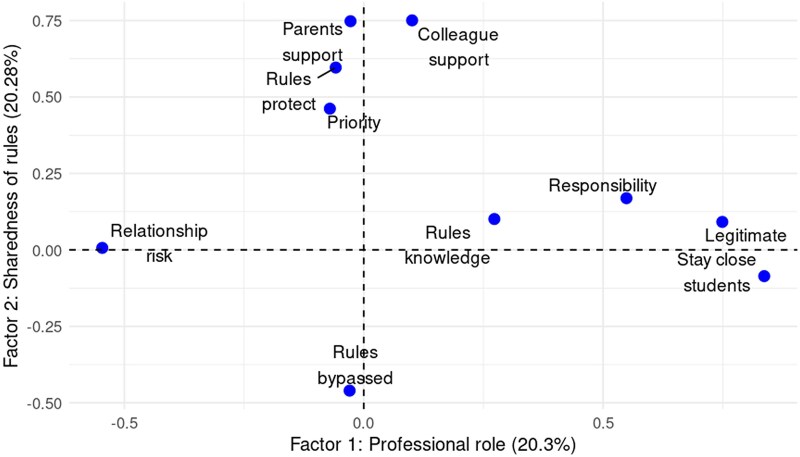 Figure 1
| Mechanisms (9) | Questions (ADHAirE study) | Proportion of agreement (%, 95% CI) |
|---|---|---|
| Mechanism 1: responsibility is part of professional role and duties | 1.1. It is my responsibility to enforce these rules | 88.6 (86.0–91.2) |
| 1.2. I feel I have legitimacy to enforce these rules | 83.0 (79.9–86.1) | |
| 1.3. Smoking prevention is a priority for my school | 61.9 (57.9–65.9) | |
| Mechanism 2: staff contribution to positive outcomes to motivate enforcement | 2.1. These rules help protect students from smoking and vaping | 73.1 (69.5–76.7) |
| 2.2. I feel supported by my colleagues to enforce these rules | 70.7 (67.0–74.4) | |
| 2.3. Students always get around these rules | 60.8 (56.8–64.8) | |
| 2.4. I feel supported by the parents to enforce these rules | 52.2 (48.1–56.3) | |
| Mechanism 3: staff’s ability to enforce the rules to be confident to enforce the STP | 3.1. I can enforce these rules while remaining close with my students | 92.4 (90.2–94.6) |
| 3.2. I know these rules well | 64.0 (60.1–67.9) | |
| 3.3. I risk damaging my relationship with my students if I enforce these rules | 14.7 (11.8–17.6) | |
| Mean score (SD, range 1–4) | – | 2.89 (0.49) |
|
| |
| Schools’ socioeconomic status (median, IQR; range = 1–20) | 8.5 (4.8–11.0) |
| Schools’ average size (mean, SD) | |
| Number of students third–fourth grade | 247.3 (112.1) |
| Number of staff | 115.3 (39.9) |
|
|
|
| Age (mean, SD) | 44.2 (9.7) |
| Sex ( | |
| Male | 202 (36.3%) |
| Female | 355 (63.7%) |
| Occupation type ( | |
| Principal | 13 (2.4%) |
| Educator | 28 (5.2%) |
| Teacher | 486 (89.0%) |
| Technical/logistical/administrative staff | 13 (2.7%) |
| Nursing staff | 4 (0.7%) |
| Years of service (mean, SD) | 13.8 (9.7) |
| Workload ( | |
| Full time | 429 (75.8%) |
| Part time | 137 (24.2%) |
| Smoking status ( | |
| Never smoker | 400 (69.4%) |
| Former smoker | 103 (17.9%) |
| Occasional smoker | 31 (5.4%) |
| Daily smoker | 42 (7.3%) |
| Multilevel analysis b (95% CI) | |||
|---|---|---|---|
| Model 0 | Model 1: factor 1 professional role | Model 2: factor 2 sharedness of rules | |
| School random effect (ICC) | 0.306 | 0.000 | 0.006 |
| School-level factors | |||
| School’s SES (low to high, 0–20) | 0.00 (−0.01; 0.01) | 0.01 (0.00; 0.02) | |
| Visibility of smoking at the entrance | −0.02 (−0.20; 0.16) | −0.01 (−0.18; 0.15) | |
| Smoking initiation | −0.57 (−1.36;0.21) | −0.42 (−1.09;0.29) | |
| Individual-level factors | |||
| Justification of the rules (disagree, to agree, score 1–5) | 0.06 (0.01; 0.10)* | 0.07 (0.03; 0.11)*** | |
| Rules are often enforced | 0.11 (0.04; 0.18)** | 0.26 (0.20; 0.32)*** | |
| Staff enforce rules cohesively | 0.08 (0.01; 0.10)* | 0.13 (0.07; 0.19)*** | |
| Smoking status | |||
| Never | Ref. | Ref. | |
| Former | −0.09 (−0.22; 0.03) | −0.01 (−0.12; 0.10) | |
| Occasional | −0.13 (−0.33; 0.07) | 0.01 (−0.17; 0.18) | |
| Daily | −0.21 (−0.41; −0.01)* | −0.12 (−0.30; 0.05) | |
- —Belgian Foundation
Peer Reviews
No public reviews on file for this paper yet. If you reviewed it on a platform where reviews are public (OpenReview, ICLR, NeurIPS, ICML), you can paste yours below so the community can read it here.
Videos
No videos yet. Explain this paper in a talk, walkthrough, or lecture? Add one.
Taxonomy
TopicsSmoking Behavior and Cessation · School Health and Nursing Education · Behavioral Health and Interventions
Introduction
Banning smoking from public places is recommended by the World Health Organization (WHO) to protect people from second-hand smoke, but it also influences people’s opportunities to smoke and is likely to de-normalize smoking (WHO 2008, 2009, Wilson et al. 2012). Bans are central to smoke-free policies, yet their effectiveness is strongly related to the capacity to enforce them (Gunningham 2010). School tobacco policies (STPs) are one strategy for preventing smoking. They regulate whether smoking is allowed in schools at all or where and when students/school staff are not allowed to smoke (Evans-Whipp et al. 2010). STPs appear more promising than an educational approach to smoking prevention because they target the social context in which young people are exposed to or can access tobacco products (Galanti et al. 2014). Nevertheless, evidence regarding their effectiveness in reducing adolescent smoking remains mixed (Galanti et al. 2014). Earlier studies did not necessarily take inconsistent or poor implementation into account but assumed a direct link between STPs and children’s behaviour. Inconsistent enforcement of STPs has been shown to undermine their effectiveness, as student-perceived enforcement is associated with decreased smoking on school premises (Lipperman-Kreda et al. 2009, Mélard et al. 2020). This study presents the development and validation of a novel instrument to measure the willingness of secondary school staff to enforce an STP and examine the factors underlying this willingness. We view school staff engagement in STP enforcement through the lens of the Advocacy Coalition Framework (AFC), which distinguishes between deep core, policy core, and secondary beliefs (Sabatier and Weible 2019). According to the theory, changing factual beliefs is one of the first steps in changing a norm and can be achieved by changing collective expectations (Bicchieri 2016, Sabatier and Weible 2019).
A qualitative study conducted among Dutch school staff members showed that core beliefs about smoking prevention in school settings may hinder STP enforcement (Schreuders et al. 2019): if staff members prioritize the values of individual freedom and autonomy over responsibility, perceive smoking as a secondary problem, fear for their positive relationship with students, or have doubts about the coherent enforcement of STPs (Schreuders et al. 2019). In their realist review, Linnansaari et al. (2019) identified three outcomes that must be achieved to facilitate STP enforcement (Linnansaari et al. 2019). First, staff must feel responsible because they experience the policy as part of their professional role and duties. Secondly, staff members should be motivated to enforce STPs because they perceive that their contribution leads to positive outcomes. Finally, feeling able to deal with students’ responses helps staff members to be confident about enforcing STPs. The situation regarding the enforcement of bans is peculiar to schools, as the enforcers and the subjects of the rules are socially close, which lowers willingness to enforce bans (Nolan 2017). The realist review is consistent with a Europe-wide qualitative study that highlighted the need for a supportive organizational structure, enforcement by the entire staff, and dialogue with students (Linnansaari et al. 2022). The latter is likely to be particularly important for staff to avoid interfering with already-vulnerable students who have a less supportive family background (Schreuders et al. 2020).
The effectiveness of STPs, therefore, depends on the willingness of staff to enforce them. As a smoke-free school cannot be achieved without the cooperation of staff members, understanding their willingness to enforce the STP and identifying the main arguments for and against it could guide interventions that address STP implementation. Since staff enforcement is crucial yet currently unmeasured, a scale is needed to assess and enhance enforcement efforts and thereby improve the overall effectiveness of STPs in reducing student smoking and vaping. To date, however, no quantitative measure has captured the willingness to enforce, leaving STPs a rather wishful strategy. This paper proposes a new measure for STP enforcement and identifies its main dimensions and key individual and school-level factors that influence enforcement.
Methods
Design and sample
This study is based on baseline data from the ADHAirE (A Decent and Healthy Air for Everyone) experimental study. Data were collected in secondary schools in the Hainaut province, Belgium. This province is known to have a high prevalence of smoking (22% current smokers vs. 19.4% in Belgium) despite smoking at school being prohibited since 2006. The study received ethical approval from the Comité d’éthique hospitalo-facultaire UCLouvain (reference number 2023/30OCT/438). Further details of the methodological features of the ADHAirE study can be found elsewhere (Laloux et al. 2025). The study follows STROBE standards of reporting (Additional file 1).
Data collection took place in 18 secondary schools between October and December 2024. In total, 624 staff members out of 2031 participated (response rate: 31%). Consent to participate was obtained before the completion of the questionnaire. They completed a self-reported online survey in which they were asked about their smoking behaviour, their perceptions of the STP, and sociodemographic factors. For complementary analysis, we also used data collected on students in the third and fourth grades from those schools. In total, 3064 adolescents out of 4347 took part in the survey (response rate: 70%). They completed an online survey in class in which they reported their smoking and vaping status, their perceptions of the STP and its enforcement, and sociodemographic information. Here again, informed consent to participate was obtained before the completion of the questionnaire. In Belgium, parental consent is not required for survey participation among children aged 13 years and older.
Measurements
Enforcement
Based on the theoretical background provided by Linnansaari et al. (2019), we developed a scale to assess staff willingness to enforce an STP, proposing three mechanisms (Linnansaari et al. 2019):
Mechanism 1: When contextual factors cause school staff to experience the STP as part of their professional role and duties, it can lead to staff members taking responsibility for STP enforcement.Mechanism 2: When contextual factors cause staff members to perceive their contribution as leading to positive outcomes, it may lead to staff members showing motivation for STP enforcement.Mechanism 3: When contextual factors cause staff to feel able to deal with students’ responses, it may lead to staff members showing confidence in STP enforcement.
Based on this framework, a preliminary list of items was selected by PL. The items measure staff perceptions of STP enforcement that influence willingness to enforce an STP. The list was then discussed with an expert in STPs (V.L.). A first version was piloted, with cognitive testing to ensure clarity and relevance. Following feedback from the staff members of a Brussels school who tested the questionnaire, we clarified the phrasing and kept the items for which we found the best theoretical alignment to the framework’s dimensions. The second version was then also tested for clarity (see scale building progress in Additional file 2). Table 1 presents the 10 items, related to the three mechanisms, which were retained and which the staff members were questioned about. Each item is rated on a four-point scale, ranging from ‘I totally disagree’ (1) to ‘I totally agree’ (4). In the distribution analysis, agreement was defined as selecting either option 3 or 4 on the scale.
Explanatory factors of enforcement
In order to identify factors influencing staff willingness to enforce the STP, we considered information at both the school and individual levels. At the school level, we collected three indicators: the school’s socioeconomic status (SES), the visibility of smoking, and smoking initiation. The latter two indicators were derived from the students’ survey. Every school in the Fédération Wallonie-Bruxelles (FWB) gets an official school SES index score based on several factors, including parents’ income, employment status, and education level. Schools are then ranked on a scale from 1 (lowest school SES) to 20 (highest school SES). To assess the visibility of smoking, students were asked how often they saw other students smoking at the school entrance. They answered on a four-point scale, which ranged from ‘Never or very rarely’ (1) to ‘Every day or almost every day’ (4). For the analysis, we measured, for each school, the proportion of students who see other students smoking at the school entrance at least once a week (responses 3 and 4). Smoking initiation was measured, for each school, as the proportion of students who reported having tried smoking at least once. We chose ‘ever smoker’ rather than ‘current smoker’ as an indicator for two reasons. First, current smoking is still rare at that age (7.88% of our sample), which limits variability. Secondly, current smoking was found to have lower variance (0.07) than ever smoking (0.19). We therefore prioritized ever smoking to ensure greater variability in the data and improve the statistical power of the analyses.
At the individual level, we collected four indicators from the school staff members: smoking status and three perceptions regarding STP enforcement. To assess staff members’ smoking status, they could report that they were either a ‘never smoker’, ‘former smoker’, ‘occasional smoker’, or ‘daily smoker’. For the first perception regarding STP enforcement, school staff were asked, ‘Do you think that sanctions against students caught smoking/vaping are justified?’ to assess their attitude towards the STP. Answers ranged from ‘I totally disagree’ (1) to ‘I totally agree’ (5) on a five-point scale. For the second perception regarding STP enforcement, we asked, ‘In your school, are rules about smoking and vaping generally enforced?’ to assess the actual enforcement of the STP. Answers ranged on a four-point scale from ‘Totally disagree’ (1) to ‘Totally agree’ (4). For the last perception regarding STP enforcement, staff members were asked, ‘How do the staff react when a student is caught smoking or vaping?’. They could answer either ‘Each member of staff applies the rules in their own way’ (1), ‘Some members of staff apply the rules in the same way’ (2), or ‘Most staff members apply the rules in the same way’ (3). This perception reflects the consistency in enforcement and the wider school communication regarding the tobacco policy.
Analysis
A missing data analysis was performed prior to the main analyses. The MCAR test (P = 0.506) indicated no systematic pattern of missingness. No significant differences were found between the complete-case sample and the full sample regarding age, sex, school role, or attitudes to smoking prevention. We therefore conducted a complete-case analysis (n = 577).
Assessment of the scale’s dimensions
To assess the scale’s properties in relation to the theoretical framework, we performed an exploratory factor analysis (EFA). Before analysis, the Kaiser-Meyer-Olkin (KMO) index value was calculated to measure the appropriateness of the data for factor analysis (Kaiser and Rice 1974). Values above 0.50 are considered suitable for factor analysis (Williams et al. 2010). We then calculated Cronbach’s alpha for the global questionnaire and for each item separately to assess internal reliability (Cronbach 1951). Values between 0.70 and 0.95 are considered acceptable (Tavakol and Dennick 2011). For the EFA, we used an oblique rotation, as orthogonality in the domain of enforcement behaviours is unrealistic (Williams et al. 2010). Factor extraction was performed following the principal components analysis, using Kaiser’s criteria and the Scree test as extraction criteria.
Enforcement predictors
To identify individual- and school-level predictors of willingness to enforce the STP, we used multilevel models, since the main outcome, willingness to enforce the STP, may be influenced by the school context. The dependent variables were the factors identified in the EFA. The score for each factor was calculated by taking the mean of the related items of the enforcement scale. Negative items (2.3. and 3.3.; see Table 1) were reversed. Predictors were used as explanatory variables. We first used an empty model (Model 0) to calculate the intra-class correlation (ICC) coefficient and evaluate the relevance of the multilevel analysis. We then performed two models (Models 1 and 2) related to the factors extracted in the EFA.
All statistical analyses were conducted in R Studio (version 4.4.1). The psych package (Revelle 2017) was used for the EFA and the lme4 package (Bates et al. 2015) for the multilevel analysis.
Results
Sample characteristics
Participants were mainly women (63.7%) and were, on average, aged 44.2 years, with nearly 14 years’ seniority (13.8; Table 2), distributions close to that of school staff across the FWB (Wallonie-Bruxelles 2024). Nine out of 10 staff members (89.0%) were teachers, but educators (5.2%), principals (2.4%), and technical/administrative support staff (2.7%) also took part in the survey, to a lesser degree. In Belgium, a teacher’s mission is to teach and transmit knowledge and competences to students, whereas an educator’s role is to support students in their education and social lives, including with their well-being, personal issues, and discipline. Out of the staff members, 75.8% had a full-time position in the participating schools. The majority of the staff members (69.4%) had never smoked, 17.9% were former smokers, and 12.7% smoked regularly. Half of the schools had a SES score below 8.5, which is lower than the median of all schools in the FWB (SES median = 10). Results from the students’ survey show that the majority of them (61.8%) see other students smoking nearly every day at the school entrance. A quarter of them (25.5%) have tried smoking at least once.
Staff members’ willingness to enforce
Most staff members agreed with nearly all aspects of enforcement, for example, agreeing that they could enforce STPs while staying close to the students (Table 1; 92.4%), and a similarly high proportion felt responsible for enforcing the rules (88.56%). A minority of the staff members agreed with the statement that they risked damaging their relationship with the students by enforcing STPs (14.73%). Parental support for enforcement was found to have the lowest level of agreement, with only half (52.17%) of the participants feeling supported by parents to enforce the STPs.
Dimensions of enforcement
The items showed good appropriateness for factor analysis (KMO index = 0.83) and good internal reliability (Cronbach’s alpha = 0.82). Following the Kaiser criterion, a solution was extracted that included two factors: professional role and sharedness of rules. This solution provided a more suitable structure in which factors correlated to multiple variables, unlike the three-factor model, in which one factor was linked to a single variable. Figure 1 shows the results of the EFA. Factor 1 accounted for 20.30% of the variance and Factor 2 for 20.28%. Factor 1 is mainly composed of items related to Mechanism 3 (confidence to enforce) and Mechanism 1 (responsibility to enforce): ‘Responsibility’, ‘Legitimacy’, ‘Stay close to students’, and ‘Relationship risk’. Factor 2 is mainly composed of Mechanism 2 items (motivation to enforce): ‘Parents’ support’, ‘Colleagues’ support’, ‘Rules protect’, ‘Priority’, and ‘Rules bypassed’. ‘Rules knowledge’ was dropped by the analysis because of too-low communality (0.13) and factor loadings. Detailed results of the EFA and preliminary analyses can be found in Additional file 2.
School staff willingness to enforce their STP, exploratory factor analysis (n = 577), ADHAirE study 2024.
Predictors of willingness to enforce
Table 3 displays the predictivity of enforcement. Nearly a third (ICC = 0.306) of the variance in staff members’ willingness to enforce the STP was attributable to the differences between schools. School-level factors were found to have no significant impact on the willingness of school staff to enforce the STP. Perceptions of enforcement (the sense that the rules are justified, the belief that the rules are most often enforced, and the perception of cohesive enforcement) were highly associated with both factors of willingness to enforce the STP. If staff scored one point higher (out of a maximum of four) on the scale measuring ‘Rules are often enforced’, they scored 0.11 points (out of a maximum of four) higher on the professional role factor. This suggests that when staff perceive that the rules are enforced at their school, they are more likely to feel responsible for and legitimate in enforcing the rules themselves. While being female was associated with a higher sense of professional role regarding STP enforcement, the association was not significant for the sharedness of rules factor. The staff members’ smoking status was found to have no significant association with either factor of willingness to enforce the STP, except for daily smoking status, which was negatively associated with the professional role.
Discussion
The success of school tobacco bans depends not only on the existence of rules but also on the school staff being committed to enforcing them, an aspect of implementation that, until now, has lacked a clear operational definition. This study addressed that gap by developing a reliable scale to measure staff willingness to enforce the STP.
This study emphasizes the essential role school staff members can play in smoking prevention by fostering a social environment that prohibits smoking. Traditionally, school smoking prevention has been viewed primarily as health education and is aimed directly at adolescents to alter their knowledge and skills (Thomas et al. 2013). Health education alone, however, may be inadequate for schools striving to create smoke- and nicotine-free environments, as it addresses individual behaviour in response to social influences (Mead et al. 2014).
The perspectives of community members on this issue are also crucial, as they can either support or undermine the smoke-free school policy (STP). Considering the viewpoints of staff members can enhance their support and acceptance of the STP (Kreuter et al. 2000). By identifying the facilitators and barriers to implementation through the insights of those involved in the intervention, schools can significantly improve the likelihood of successful policy execution (Pearson et al. 2015, Wolfenden et al. 2022).
Main findings
Among school staff, the enforcement of school tobacco bans is shaped by two dimensions: professional role and sharedness of rules. The first dimension regards how the staff extends its professional role to tobacco rules while fostering a positive student–staff relationship. The second dimension concerns the sense of shared responsibility for the rules among the staff members and the wider educational community (e.g. parents). It is built on the sense that smoking prevention is an important task for all, the need for support, and the feeling of effectiveness when enforcing STPs. In general, most staff members felt that they were responsible and had the legitimacy to enforce the STP while maintaining a positive relationship with the students. A substantial proportion, however, did not feel supported by parents or by their colleagues. Furthermore, smoking prevention turned out not to be a priority for a large proportion of participants, and a significant share of them did not consider it effective. Staff members’ perceptions of how the rules were enforced by the rest of the educational community predicted their willingness to enforce the STP. Except for daily smokers, who do not perceive STP enforcement as part of their professional role, smoking status was not associated with willingness to enforce the STP. Nor were school-level factors such as school SES or visibility of smoking associated with the willingness to enforce the STP.
Interpretation
Our results enrich the initial conceptual framework. The dimension capturing the professional role encompassed two of the three concepts suggested in the realist review: responsibility and confidence (Linnansaari et al. 2019). High agreement was found among staff members for the items related to the first factor, which means that, globally, staff members feel that enforcing STPs is one of their professional duties and does not threaten their relationship with students. The second dimension, the sense of shared responsibility, was mainly related to the motivation concept identified in the initial framework (Linnansaari et al. 2019). Compared to motivation, which is an individual-level concept, the sharing of rules emphasizes the collective endeavour of STP enforcement and suggests that motivation to enforce the STP depends on how one expects colleagues and parents to behave (Bicchieri 2016, Finch et al. 2018). Weaker agreement was found among staff members for the corresponding items. For a significant proportion of the staff, smoking prevention is not a school priority, as suggested to be a prerequisite to achieving the implementation of the STP (Damschroder et al. 2009). Furthermore, enforcement as a collective behaviour was not shared: a large proportion felt that they were not supported, either by staff members or by parents. Moreover, the feeling that the students will circumvent the rules anyway also reflects a lack of support on their part. According to May and Finch, to be embedded in a school’s routine, STP enforcement must be bought into by a majority of actors (May and Finch 2009).
Findings relating to the predictors of enforcement strengthen the second dimension identified in the EFA. Believing that colleagues are most often enforcing the rules, and that a majority of them are doing so in a cohesive way, fosters willingness to enforce the STP. This is consistent with social norm theory (Bicchieri 2016): people are more willing to act when they know that others around them are also doing so. The sense that the rules were justified also predicted greater willingness to enforce the STP. So, staff are more willing to enforce rules they perceive as justified, which is consistent with previous assertions that staff will engage in health promotion interventions as long as they do not perceive them to be conflicting with the aims of education (Tjomsland et al. 2009, Fielding 2022). We did not find a predictive value of staff members’ smoking status on enforcement, except for daily smokers who feel less responsible for STP enforcement and feel that they have less legitimacy to enforce STPs. Although staff members who smoke are less supportive of smoke-free schools than non-smokers, studies have shown that smokers still express support for measures that target minors as long as they are not targeted themselves (Schumann et al. 2006, Bonevski et al. 2011, Chung-Hall et al. 2018).
School-level factors such as smoking prevalence and visibility of smoking seem to be less relevant when assessing willingness enforce the STP. A previous study showed that greater willingness to enforce STPs was predicted by a higher school socioeconomic status (Mélard et al. 2025). Schreuders et al. showed that staff are more reluctant to apply stricter rules to adolescents who are already more vulnerable and whose overall situation deprioritizes the smoking issue (Schreuders et al. 2020).
Strengths and limitations
To our knowledge, this is the first study to quantify and analyse the willingness of school staff to enforce STPs using a large sample of staff from different schools in an area where smoking remains prevalent. The study’s main limitation is its geographical reach, as we conducted the survey in a specific Belgian province with high deprivation and frequent smoking. Further studies could test the developed scale in other countries and regions to assess its generalizability and compare the results. Only two dimensions were captured from the scale, however, so a shorter version, with fewer items, could also be tested. The interpretation of the results may also be limited by a reporting bias, for example, non-smoking is reported due to its social desirability. The prevalence of smoking in our sample, however, is similar to that observed among individuals with comparable educational levels in the same province (Gisle and Demarest 2025). Another limitation concerns the variation in the response rate between schools (ranging from 1 to 55%). Nevertheless, supplementary analyses did not reveal any associations between schools’ response rates and schools’ SES, students’ or staff’s smoking prevalence, smoking visibility, gender proportion, or mean age of school staff (Additional file 4). These variables, therefore, do not indicate selection biases.
Implications
Our study adds to the recent qualitative research by pinpointing the main perceptions held by staff members that schools should address when aiming to become smoke-free. Whereas previous studies have argued that staff members would not feel they had legitimacy to enforce the STP or that they would fear ruining their relationship with the students by doing so, our study showed that these concerns are overstated (Schreuders et al. 2019, 2020, Linnansaari et al. 2022). Our results pointed more to the need, highlighted in recent studies, for shared responsibility for enforcement: perceived collegial and managerial support, garnering support from the parents, and developing the common view that adolescent smoking is more important than it is currently considered (Linnansaari et al. 2019, Schreuders et al. 2019, Linnansaari et al. 2022). More broadly, our study aligns with qualitative findings from a Danish study, which highlighted that facilitators of STP implementation include the perception of health promotion as a school role and duty and that changes can be achieved by developing a common understanding of the STP (Hjort et al. 2021). The authors also identified barriers such as feeling that students have other, more important problems than smoking, and that implementing the STP could influence staff–student relationships. The latter did not emerge in our study.
Harnessing support from the whole school community in the process of enforcing policies, and thereby developing a joint understanding, has already been suggested by others as a way to improve the adoption of smoking bans (Durlak and DuPre 2008, Rozema et al. 2016). When people know that they are not acting alone, they are more willing to engage in a specific behaviour (Bicchieri 2016). If stakeholders feel they have ownership of the STP, they will be more likely to support and accept the rules (Kreuter et al. 2000). According to the social norm theory and the ACF, changing factual beliefs about STP enforcement and involving the school’s stakeholders in the decision-making process are essential steps to encourage staff members to engage in STP enforcement tasks and feel supported in doing so (Kreuter et al. 2000, Bicchieri 2016, Sabatier and Weible 2019, Schreuders et al. 2019). Sharing ways of achieving this is a stepping stone to STPs becoming part of the new normative framework (Bicchieri 2016).
Individual schools and educational authorities can use the scale to monitor the current situation and plan activities to enhance school staff’s enforcement skills. By conducting repeated surveys, for example, every 3 years, they can track whether the schools are progressing in the desired direction.
Conclusion
This study identifies the main arguments that explain poor enforcement of STPs by school staff. The results show that staff members felt that enforcing school rules regarding smoking and vaping was part of their professional role and that they could enforce those rules while staying close to their students, but that they did not have a shared understanding of the rules. Staff members need to feel supported by their colleagues to enforce STPs. Future school smoking prevention interventions could rely on this validated scale to integrate staff members’ positions on the matter and thereby increase the success rate of the intervention.
Supplementary Material
daag031_Supplementary_Data
The reference list from the paper itself. Each links out to its DOI / PubMed record.
- 1Bates D, Maechler M, Bolker B et al Fitting linear mixed-effects models using lme 4 (R package version 1.1-38). J Stat Softw 2015;67:1–48.
- 2Bicchieri C . Norms in the Wild: how to Diagnose, Measure, and Change Social Norms. Oxford, UK: Oxford University Press, 2016. 10.1093/acprof:oso/9780190622046.001.0001 · doi ↗
- 3Bonevski B, Paul CL, Walsh RA et al Support for smoke-free vocational education settings: an exploratory survey of staff behaviours, experiences and attitudes. Health Promot J Austr 2011;22:11–6. 10.1071/HE 1101121717831 · doi ↗ · pubmed ↗
- 4Chung-Hall J, Fong GT, Driezen P et al Smokers’ support for tobacco endgame measures in Canada: findings from the 2016 international tobacco control smoking and vaping survey. Canadian Medical Association Open Access Journal 2018;6:E 412–22. 10.9778/cmajo.20180025 · doi ↗
- 5Cronbach LJ . Coefficient alpha and the internal structure of tests. Psychometrika 1951;16:297–334. 10.1007/BF 02310555 · doi ↗
- 6Damschroder LJ, Aron DC, Keith RE et al Fostering implementation of health services research findings into practice: a consolidated framework for advancing implementation science. Implement Sci 2009;4:50. 10.1186/1748-5908-4-5019664226 PMC 2736161 · doi ↗ · pubmed ↗
- 7Durlak JA, Du Pre EP. Implementation matters: a review of research on the influence of implementation on program outcomes and the factors affecting implementation. Am J Community Psychol 2008;41:327–50. 10.1007/s 10464-008-9165-018322790 · doi ↗ · pubmed ↗
- 8Evans-Whipp TJ, Bond L, Ukoumunne OC et al The impact of school tobacco policies on student smoking in Washington State, United States and Victoria, Australia. Int J Environ Res Public Health 2010;7:698–710. 10.3390/ijerph 703069820616998 PMC 2872326 · doi ↗ · pubmed ↗