Lessons learned from the safety investigation of an omitted dose-dispensed medicine
Hanna Tiirinki, Alpo Vuorio

Abstract
Graphical Abstract
Genes, proteins, chemicals, diseases, species, mutations and cell lines named across the full text — each resolved to its canonical identifier and authoritative record.
Click any figure to enlarge with its caption.
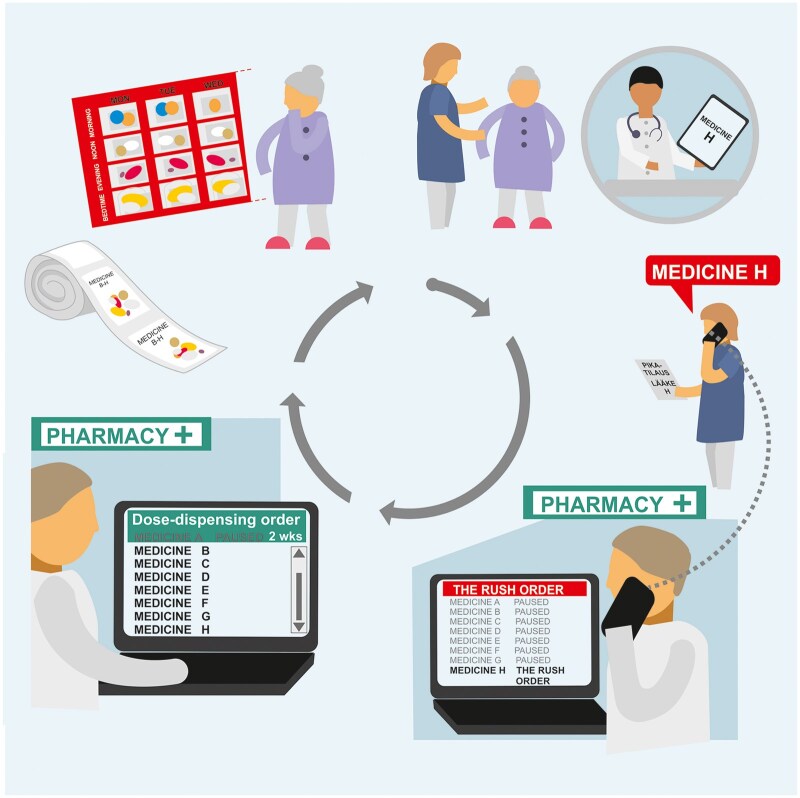 Figure 1
Peer Reviews
No public reviews on file for this paper yet. If you reviewed it on a platform where reviews are public (OpenReview, ICLR, NeurIPS, ICML), you can paste yours below so the community can read it here.
Videos
No videos yet. Explain this paper in a talk, walkthrough, or lecture? Add one.
Taxonomy
TopicsBiomedical Ethics and Regulation · Statistical Methods in Clinical Trials · Pharmaceutical studies and practices
Introduction
Issues related to automation in healthcare and its impact on safety and quality are continuously highly relevant topics [2]. Safety investigations in healthcare provide valuable lessons that help reduce similar incidents in the future [3]. Medication errors (MEs) have received widespread attention in recent decades and are a major concern for healthcare organizations worldwide [4]. Automated dose dispensing (ADD) is a technology-assisted system in which regularly used medicines are machine-packed in unit-dose bags according to administration times [5]. ADD is designed to improve medication safety and support medication management, especially for older home care clients and the elderly with polypharmacy [5–7]. A recent systematic review found that ADD can improve medication safety and quality of care [8]. However, despite its benefits, several types of MEs—such as prescribing errors—still persist. Medical errors can occur at any stage of the medication process, including prescribing, dispensing, administration, or medication follow-up. Dispensing is considered a high-risk activity, mainly due to the heavy workload faced by pharmacists. Although many of these errors are intercepted before reaching the patient, they remain a significant safety concern [6].
Emerging technologies also introduce new safety challenges, highlighting the need to better understand related risks. Another review emphasized that, due to the high costs and complex implementation of ADD, further studies on its cost-effectiveness are needed to guide decision-making [9].
There are several available ADD guidelines providing good practices [10–12]. The guidelines aim to improve ADD quality and reduce errors, encouraging error reporting. However, they lack practical instructions for investigating safety issues in the complex, multi-interface ADD system.
Safety investigation of the omission of a dose-dispensed medicine
The Finnish Safety Investigation Authority examined the omission of a medication in ADD [13]. In this incident, one prescribed medicine was omitted when the order was sent to the dose-dispensing unit (Fig. 1). The safety investigation was challenging due to ADD’s multiple interfaces with healthcare actors and regulators. Investigators also identified a need to explore interactions between healthcare professionals and the ADD system. The nearly year-long investigation included stakeholder hearings, a pharmacy staff survey, and reviews of both supervisory authorities’ work and the ADD system.
An automatic dose-dispensed medicine was omitted after the patient’s existing medications were paused in the system. The vertical list display made it unclear which medicines were paused [1].
During the investigation [1], it was found that 586 pharmacies offer ADD services in Finland. The amount of dose-dispensing units is four. Currently, there are approximately 120,000 ADD customers, and the number of ADD customers is rapidly growing. At the moment, the percentage of elderly patients with multiple medications is estimated to be about 21% of all the ADD customers.
Based on the questionnaire addressed to pharmacists, the high-risk events in the ADD are related medication changes, starting and discontinuing ADD, mixing ADD and regularly dispensed medication and continuing ADD after the patient has visited the outpatient clinic.
The investigation highlighted risks related to ADD of medications, inconsistencies in operational practices, and gaps in legislation. Key national-level findings included a recommendation for the Ministry of Social Affairs and Health to assess the limitations of current information systems and consider legislative changes enabling more detailed regulatory requirements. The Ministry should also facilitate the effective communication of ME reports and lessons learned between pharmacies and well-being services counties, supported by clear procedures. The Finnish Medicines Agency was advised to strengthen pharmacy self-regulation in order to improve medication safety. Additionally, the Ministry should revise the Guide on Good Practices in Patient-specific Dispensing of Medication in collaboration with relevant stakeholders. At the international level, it was recommended to conduct comprehensive safety investigations into dose dispensing events across countries, with shared learning and harmonized development efforts that respect national legislation and practices.
Conclusion
Dose dispensing is one example of a rapidly expanding process in healthcare, and its aim is to enhance both medication safety and cost efficiency [7, 8]. However, it is crucial to recognize the associated risks and allocate resources and time to understand the factors that may compromise patient safety. It is essential to identify and address these risks in ensuring the safe and effective implementation of such systems [3].
ADD of medications is increasingly utilized in healthcare, offering efficiency and safety benefits. However, emerging evidence highlights associated risks, including technical failures, medication selection errors, and insufficient system oversight. Integration challenges with existing healthcare workflows may lead to communication gaps and delays. Moreover, increased reliance on technology can diminish human oversight, potentially allowing errors to go unnoticed. A thorough understanding of these risks is critical in safeguarding patient safety.
The reference list from the paper itself. Each links out to its DOI / PubMed record.
- 1Safety Investigation Authority Finland (SIAF). Omission of a dose-dispensed medicine in Satakunta in the spring 2023. Investigation report 1/2024. https://turvallisuustutkinta.fi/material/sites/otkes/otkes/kg 176qu 5a/T 2023-01_Satakunta_Investigation_report.pdf (2 April 2025, date last accessed).
- 2Chiu YJ. Automated medication verification system (AMVS): system based on edge detection and CNN classification drug on embedded systems. Heliyon 2024;10:e 30486.38742071 10.1016/j.heliyon.2024.e 30486 PMC 11089321 · doi ↗ · pubmed ↗
- 3Halinen M , Tiirinki H, Rauhala A et al Root causes behind patient safety incidents in the emergency department and suggestions for improving patient safety: an analysis in a Finnish teaching hospital. BMC Emerg Med 2024;24:Art. 209.10.1186/s 12873-024-01120-9PMC 1154226339506678 · doi ↗ · pubmed ↗
- 4Panagioti M , Khan K, Keers RN et al Prevalence, severity, and nature of preventable patient harm across medical care settings: systematic review and meta-analysis. BMJ 2019;366:l 4185.31315828 10.1136/bmj.l 4185 PMC 6939648 · doi ↗ · pubmed ↗
- 5Tahvanainen H , Kuitunen S, Holmström AR et al Integrating medication risk management interventions into regular automated dose dispensing service of older home care clients—a systems approach. BMC Geriatr 2021;21:663. 10.1186/s 12877-021-02607-x 34814848 PMC 8609790 · doi ↗ · pubmed ↗
- 6Tu HN , Shan TH, Wu YC et al Reducing medication errors by adopting automatic dispensing cabinets in critical care units. J Med Syst 2023;47:52. 10.1007/s 10916-023-01953-037103718 PMC 10136387 · doi ↗ · pubmed ↗
- 7Martín-Oliveros A , Plaza Zamora J, Monaco A et al Multidose drug dispensing in community healthcare settings for patients with multimorbidity and polypharmacy. Inquiry 2024;61:469580241274268.39373170 10.1177/00469580241274268 PMC 11526267 · doi ↗ · pubmed ↗
- 8Ahtiainen HK , Kallio MM, Airaksinen M et al Safety, time and cost evaluation of automated and semi-automated drug distribution systems in hospitals: a systematic review. Eur J Hosp Pharm 2020;27:253–62.32839256 10.1136/ejhpharm-2018-001791 PMC 7447254 · doi ↗ · pubmed ↗