Seroincidence Rate of Typhoidal Salmonella in Children, Kenya, 2017–2018
Aslam Khan, Polina Kamenskaya, Izabela Rezende, Francis M. Mutuku, Bryson Ndenga, Zainab Jembe, Priscilla Maina, Philip Chebii, Charles Ronga, Victoria Okuta, Denise O. Garrett, Donal Bisanzio, Kristen Aiemjoy, Jason R. Andrews, A. Desiree LaBeaud, Richelle Charles

TL;DR
The study found higher rates of typhoidal Salmonella infection in coastal Kenyan children compared to western Kenya, highlighting the need for better public health measures.
Contribution
The novel use of IgG responses to hemolysin E provided new insights into typhoidal Salmonella seroincidence in Kenyan communities.
Findings
Enteric fever seroincidence was 37/100 person-years in coastal Kenya versus 3.6/100 in western Kenya.
Higher seroincidence was linked to nonpiped water, lower income, and higher population density.
The findings highlight a critical need for typhoid conjugate vaccine introduction in Kenya.
Abstract
Enteric fever, caused by Salmonella enterica serovars Typhi and Paratyphi, results in high rates of illness and death globally. The lack of reliable diagnostic assays limits surveillance, leading to major gaps in understanding the population-level burden in low- and middle-income countries. We applied a novel serologic tool measuring IgG responses to hemolysin E to assess typhoidal Salmonella infection rates in children from 4 communities: 2 in western Kenya (Kisumu and Chulaimbo) and 2 in coastal Kenya (Ukunda and Msambweni). We found a substantially higher enteric fever seroincidence rate in coastal Kenya (37/100 person-years) than in western Kenya (3.6/100 person-years). We found a higher seroincidence rate in households with nonpiped water and lower incomes and in neighborhoods with higher population density. Our findings contribute to Kenya's limited enteric fever surveillance…
Genes, proteins, chemicals, diseases, species, mutations and cell lines named across the full text — each resolved to its canonical identifier and authoritative record.
Click any figure to enlarge with its caption.
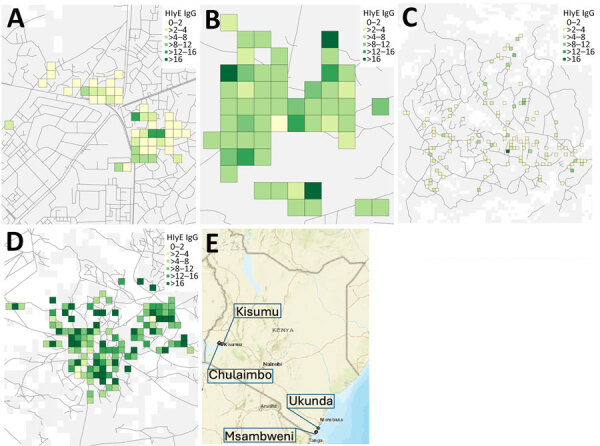 Figure 1
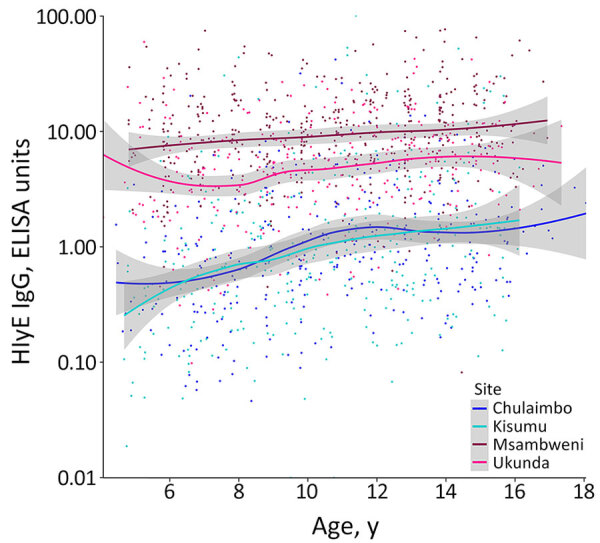 Figure 2
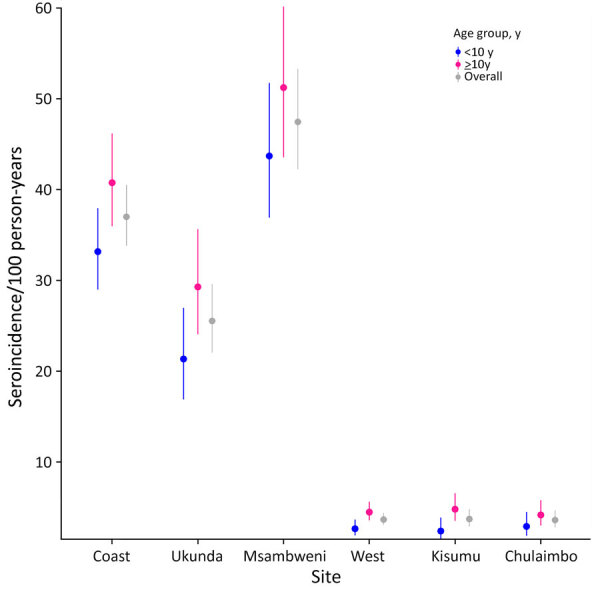 Figure 3
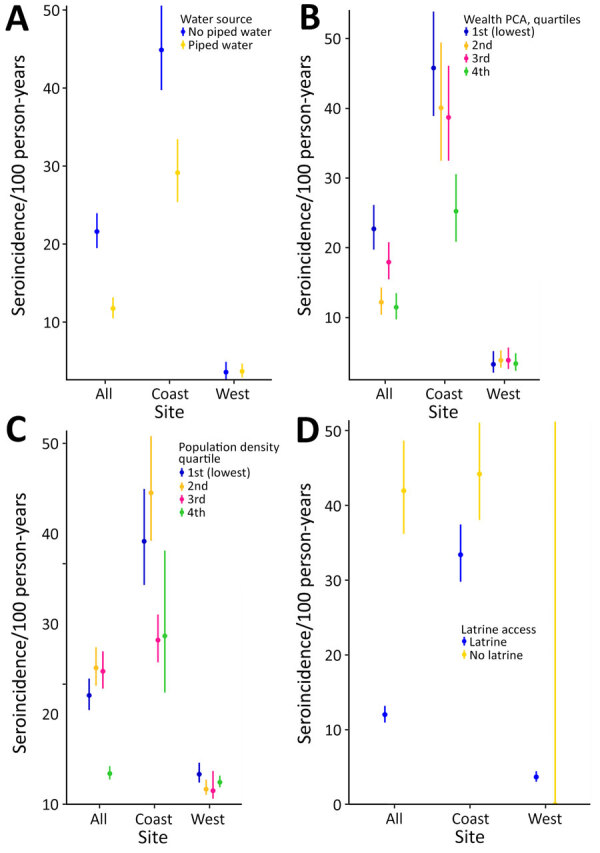 Figure 4
Peer Reviews
No public reviews on file for this paper yet. If you reviewed it on a platform where reviews are public (OpenReview, ICLR, NeurIPS, ICML), you can paste yours below so the community can read it here.
Videos
No videos yet. Explain this paper in a talk, walkthrough, or lecture? Add one.
Taxonomy
TopicsSalmonella and Campylobacter epidemiology · Diphtheria, Corynebacterium, and Tetanus · Bacterial Infections and Vaccines