Lymphocytic Choriomeningitis Virus Seroprevalence among Urban Pregnant Women and Newborns, Philadelphia, Pennsylvania, USA, 2021
Dustin D. Flannery, Caitlin M. Cossaboom, Timothy D. Flietstra, Alvaro Zevallos Barboza, Heather H. Burris, Karen M. Puopolo, Aridth Gibbons, Deborah L. Cannon, Inna Krapiunaya, Leanna Sayyad, Katrin S. Sadigh, Kami Smith, Joel M. Montgomery, Trevor Shoemaker, John D. Klena

TL;DR
This study found a low but notable LCMV seroprevalence among urban pregnant women in Philadelphia, highlighting the risk of rodent-borne infections during pregnancy.
Contribution
The study provides new seroprevalence data for LCMV in urban pregnant populations and identifies risk factors like neighborhood deprivation.
Findings
LCMV IgG seroprevalence was 2.4% in high-risk and 2.7% in randomly selected pregnant women.
Seroprevalence varied by hospital site, maternal race or ethnicity, and neighborhood deprivation level.
All maternal LCMV IgM tests were negative, and 37 fetuses with neurologic malformations were LCMV seronegative.
Abstract
Lymphocytic choriomeningitis virus (LCMV) is a globally distributed rodentborne pathogen that can cause severe congenital infections. We conducted a retrospective cross-sectional seroepidemiologic study using remnant serum samples from pregnant women and newborns at 2 hospitals in Philadelphia, Pennsylvania, USA. We tested samples for LCMV IgG and IgM in 3 phases: a high-risk group determined by neighborhood deprivation index scores, a random sample of all birthing women, and a group with prenatally diagnosed neurologic malformations. We found LCMV IgG seroprevalence was 2.4% among 700 high-risk and 2.7% among 300 randomly selected pregnant women. Seroprevalence varied by hospital site, maternal race or ethnicity, and neighborhood deprivation level. All seropositive maternal samples were IgM-negative. Thirty-seven pregnant women carrying fetuses with neurologic malformations were…
Genes, proteins, chemicals, diseases, species, mutations and cell lines named across the full text — each resolved to its canonical identifier and authoritative record.
Click any figure to enlarge with its caption.
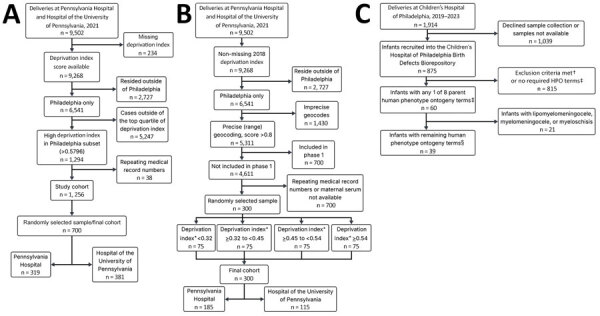 Figure 1
Peer Reviews
No public reviews on file for this paper yet. If you reviewed it on a platform where reviews are public (OpenReview, ICLR, NeurIPS, ICML), you can paste yours below so the community can read it here.
Videos
No videos yet. Explain this paper in a talk, walkthrough, or lecture? Add one.
Taxonomy
TopicsPolyomavirus and related diseases · Viral Infections and Outbreaks Research · Respiratory viral infections research