Two Cases of Posttraumatic Kosakonia Infection, Argentina, 2023
Claudia Barberis, Maria Sol Haim, Paula Zomero, Germán Traglia, Alejandro Ellis, Roxana Cittadini, Tomás Poklépovich, Marisa Almuzara, Carlos Vay

TL;DR
Two cases of plant-related bacterial infections in Argentina were identified using genome sequencing, showing its importance in diagnosing rare pathogens.
Contribution
Demonstrates the effectiveness of whole-genome sequencing in identifying emerging Kosakonia species in clinical settings.
Findings
Whole-genome sequencing identified K. cowanii and K. oryzae as causative agents.
Biochemical and MALDI-TOF MS methods had limitations in identifying the pathogens.
Genomics is crucial for detecting underestimated emerging pathogens.
Abstract
We describe 2 plant-associated posttraumatic Kosakonia infections in Argentina. Facing biochemical and matrix-assisted laser desorption/ionization time-of-flight mass spectrometry limitations, we used whole-genome sequencing to successfully identify K. cowanii and K. oryzae as the causative agents. Our data highlight the crucial role of genomics in correctly identifying these underestimated emerging pathogens.
Genes, proteins, chemicals, diseases, species, mutations and cell lines named across the full text — each resolved to its canonical identifier and authoritative record.
Click any figure to enlarge with its caption.
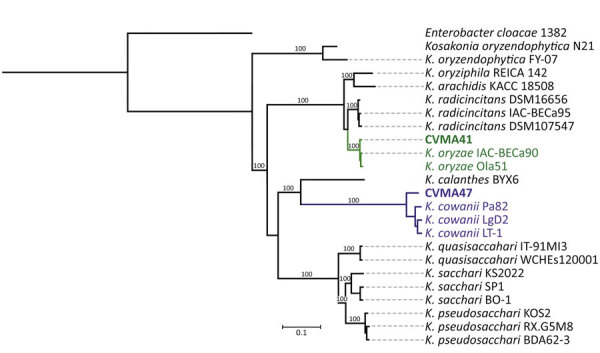 Figure 1
Peer Reviews
No public reviews on file for this paper yet. If you reviewed it on a platform where reviews are public (OpenReview, ICLR, NeurIPS, ICML), you can paste yours below so the community can read it here.
Videos
No videos yet. Explain this paper in a talk, walkthrough, or lecture? Add one.
Taxonomy
TopicsMyxozoan Parasites in Aquatic Species · Advanced Synthetic Organic Chemistry · Infections and bacterial resistance