Testing a dominance-region hypothesis for interaural time discrimination using off-frequency maskers
Richard L. Freyman, Benjamin H. Zobel, Patrick M. Zurek

TL;DR
This study tested if a specific hearing region affects how well people detect time differences between sounds in each ear.
Contribution
The study tested a novel hypothesis about how hearing sensitivity to sound timing is affected by a specific frequency region.
Findings
Masking around 700 Hz did not significantly reduce sensitivity to higher-frequency sound timing differences.
The dominance-region hypothesis was not supported by the experimental results.
Abstract
This study evaluated a recent proposal that the steep roll-off in fine structure–based sensitivity to interaural time delay (ITD-FS) between 1.2 and 1.5 kHz could be because of diminishing spread of excitation to a dominance region around 700 Hz. Experiment 1 measured the effects of interaurally uncorrelated masking noise lowpass filtered at 800 Hz on ITD-FS sensitivity for higher-frequency tones. Experiment 2 investigated the complementary configuration, with tones lower in frequency than the masking noise. In neither experiment was it found that masking the region around 700 Hz was especially effective in reducing ITD-FS discriminability at other frequencies.
Genes, proteins, chemicals, diseases, species, mutations and cell lines named across the full text — each resolved to its canonical identifier and authoritative record.
Click any figure to enlarge with its caption.
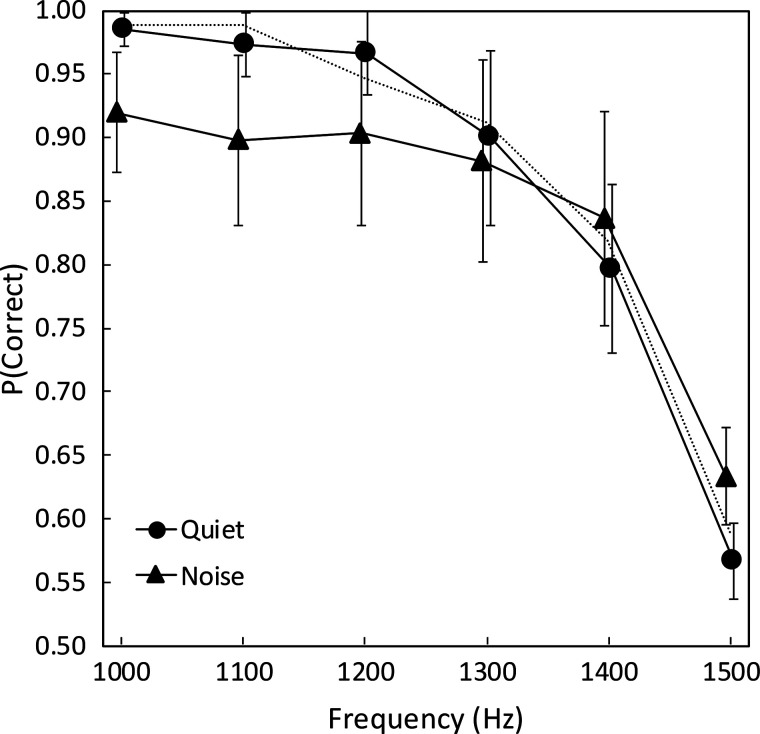 Figure 1
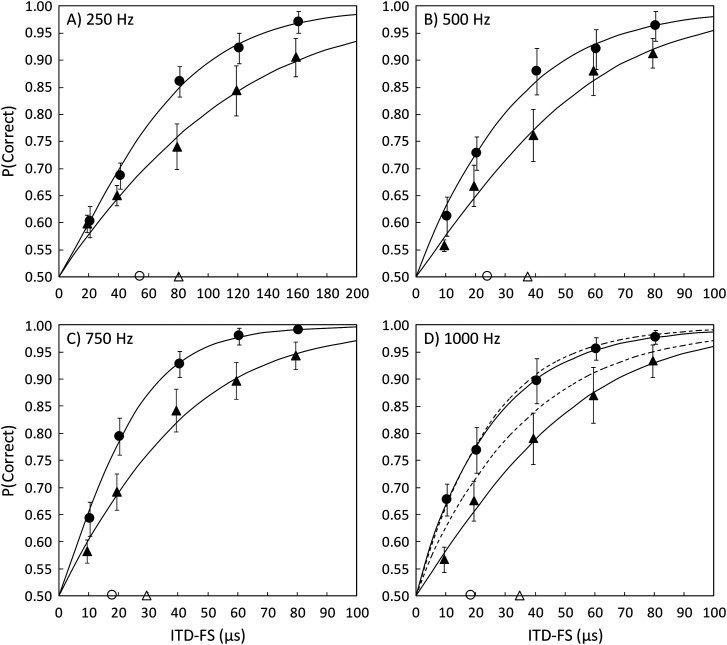 Figure 2
Peer Reviews
No public reviews on file for this paper yet. If you reviewed it on a platform where reviews are public (OpenReview, ICLR, NeurIPS, ICML), you can paste yours below so the community can read it here.
Videos
No videos yet. Explain this paper in a talk, walkthrough, or lecture? Add one.
Taxonomy
TopicsHearing Loss and Rehabilitation · Aerodynamics and Acoustics in Jet Flows · Machine Fault Diagnosis Techniques