The human amygdala in threat learning and extinction
Sjoerd Meijer, Eleonora Carpino, Benjamin R. Kop, Jesse Lam, Lycia D. de Voogd, Karin Roelofs, Lennart Verhagen

TL;DR
This study shows that the human amygdala is crucial for forming lasting threat memories and that targeting it with ultrasound can alter these processes.
Contribution
The study provides causal evidence that the human amygdala is essential for forming threat memories resistant to extinction.
Findings
Amygdala stimulation slowed initial threat acquisition and increased extinction.
Amygdala stimulation modulated memory of threat probability.
TUS offers potential for neuromodulation in disorders involving persistent threat memories.
Abstract
Here, we resolve the long-standing but unconfirmed hypothesis that the human amygdala is essential for rapidly acquiring cued-conditioned threat responses. We provide causal evidence for the amygdala’s contribution to forming threat memories that are resistant to extinction. Using transcranial ultrasound stimulation (TUS), a noninvasive technique that modulates deep brain structures with high spatial and temporal precision, we targeted the bilateral amygdala during Pavlovian threat conditioning in healthy adults. Linear mixed-effects models and computational modeling of trial-level skin conductance responses revealed that amygdala-TUS (experiment I, n = 25), but not hippocampus-TUS (experiment II, n = 25), selectively slowed initial threat acquisition, augmented subsequent extinction, and modulated declarative memory of retrospective threat probability. These findings demonstrate that…
Genes, proteins, chemicals, diseases, species, mutations and cell lines named across the full text — each resolved to its canonical identifier and authoritative record.
Click any figure to enlarge with its caption.
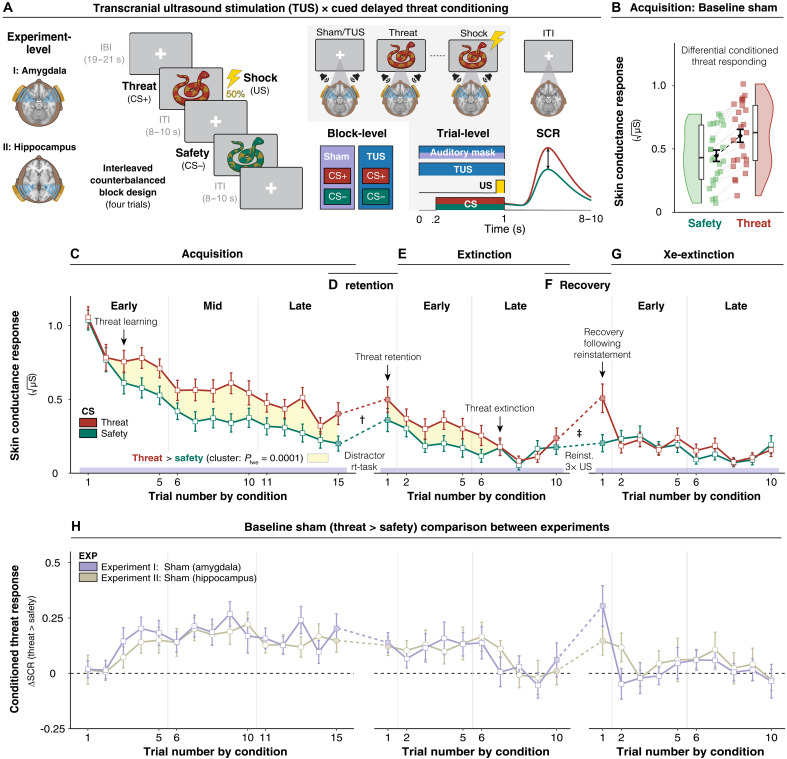 Figure 1
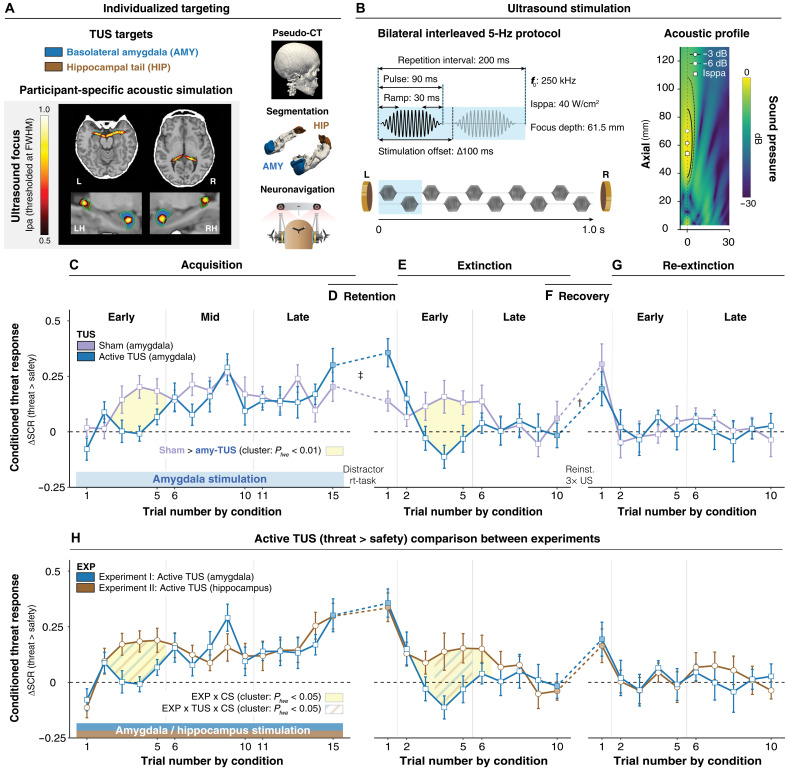 Figure 2
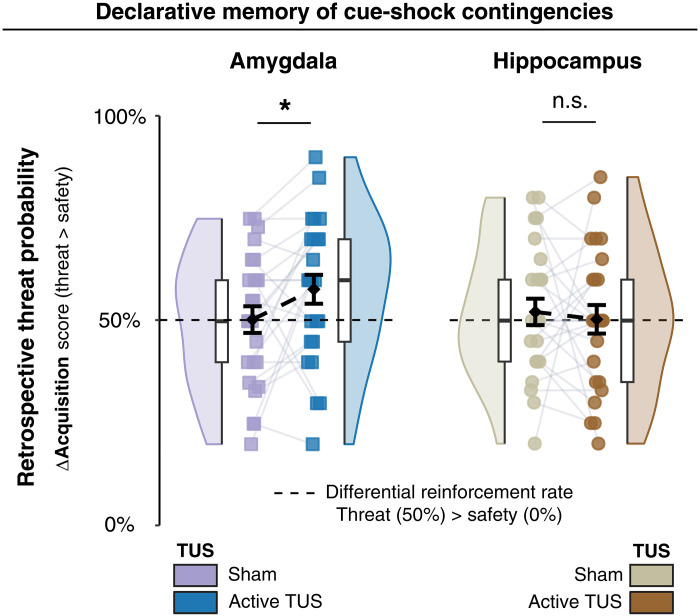 Figure 3
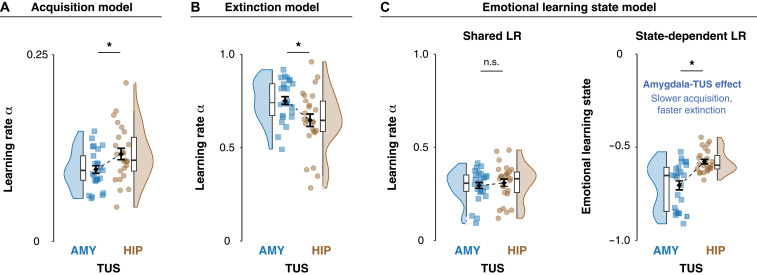 Figure 4
Peer Reviews
No public reviews on file for this paper yet. If you reviewed it on a platform where reviews are public (OpenReview, ICLR, NeurIPS, ICML), you can paste yours below so the community can read it here.
Videos
No videos yet. Explain this paper in a talk, walkthrough, or lecture? Add one.
Taxonomy
TopicsMemory and Neural Mechanisms · Virtual Reality Applications and Impacts · Traumatic Brain Injury Research