Peer bullying victimisation and depressive symptoms as serial mediators between attention‐deficit/hyperactivity disorder symptoms and internet gaming disorder among Chinese adolescents: A three‐wave longitudinal study
Pu Peng, Zhangming Chen, Silan Ren, Ying He, Jinguang Li, Aijun Liao, Linlin Zhao, Xu Shao, Shanshan Chen, Ruini He, Yudiao Liang, Youguo Tan, Xiaogang Chen, Jinsong Tang, Yanhui Liao

TL;DR
This study shows that ADHD symptoms in Chinese adolescents can lead to internet gaming disorder through peer bullying and depression, with these effects varying by sex and age.
Contribution
The study is the first to show that peer bullying and depressive symptoms sequentially mediate the ADHD-internet gaming disorder link in adolescents.
Findings
ADHD symptoms predict IGD severity both directly and indirectly through peer bullying and depression.
Peer bullying's role is stronger in boys and early adolescents, while depression mediates across all groups.
The findings support the dual failure and compensatory internet use models in explaining the ADHD-IGD relationship.
Abstract
The association between attention‐deficit/hyperactivity disorder (ADHD) symptoms and internet gaming disorder (IGD) is well‐established, yet the psychological mechanisms underlying this comorbidity remain underexplored. Grounded in the dual failure model and the compensatory internet use model, this study examined peer bullying victimisation and depressive symptoms as serial mediators in the longitudinal association between ADHD symptoms and IGD severity among 20 137 Chinese adolescents. Participants were assessed at baseline (T1, November 2020) and followed up at one (T2) and two years (T3). Standardised measures assessed peer bullying victimisation (Multidimensional Peer Victimisation Scale), ADHD symptoms (Strengths and Difficulties Questionnaire), depressive symptoms (9‐item Patient Health Questionnaire) and IGD severity (Internet Gaming Disorder Scale–Short Form). Longitudinal…
Genes, proteins, chemicals, diseases, species, mutations and cell lines named across the full text — each resolved to its canonical identifier and authoritative record.
Click any figure to enlarge with its caption.
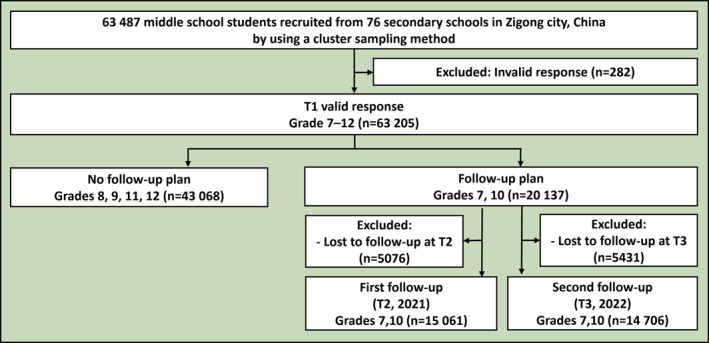 Figure 1
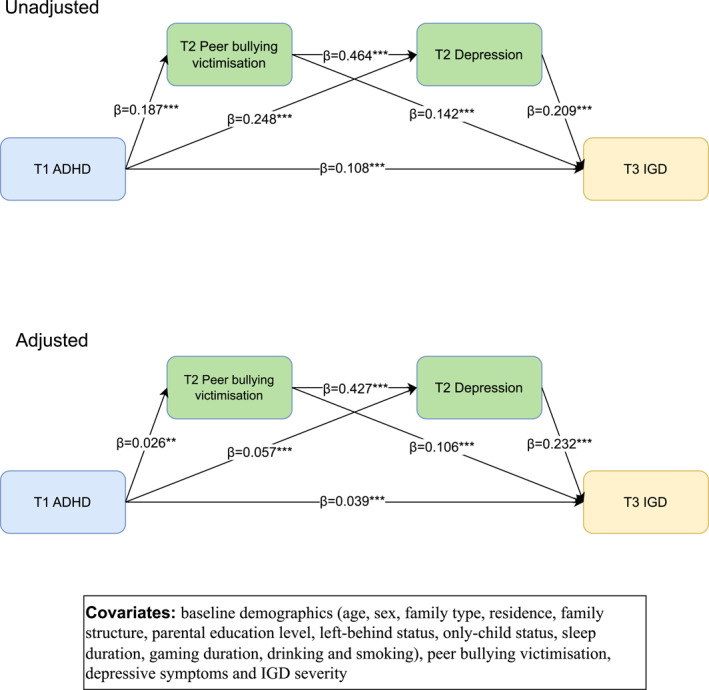 Figure 2
Peer Reviews
No public reviews on file for this paper yet. If you reviewed it on a platform where reviews are public (OpenReview, ICLR, NeurIPS, ICML), you can paste yours below so the community can read it here.
Videos
No videos yet. Explain this paper in a talk, walkthrough, or lecture? Add one.
Taxonomy
TopicsImpact of Technology on Adolescents · Bullying, Victimization, and Aggression · Attention Deficit Hyperactivity Disorder