The International, Prospective COSMOS (CytOSorb® TreatMent Of Critically Ill PatientS) Registry: Interim Results in Patients with Septic Shock
Ricard Ferrer, Thomas Kirschning, Moritz Unglaube, Ulf Guenther, Julian Kreutz, Matthias Thielmann, Andreas Baumann, Andreas Kribben, Dietrich Henzler, Nuno Germano, Aschraf El-Essawi, Filippo Aucella, Thomas Guenther, Martin Bellgardt, Bartosz Tyczynski, P. Christian Schulze

TL;DR
This study shows that CytoSorb® treatment in septic shock patients leads to early clinical improvements like better fluid balance and hemodynamic stability.
Contribution
The paper presents interim real-world data on CytoSorb® use in septic shock, highlighting its clinical benefits and safety profile.
Findings
CytoSorb® therapy significantly reduced IL-6 levels, noradrenaline requirements, and fluid balance in septic shock patients.
The treatment improved oxygenation and showed system-specific improvements in SOFA scores for respiratory, cardiovascular, and renal functions.
Despite a significant drop in platelet count, no serious device-related adverse effects were reported.
Abstract
The international prospective COSMOS Registry (NCT05146336) collects real-world data on CytoSorb® (CS) hemoadsorption utilization patterns and outcomes in critically ill patients. This analysis focuses on patients with septic shock. Following informed consent, data was systematically collected before, during, and after CS treatment. Time frame of data collection was from the initiation of COSMOS study enrollment (July 15, 2022) to date of data extraction (May 7, 2025). Study follow-up extended to 90 days. We compared details on vasopressor requirements, fluid balance, and P/F ratio before and after CS treatment. APACHE II was assessed at ICU admission, while SOFA scores were determined at the start and end of CS therapy. Safety of the device was assessed based on investigator-reported device-related adverse effects. Data are presented as either mean ± standard deviation or as median…
Genes, proteins, chemicals, diseases, species, mutations and cell lines named across the full text — each resolved to its canonical identifier and authoritative record.
Click any figure to enlarge with its caption.
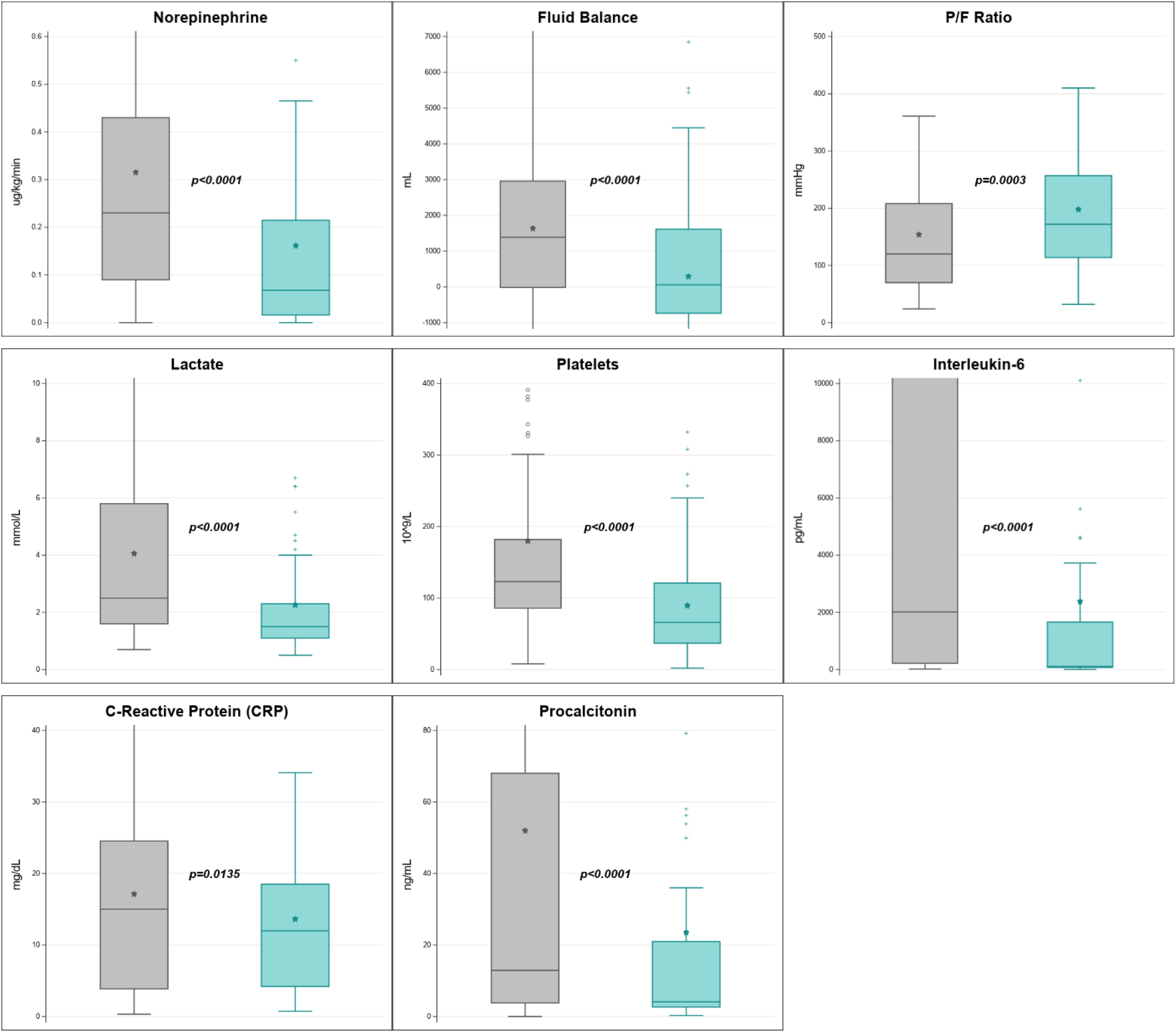 Figure 1
Peer Reviews
No public reviews on file for this paper yet. If you reviewed it on a platform where reviews are public (OpenReview, ICLR, NeurIPS, ICML), you can paste yours below so the community can read it here.
Videos
No videos yet. Explain this paper in a talk, walkthrough, or lecture? Add one.
Taxonomy
TopicsSepsis Diagnosis and Treatment · Adrenal Hormones and Disorders · Immune Response and Inflammation