Amyloid-linked versus age-driven copathologies in Alzheimer’s dementia: differential associations with APOE ε4
Íñigo Rodríguez-Baz, Lidia Vaqué-Alcázar, Lucía Maure-Blesa, Lucía Pertierra, Javier Arranz Martinez, Laura Molina-Porcel, Iban Aldecoa, Naomi Ferreira, Regina Paradela, Laura Videla, Isabel Barroeta, María Carmona-Iragui, Ma Belén Sánchez-Saudinós, Judit Selma-González

TL;DR
APOE ε4 is linked to amyloid-related brain pathologies in Alzheimer’s dementia, while other issues are driven by aging, not APOE.
Contribution
APOE ε4 selectively amplifies amyloid-related pathology, particularly cerebral amyloid angiopathy, while other copathologies are age-driven and APOE-independent.
Findings
Cerebral amyloid angiopathy shows a strong ε4 dose-response effect.
Arteriolosclerosis and atherosclerosis risks increase with age, independent of APOE.
TDP-43 pathology progression is age-related with minimal APOE dependence.
Abstract
The mechanisms by which apolipoprotein E (APOE) drives copathologies in established Alzheimer’s disease (AD) dementia via amyloid-dependent versus age-driven pathways remain unresolved. Analyzing data from 11,897 autopsied individuals from the National Alzheimer’s Coordinating Center, with copathology analyses restricted to amyloid-positive AD dementia, we show that APOE effects followed two distinct trajectories. Cerebral amyloid angiopathy exhibited a striking ε4 dose-response (OR = 5.76, 95% CI: 4.20–7.96, p < 0.001; for ε4/ε4 compared to ε3/ε3), whereas arteriolosclerosis and atherosclerosis risk increased with age, independent of APOE haplotype. Lewy body pathology showed modest APOE associations restricted to limbic/amygdalar-predominant forms and was related to dementia duration, suggesting AD-mediated secondary synucleinopathy. TDP-43 pathology was associated with chronological…
Genes, proteins, chemicals, diseases, species, mutations and cell lines named across the full text — each resolved to its canonical identifier and authoritative record.
Click any figure to enlarge with its caption.
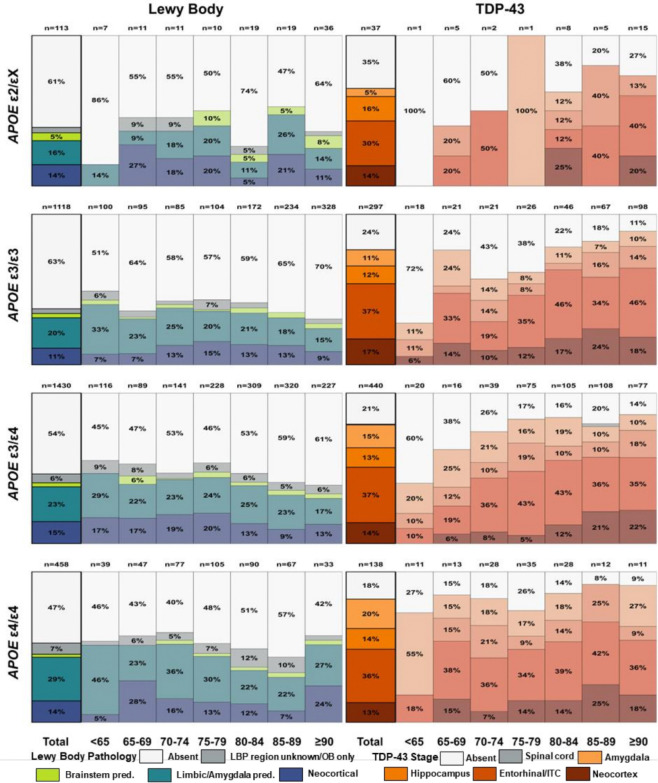 Figure 1
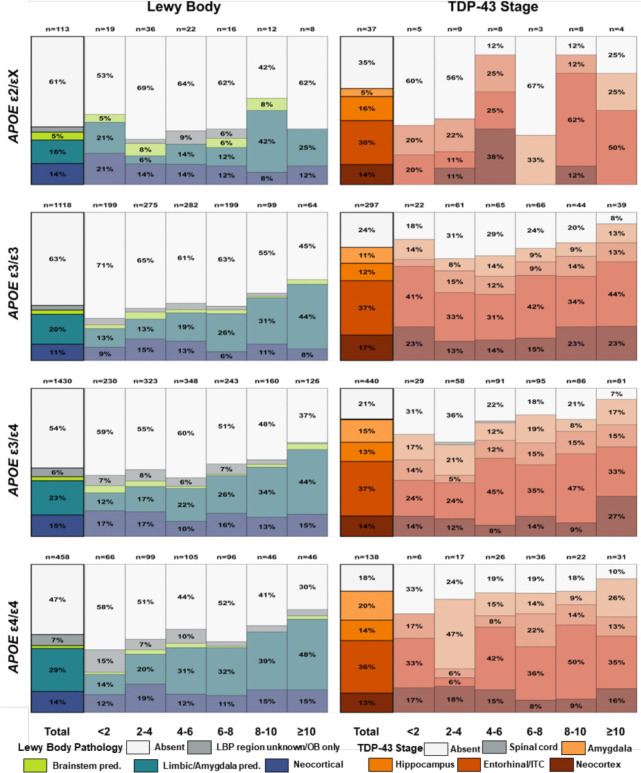 Figure 2
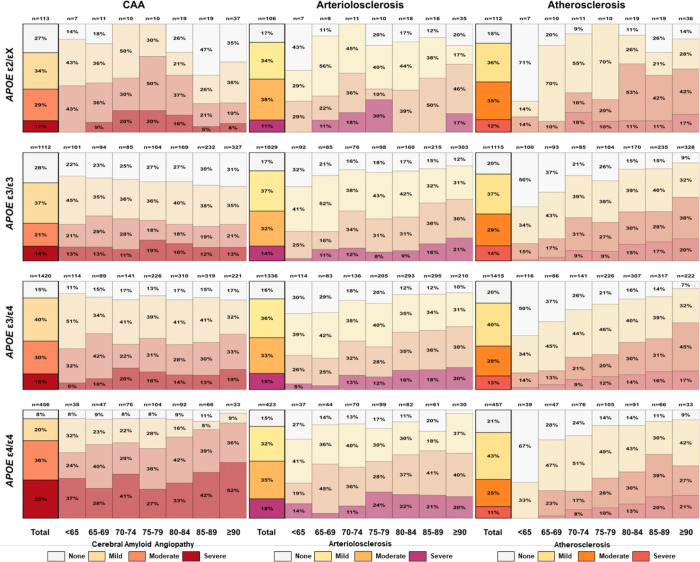 Figure 3
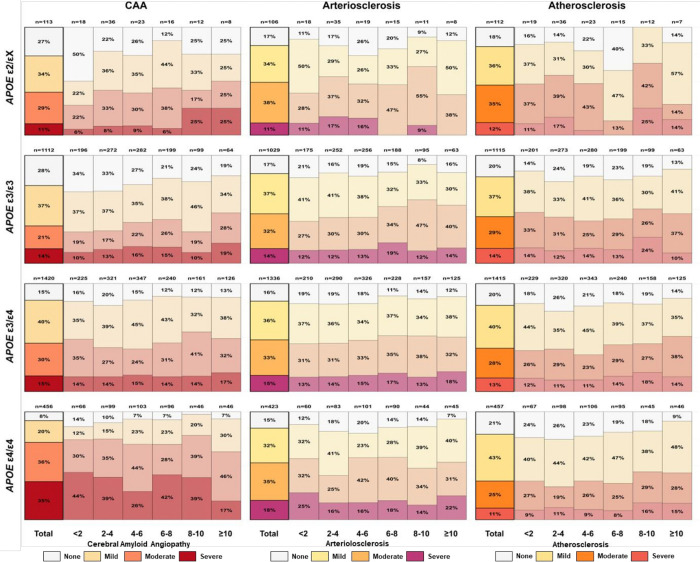 Figure 4
Peer Reviews
No public reviews on file for this paper yet. If you reviewed it on a platform where reviews are public (OpenReview, ICLR, NeurIPS, ICML), you can paste yours below so the community can read it here.
Videos
No videos yet. Explain this paper in a talk, walkthrough, or lecture? Add one.
Taxonomy
TopicsDementia and Cognitive Impairment Research · Alzheimer's disease research and treatments · Intracerebral and Subarachnoid Hemorrhage Research