Artificial Intelligence–Driven Electrocardiogram Screening for Asymptomatic Left Ventricular Systolic Dysfunction in the General Population
Tae-Min Rhee, Sora Kang, Min Sung Lee, Ga In Han, Ah-Hyun Yoo, Jong-Hwan Jang, Yong-Yeon Jo, Jeong Min Son, Joon-myoung Kwon, Su-Yeon Choi, Hak Seung Lee, Heesun Lee

TL;DR
An AI model using ECGs can accurately detect early heart issues in the general population, potentially preventing heart failure.
Contribution
An AI model (AiTiALVSD) achieves high diagnostic accuracy for asymptomatic left ventricular systolic dysfunction in a large screening population.
Findings
The AiTiALVSD model achieved an AUROC of 0.973 and a sensitivity of 90.6% for detecting LVSD.
The model outperformed existing HF risk scores like MESA and Pooled Cohort Equations in discrimination metrics.
Simulation suggested 1,841 ECGs and 13 TTEs would be needed to detect one case of LVSD in low-prevalence populations.
Abstract
Asymptomatic left ventricular systolic dysfunction (LVSD) is a well-established precursor of overt heart failure (HF), yet it often remains undiagnosed in the general population. Artificial intelligence–enabled electrocardiogram (ECG) analysis offers a scalable approach for early detection. The purpose of this study was to evaluate the diagnostic performance of an artificial intelligence–enabled ECG model (AiTiALVSD) for identifying asymptomatic LVSD in a large health screening population. In this retrospective, single-center study, we evaluated the AiTiALVSD model among 40,713 self-referred adults who underwent a total of 60,711 ECG-transthoracic echocardiography (TTE) pairs between 2011 and 2023. LVSD was defined as a left ventricular ejection fraction ≤40%. Model discrimination was assessed using the area under the receiver-operating characteristic curve (AUROC) and the area under…
Genes, proteins, chemicals, diseases, species, mutations and cell lines named across the full text — each resolved to its canonical identifier and authoritative record.
Click any figure to enlarge with its caption.
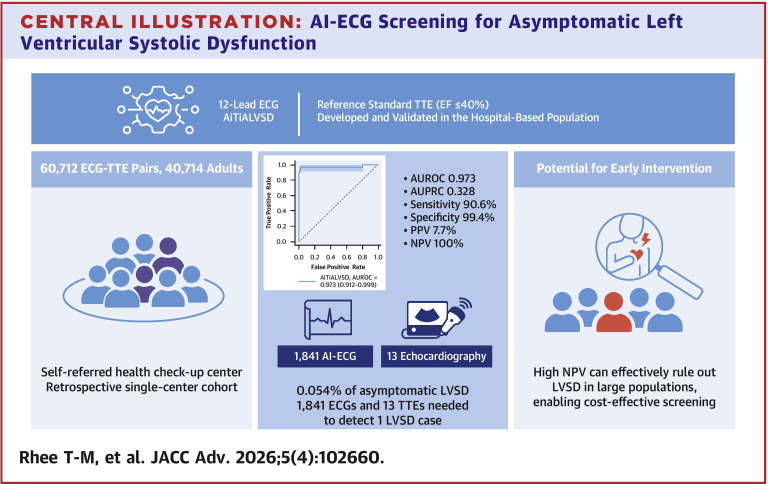 Figure 1
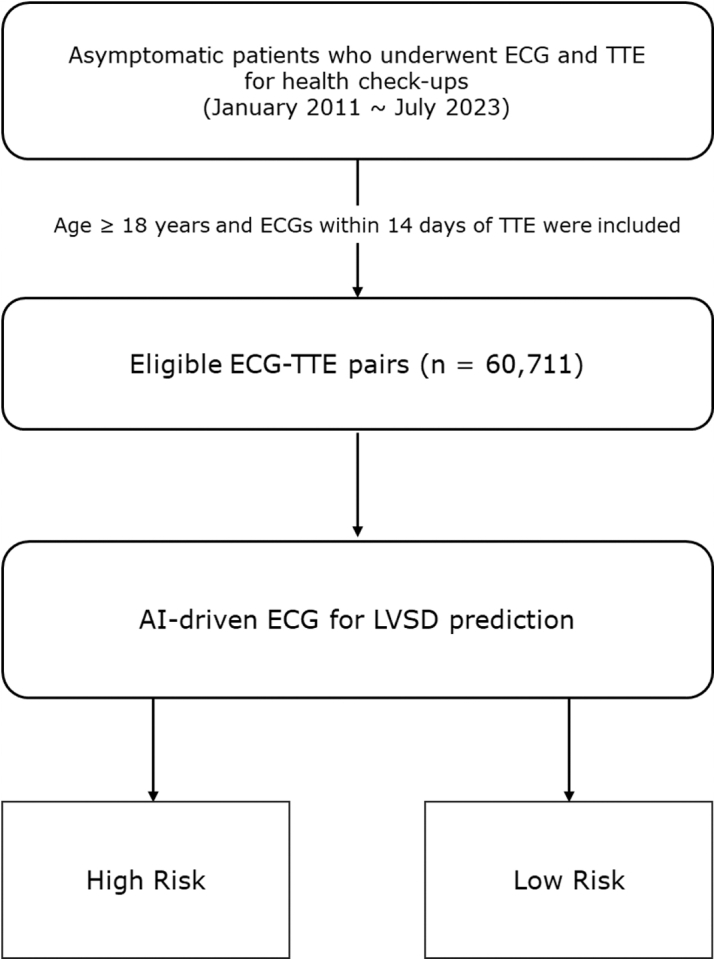 Figure 2
 Figure 3
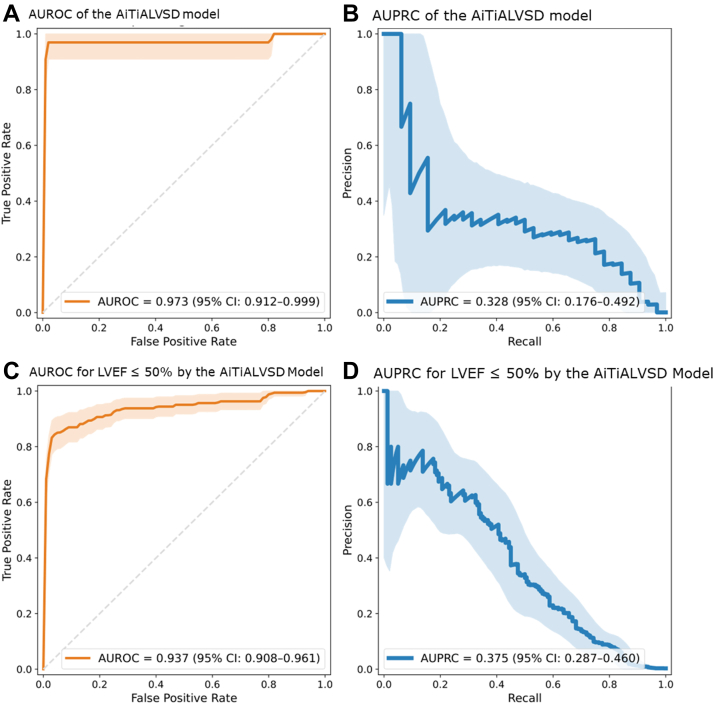 Figure 4
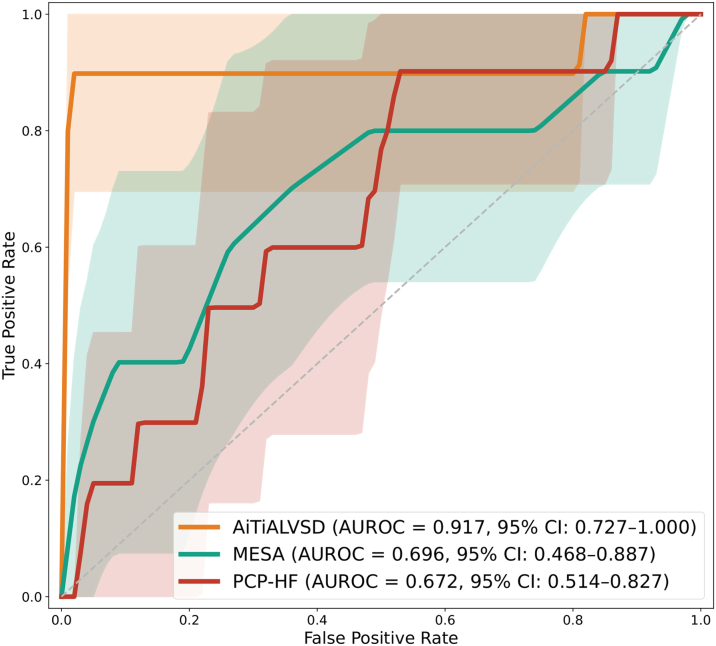 Figure 5
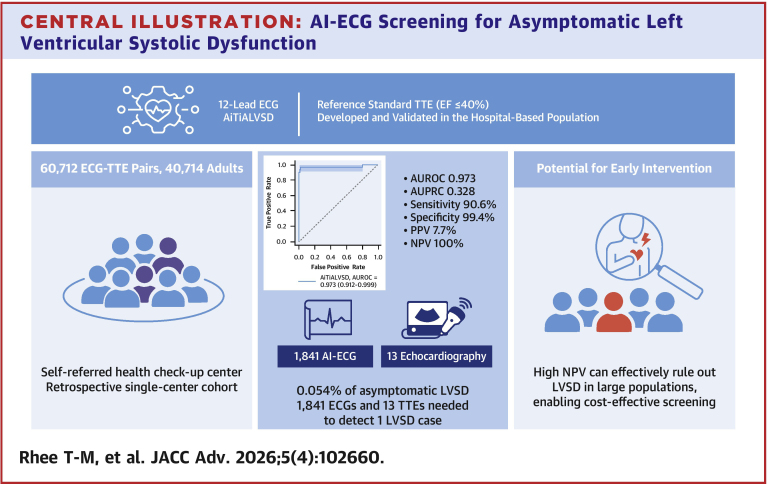 Figure 6
Peer Reviews
No public reviews on file for this paper yet. If you reviewed it on a platform where reviews are public (OpenReview, ICLR, NeurIPS, ICML), you can paste yours below so the community can read it here.
Videos
No videos yet. Explain this paper in a talk, walkthrough, or lecture? Add one.
Taxonomy
TopicsECG Monitoring and Analysis · Cardiovascular Function and Risk Factors · Cardiac electrophysiology and arrhythmias