Evaluation of immunohistochemical and gene expression of Janus kinase1 and Janus kinase3 in the skin of different clinical types of mycosis fungoides patients – Part II: reverse transcriptase–polymerase chain reaction
Heba Saed El-Amawy, Basma Mourad Mohamed Ali, Mohamed Labib Salem, Lamia Elgarhy

TL;DR
This study found that JAK1 and JAK3 genes are overactive in skin samples from mycosis fungoides patients, suggesting they may contribute to the disease and could be targets for treatment.
Contribution
The study provides new evidence on the role of JAK1 and JAK3 gene expression in different stages of mycosis fungoides.
Findings
JAK1 and JAK3 were significantly upregulated in lesional MF skin compared to healthy controls.
JAK1 showed higher upregulation in early-stage MF than JAK3.
The findings suggest JAK1 and JAK3 inhibitors could be potential treatments for MF.
Abstract
Mycosis Fungoides (MF) is the commonest type of primary cutaneous T-Cell lymphomas representing about 50% of all lymphomas arising primarily in the skin. Janus kinases are non-receptor intracellular tyrosine kinases that play an important role in the pathogenesis of variant skin disorders and several hematological malignancies. The aim of this study was to investigate the gene expression of Janus Kinase-1 (JAK1) and Janus Kinase-3 (JAK3) in the skin of different types of MF patients using Real-time Quantitative Reverse Transcription Polymerase Chain Reaction (RT-PCR). The current study included 53 patients with MF, and 53 control samples. RT-PCR for JAK1 and JAK3 was done in the skin specimens obtained from patients and controls. Both JAK1 and JAK3 fold changes showed stepwise upregulation in lesional MF skin than normal control skin, with statistically significant increase in MF…
Genes, proteins, chemicals, diseases, species, mutations and cell lines named across the full text — each resolved to its canonical identifier and authoritative record.
Click any figure to enlarge with its caption.
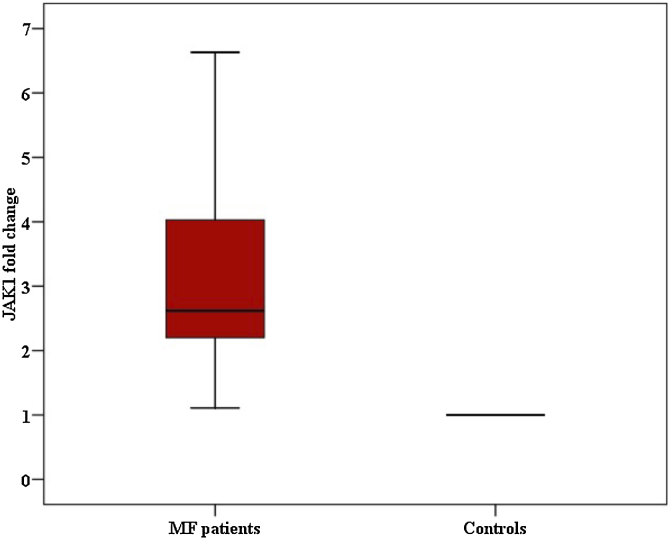 Figure 1
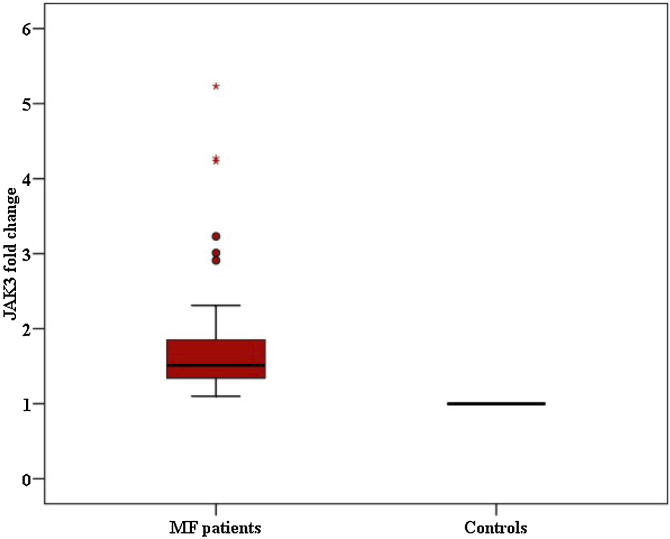 Figure 2
Peer Reviews
No public reviews on file for this paper yet. If you reviewed it on a platform where reviews are public (OpenReview, ICLR, NeurIPS, ICML), you can paste yours below so the community can read it here.
Videos
No videos yet. Explain this paper in a talk, walkthrough, or lecture? Add one.
Taxonomy
TopicsCutaneous lymphoproliferative disorders research · Lymphoma Diagnosis and Treatment · CNS Lymphoma Diagnosis and Treatment