Current perspectives in sudden unexpected death in epilepsy (SUDEP): epidemiology, research approaches and pathways to prevention
Catrin Mann, Susanne Schubert-Bast, Felix Rosenow, Adam Strzelczyk

TL;DR
SUDEP is a major cause of death in epilepsy patients, with risk factors like frequent seizures and living alone, and research is ongoing to understand and prevent it.
Contribution
This review summarizes current SUDEP research, identifies risk factors, and highlights recent insights into potential mechanisms and biomarkers.
Findings
SUDEP affects approximately 1 in 1,000 epilepsy patients annually, with higher rates in those with severe epilepsy.
Frequent bilateral tonic–clonic seizures, living alone, and drug-resistant epilepsy are established risk factors.
Recent studies suggest brainstem dysfunction and sleep disruption may contribute to SUDEP mechanisms.
Abstract
People with epilepsy (PWE) are affected not only by the unpredictability of seizures, the risk of accidents, stigma, and comorbidities, but also by increased mortality. The most common directly epilepsy‑associated cause of death is sudden unexpected death in epilepsy patients (SUDEP). Across all PWE, SUDEP affects approximately 1 in 1,000 patients per year; depending on epilepsy severity, the annual SUDEP rate can exceed 10 per 1,000 patient years. Because many PWE live with the disorder for several decades, the cumulative SUDEP risk amounts to an average lifetime risk of 5–20%, rendering SUDEP a relevant contributor to mortality in PWE; however, considering its comparatively low annual incidence, SUDEP research remains challenging. Established risk factors and associated patient characteristics include frequent bilateral tonic–clonic seizures (BTCS) -especially when nocturnal-, living…
Genes, proteins, chemicals, diseases, species, mutations and cell lines named across the full text — each resolved to its canonical identifier and authoritative record.
Click any figure to enlarge with its caption.
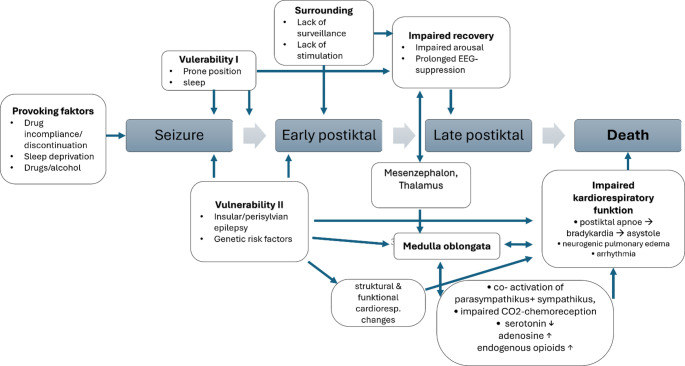 Figure 1
Peer Reviews
No public reviews on file for this paper yet. If you reviewed it on a platform where reviews are public (OpenReview, ICLR, NeurIPS, ICML), you can paste yours below so the community can read it here.
Videos
No videos yet. Explain this paper in a talk, walkthrough, or lecture? Add one.
Taxonomy
TopicsEpilepsy research and treatment · Pharmacological Effects and Toxicity Studies · EEG and Brain-Computer Interfaces