Riboflavin Deficiency Is Highly Prevalent in Females and Children across High and Low/Middle Income Countries Worldwide
Liadhan McAnena, Mary Ward, Adrian McCann, Kristina Pentieva, Leane Hoey, Ryan Barlow, Harry R Jarrett, Maeve A Kerr, JJ Strain, Catherine Hughes, Albert Flynn, Janette Walton, Yvonne Lamers, Parveen Bhatti, Crystal D Karakochuk, Kyly C Whitfield, Michelle Murphy

TL;DR
This study finds that riboflavin deficiency is common in women and children globally, with higher rates in low/middle-income countries, highlighting the need for public health interventions.
Contribution
The study provides the first global comparative analysis of riboflavin deficiency using a functional biomarker across high- and low/middle-income countries.
Findings
Over 48% of unsupplemented females in Ireland and the UK had riboflavin deficiency.
Children in low/middle-income countries had riboflavin deficiency rates of 39% to 75%.
Ugandan children aged 5–17 y showed severe deficiency with median EGRac of 1.77.
Abstract
Riboflavin, as flavin mononucleotide and flavin adenine dinucleotide, is essential for numerous metabolic pathways. However, the prevalence of riboflavin deficiency worldwide remains unclear, because status biomarkers are very rarely measured in human studies. This study aimed to investigate riboflavin status in females of reproductive age and children from several regions of the world, representing both high-income countries and low/middle-income countries (HICs and LMICs). We measured riboflavin status in population-representative samples from Ireland, United Kingdom, Cambodia, and Democratic Republic of the Congo, and in cohort samples from HICs (Northern Ireland, Spain, Canada) and LMICs (Malaysia, Lao People’s Democratic Republic, Cambodia, Uganda) using the functional assay, erythrocyte glutathione reductase activation coefficient (EGRac), with higher values indicating lower…
Genes, proteins, chemicals, diseases, species, mutations and cell lines named across the full text — each resolved to its canonical identifier and authoritative record.
Click any figure to enlarge with its caption.
 Figure 1
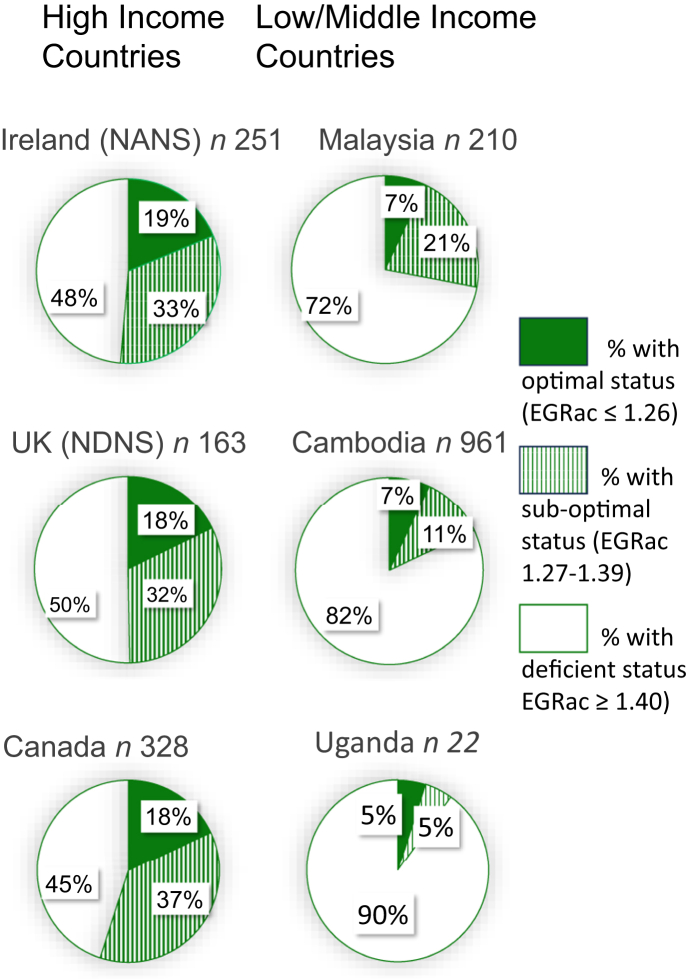 Figure 2
Peer Reviews
No public reviews on file for this paper yet. If you reviewed it on a platform where reviews are public (OpenReview, ICLR, NeurIPS, ICML), you can paste yours below so the community can read it here.
Videos
No videos yet. Explain this paper in a talk, walkthrough, or lecture? Add one.
Taxonomy
TopicsFolate and B Vitamins Research · Metabolism and Genetic Disorders · Fatty Acid Research and Health