Associations of baseline characteristics, patient-reported outcomes, and satisfaction with pain therapy with the patient's global impression of change: a prospective cohort study
Lydia Roper, Joletta Belton, Claudia Weinmann, Dominique Fletcher, Patricia Lavand'homme, Eija Kalso, Winfried Meissner, Daniela Constanze Rosenberger, Daniel Segelcke, Jan Vollert, Esther Miriam Pogatzki-Zahn

TL;DR
This study explores how various patient-reported outcomes and satisfaction with pain therapy influence a patient's overall impression of change after surgery.
Contribution
The study identifies pain intensity as the most significant factor affecting global impression of change, while highlighting the role of self-efficacy and adverse events.
Findings
Pain intensity contributed 55% to the patient's global impression of change (PGIC).
Anxiety, preoperative pain, and low treatment satisfaction were associated with less improvement after surgery.
Receiving information about treatment was linked to greater improvement in PGIC.
Abstract
Patient-reported outcome measures (PROMs) are key elements of assessing the efficacy of perioperative pain management. Here, we aimed to capture the association of 10 individually reported aspects of patient's specific impression of change since surgery (PSIC) related to four outcome domains of a previously defined core outcome set, relative to the patient's global impression of change (PGIC). We further evaluated the influence of type of surgery, sex, preoperative baseline characteristics, and satisfaction with pain management on PGIC. This exploratory analysis used the PROMPT NIT-1 study data (2661 patients, 18 sites, four surgery types: total knee arthroplasty, sternotomy, breast cancer surgery, or endometriosis surgery). Male and female adults were included. All PROMs were assessed on postoperative day 3. We used ordinal regression models with PGIC as a dependent variable and PSICs…
Genes, proteins, chemicals, diseases, species, mutations and cell lines named across the full text — each resolved to its canonical identifier and authoritative record.
Click any figure to enlarge with its caption.
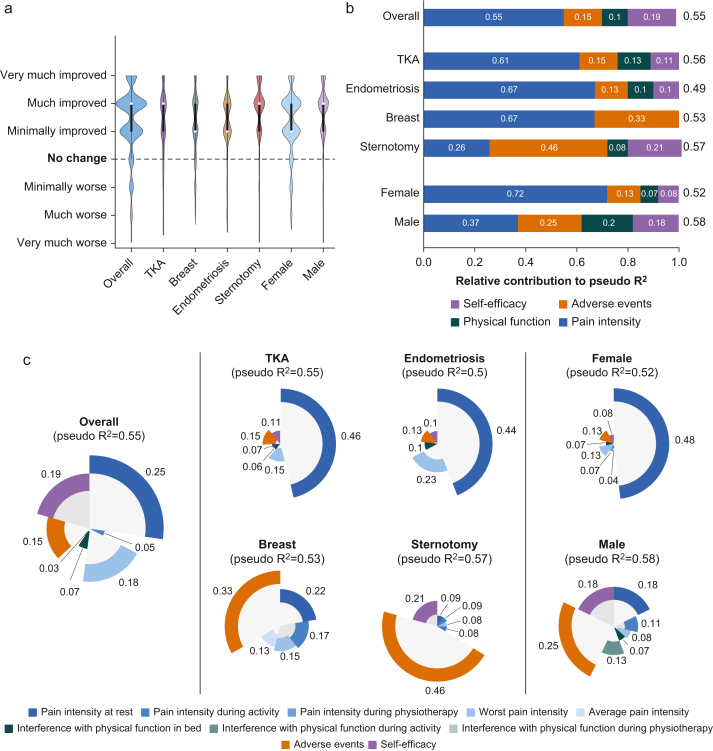 Figure 1
Peer Reviews
No public reviews on file for this paper yet. If you reviewed it on a platform where reviews are public (OpenReview, ICLR, NeurIPS, ICML), you can paste yours below so the community can read it here.
Videos
No videos yet. Explain this paper in a talk, walkthrough, or lecture? Add one.
Taxonomy
TopicsPain Management and Opioid Use · Opioid Use Disorder Treatment · Musculoskeletal pain and rehabilitation