Electron Pool Enrichment of Polyhedral Carboranes: A Key to Isomerization and Nucleophilicity
Vlastimil Němec, Josef Holub, Maksim A. Samsonov, Zdeňka Růžičková, Josef Cvačka, Jan Vrána, Aleš Růžička

TL;DR
This paper introduces a new method for modifying carboranes using carbenes, enabling isomerization and altering their reactivity.
Contribution
A novel method for carborane isomerization and functionalization using carbene reactivity is presented.
Findings
Carbene reactions with closo-1,2-C2B8H10 produce arachno-shaped carboranes with unique reactivity.
Dihydrogen elimination and C–C bond cleavage occur at low temperatures in these carboranes.
Carbene-carborane adducts undergo hydrogen-induced redox changes and chlorination.
Abstract
Carboranes are inorganic clusters exhibiting 3D aromaticity, which imparts exceptional thermal stability, low electrophilicity, and a large HOMO–LUMO gap. The isomerization of carboranes at ambient temperature remains, in many cases, a synthetic challenge. In this work, we present a new method based on the reactivity of closo-1,2-C2B8H10 with various types of carbenes. Such reactions yield arachno-shaped carboranes, which undergo facile dihydrogen elimination at low temperatures, accompanied by C–C bond cleavage and migration of the carbon atoms. These compounds react in the reverse manner compared to common neutral boranes, and their basicity is governed by the electronic parameters of the coordinated carbene molecules. Treatment with hydrogen chloride can thus leave the neutral carborane intact or protonate it once or even twice. The doubly protonated carboranes immediately undergo…
Genes, proteins, chemicals, diseases, species, mutations and cell lines named across the full text — each resolved to its canonical identifier and authoritative record.
Click any figure to enlarge with its caption.
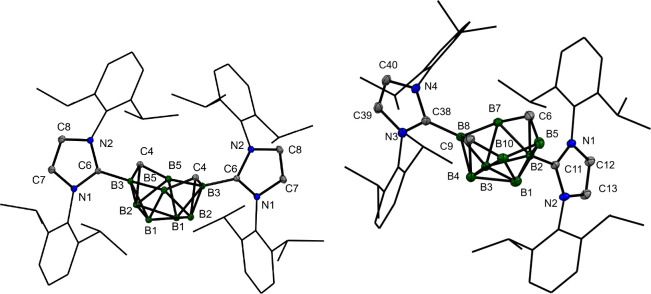 Figure 1
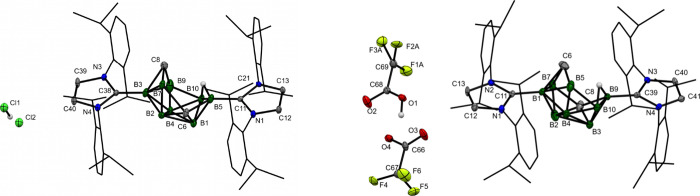 Figure 2
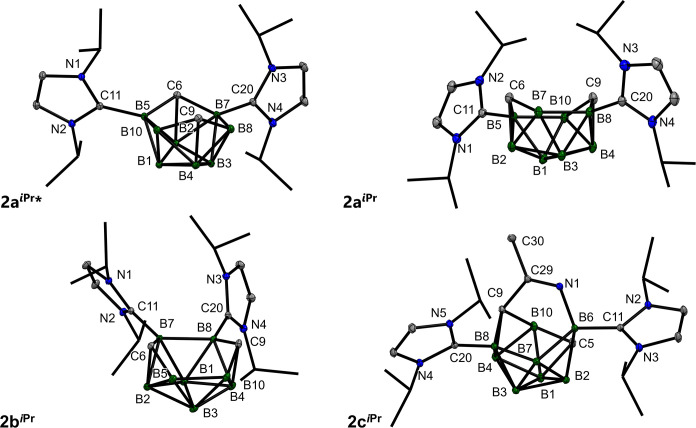 Figure 3
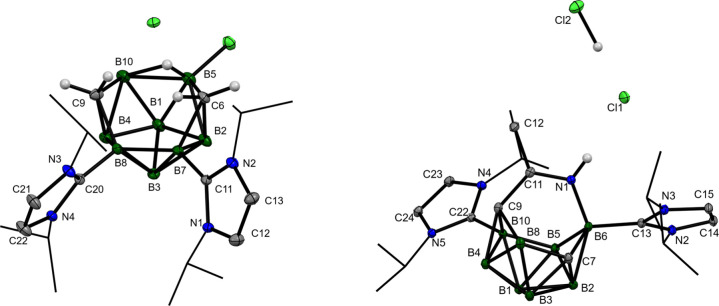 Figure 4
 Figure 5
 Figure 6
 Figure 7
 Figure 8
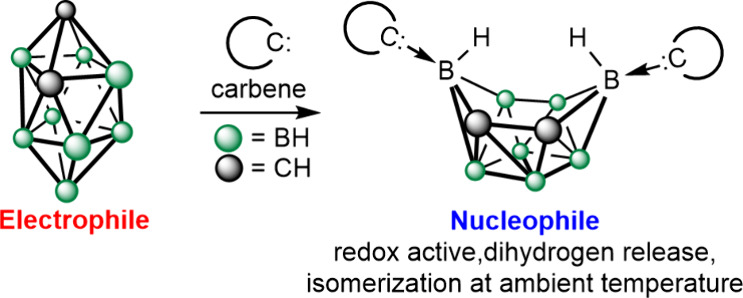 Figure 9
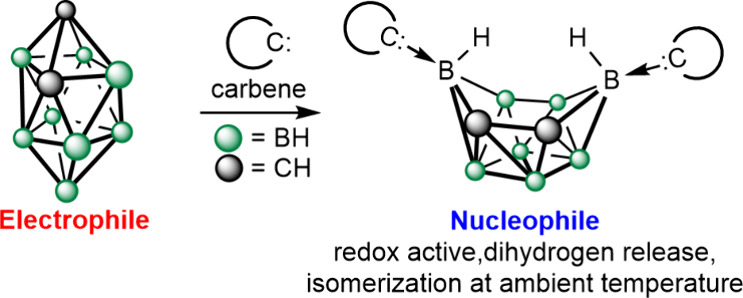 Figure 10
Peer Reviews
No public reviews on file for this paper yet. If you reviewed it on a platform where reviews are public (OpenReview, ICLR, NeurIPS, ICML), you can paste yours below so the community can read it here.
Videos
No videos yet. Explain this paper in a talk, walkthrough, or lecture? Add one.
Taxonomy
TopicsBoron Compounds in Chemistry · Supramolecular Chemistry and Complexes · Crystallography and molecular interactions