The critical role of surface dipoles in CsPbI3 perovskite solar cells
Ran Ji, Nathaniel Gallop, Shivam Singh, Richard Beier, Yitian Du, Zongbao Zhang, Fulya Koc, Marielle Deconinck, Vladimir Shilovskikh, Jose Roberto Bautista-Quijano, Boris Rivkin, Yana Vaynzof

TL;DR
This paper shows that surface dipoles in CsPbI3 perovskite solar cells significantly impact performance and stability, with efficiency increasing from 10% to 20%.
Contribution
The study reveals that surface dipoles formed by modifying surface stoichiometry strongly influence device performance and stability.
Findings
Modifying the Cs:Pb ratio in the top 1 nm of CsPbI3 creates surface dipoles that alter the work function by over 2 eV.
Surface dipoles increase power conversion efficiency from below 10% to ∼20%.
High-performing devices with strong dipoles degrade more rapidly, affecting stability.
Abstract
Interfacial modification is a key strategy for improving the performance of perovskite photovoltaic devices. However, most commonly, improvements in device performance through surface treatments of the perovskite active layer are attributed to defect passivation. At the same time, such treatments may also lead to the formation of a dipole at the surface of the perovskite active layer. In this work, we demonstrate that treatments that modify the surface stoichiometry of CsPbI3 perovskites can lead to effective defect passivation, yet result in the formation of surface dipoles of opposing directions that modulate the work function of CsPbI3 over a range of more than 2 eV. Such dipoles influence the built-in potential of the devices and the efficiency of interfacial charge transfer in CsPbI3 solar cells, resulting in power conversion efficiencies that increase from below 10% to ∼20%…
Genes, proteins, chemicals, diseases, species, mutations and cell lines named across the full text — each resolved to its canonical identifier and authoritative record.
Click any figure to enlarge with its caption.
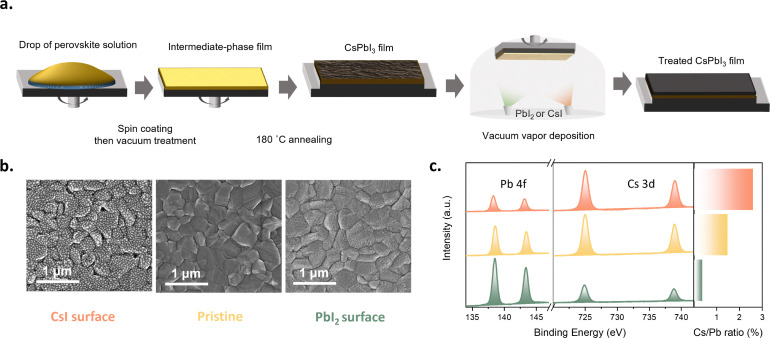 Figure 1
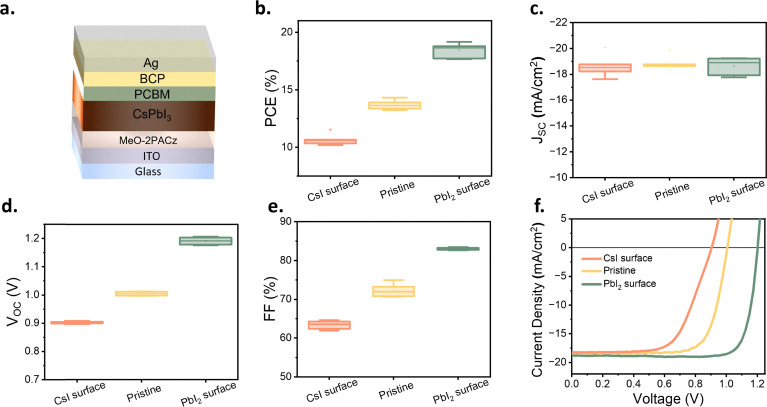 Figure 2
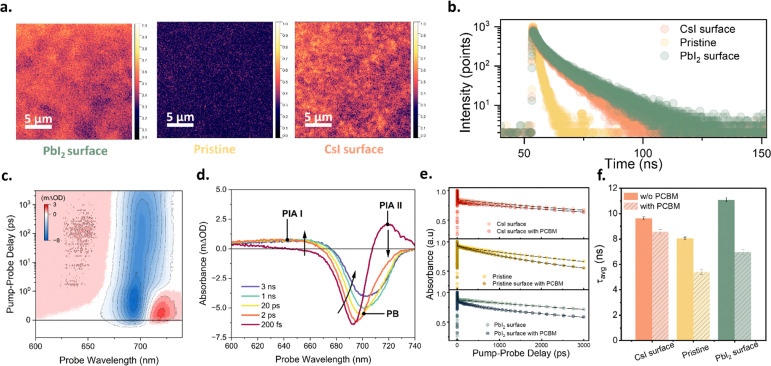 Figure 3
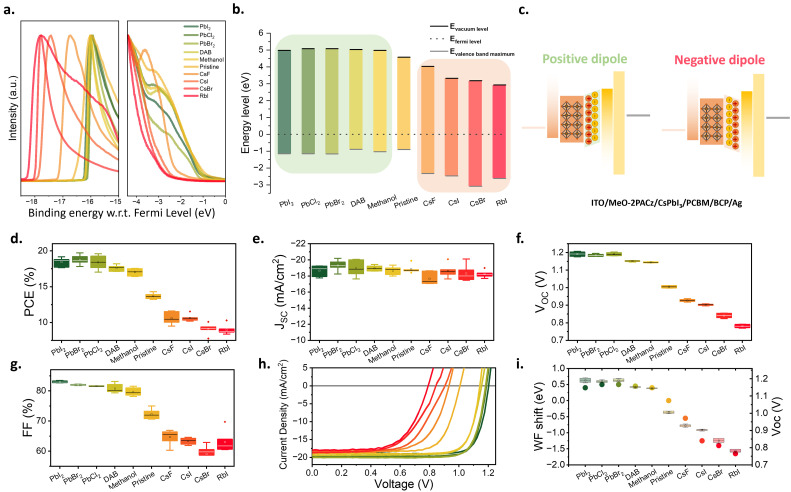 Figure 4
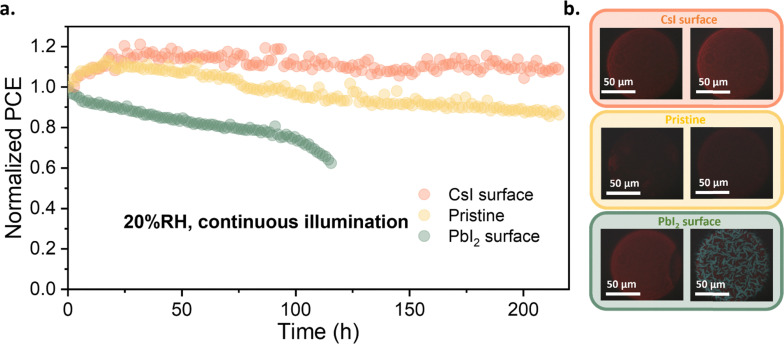 Figure 5
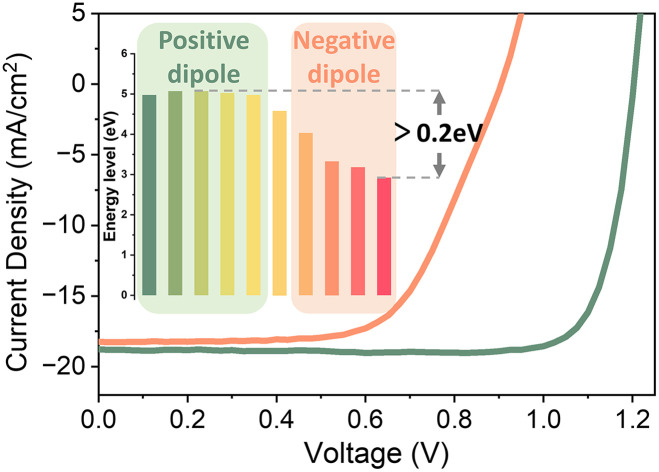 Figure 6
 Figure 7
Peer Reviews
No public reviews on file for this paper yet. If you reviewed it on a platform where reviews are public (OpenReview, ICLR, NeurIPS, ICML), you can paste yours below so the community can read it here.
Videos
No videos yet. Explain this paper in a talk, walkthrough, or lecture? Add one.
Taxonomy
TopicsPerovskite Materials and Applications · Chemical and Physical Properties of Materials · Chalcogenide Semiconductor Thin Films