Craniospinal cerebrospinal fluid volume changes after extreme bilateral frontotemporoparietal craniectomy and cranioplasty: a volumetric magnetic resonance imaging case report
Sergej Mihailovič Marasanov, Milan Radoš, Filip Njavro, Miroslav Vukić, Ivana Jurjević, Marijan Klarica

TL;DR
A patient with severe brain injury showed increased cerebrospinal fluid volume after skull reconstruction, supporting new theories about fluid dynamics in the brain.
Contribution
This case provides in vivo evidence supporting modern CSF physiology models through volumetric craniospinal imaging after cranioplasty.
Findings
Cranial and spinal CSF volumes increased by 64.7 mL after cranioplasty without changes in brain tissue volume.
The findings align with the Bulat-Klarica-Orešković hypothesis of integrated neurofluid dynamics.
Quantitative volumetry after cranioplasty may help guide treatment timing in decompressive craniectomy patients.
Abstract
We report on an 18-year-old woman who sustained severe traumatic brain injury in a traffic accident. The resulting refractory intracranial hypertension required emergency bilateral frontotemporoparietal decompressive craniectomies, which left a large bilateral skull defect. Postoperatively, she developed a bilateral sinking skin flap syndrome, consistent with atmospheric pressure-driven collapse of the cranial compartment. She underwent full neuraxis 3D craniospinal imaging before and three months after elective bilateral cranioplasty using custom implants. Pre-cranioplasty volumetric assessment showed cranial cerebrospinal fluid (CSF) volume of 100.8 mL and spinal CSF volume of 78.2 mL (179.0 mL total). After cranioplasty, cranial CSF volume increased to 152.7 mL and spinal CSF volume to 91.1 mL (243.7 mL total), with an overall CSF net gain of 64.7 mL without relevant change in brain…
Genes, proteins, chemicals, diseases, species, mutations and cell lines named across the full text — each resolved to its canonical identifier and authoritative record.
Click any figure to enlarge with its caption.
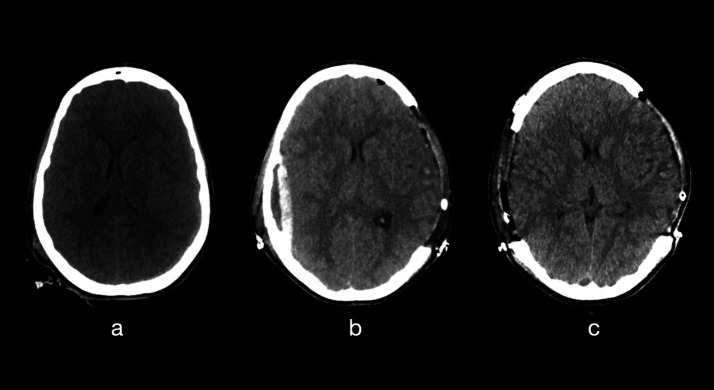 Figure 1
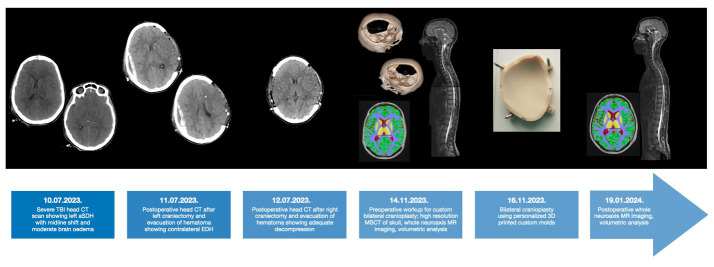 Figure 2
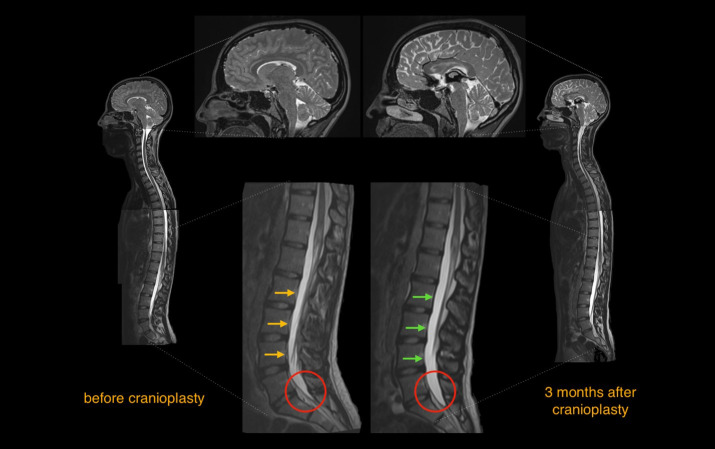 Figure 3
Peer Reviews
No public reviews on file for this paper yet. If you reviewed it on a platform where reviews are public (OpenReview, ICLR, NeurIPS, ICML), you can paste yours below so the community can read it here.
Videos
No videos yet. Explain this paper in a talk, walkthrough, or lecture? Add one.
Taxonomy
TopicsTraumatic Brain Injury and Neurovascular Disturbances · Cerebrospinal fluid and hydrocephalus · Head and Neck Surgical Oncology