Covalency of M–N Bonds in Isomorphous Lanthanide and Actinide 5‑(2-Pyridyl)‑1H‑tetrazolate Complexes
Zhuanling Bai, Madeline C. Martelles, Qiang Gao, Nicholas B. Beck, Jacob P. Brannon, Joseph M. Sperling, Thomas E. Albrecht

TL;DR
This study compares the bonding in lanthanide and actinide complexes with a nitrogen-donor ligand, finding that actinide bonds show more covalent character.
Contribution
The paper reveals how bonding differences arise in actinide complexes due to changes in orbital interactions and energy degeneracy.
Findings
Actinide–nitrogen bond lengths are shorter than lanthanide analogs, indicating greater covalency.
Orbital contributions to An–N bonding show decreasing 5f participation and increasing 7s involvement from Pu³⁺ to Cm³⁺.
Energy degeneracy between 5f and 2p orbitals increases, counteracting 5f orbital contraction in the actinide series.
Abstract
Experimental and computational analyses of [M(pdtz)3(H2O)3]·3.5H2O (M3+ = Pu3+–Cm3+, La3+–Nd3+, and Sm3+–Ho3+, pdtz– = 5-(2-pyridyl)-1H-tetrazolate) were conducted to understand potential differences in bonding between lanthanide and actinide complexes with a N-donor ligand. Structural analyses show that the An–N bond distances in the Pu3+, Am3+, and Cm3+ complexes are within error of one another. Whereas in the lanthanide series, there is a nearly linear decrease in the Ln–N bond lengths from La3+ to Ho3+ (excluding Pm3+). The An–N bond lengths are ∼0.015 Å shorter than their similarly-sized lanthanide analogs, in agreement with computational results that suggest greater covalent character in these bonds versus those with lanthanides. QTAIM analysis indicates that the An–N orbital mixing remains essentially unchanged from Pu3+ to Cm3+, consistent with the nearly identical An–N bond…
Genes, proteins, chemicals, diseases, species, mutations and cell lines named across the full text — each resolved to its canonical identifier and authoritative record.
Click any figure to enlarge with its caption.
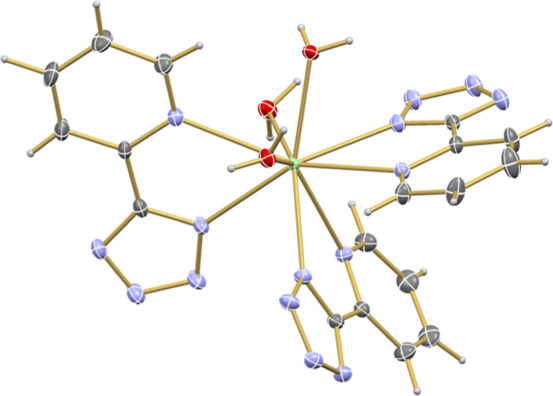 Figure 1
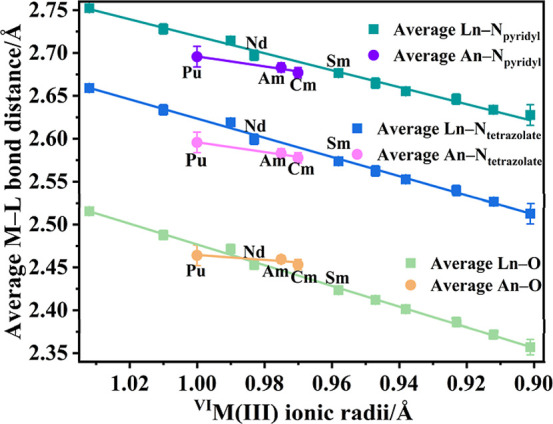 Figure 2
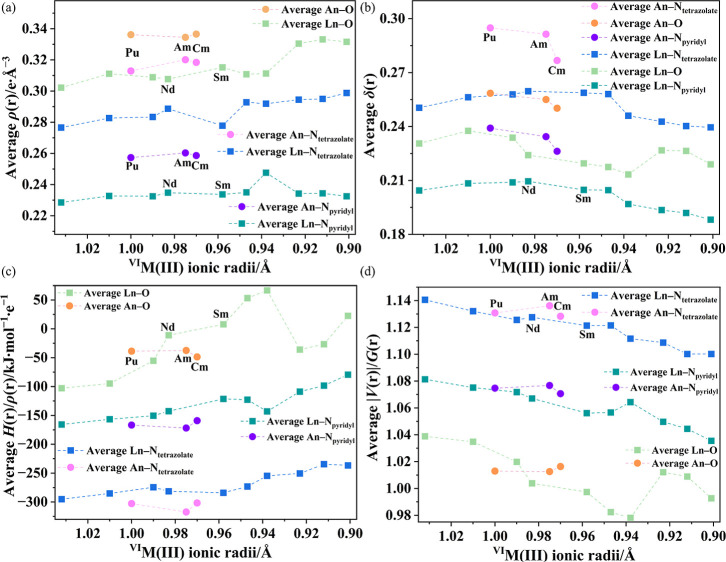 Figure 3
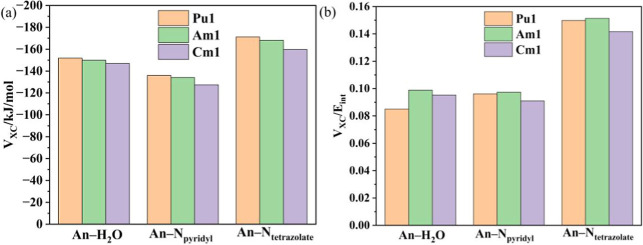 Figure 4
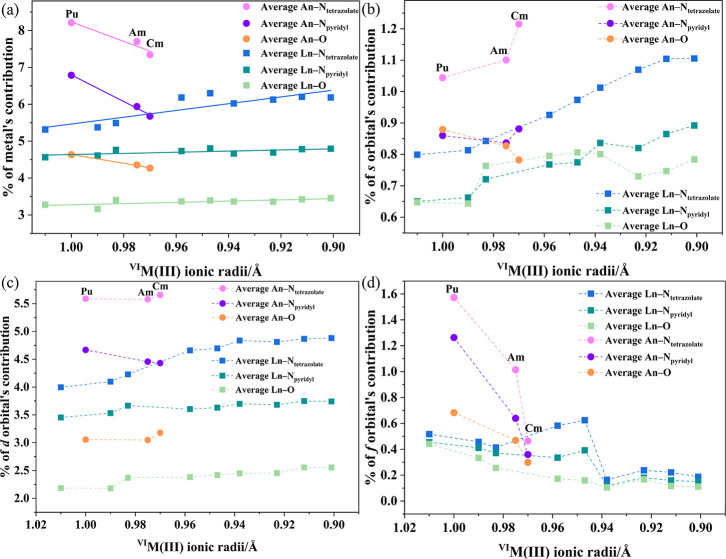 Figure 5
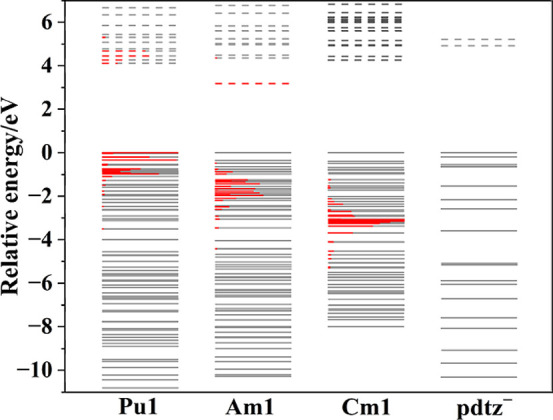 Figure 6
 Figure 7
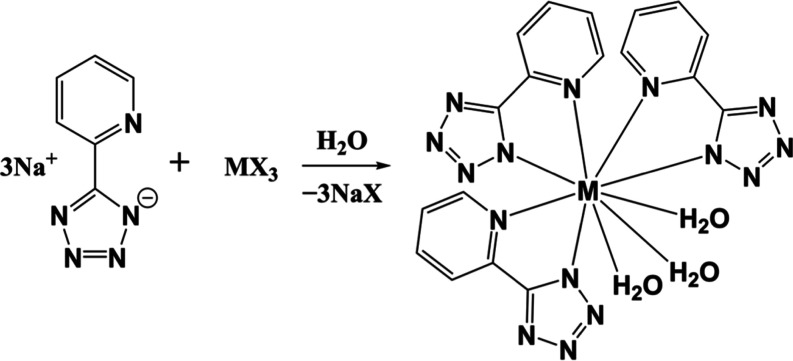 Figure 8
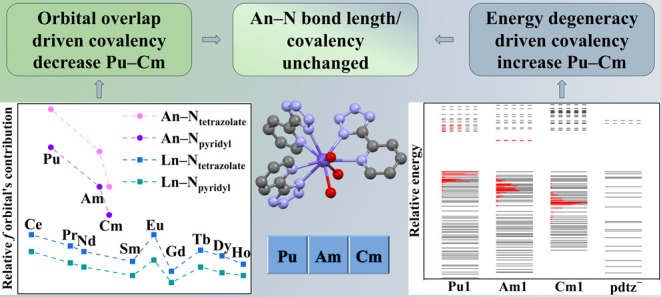 Figure 9
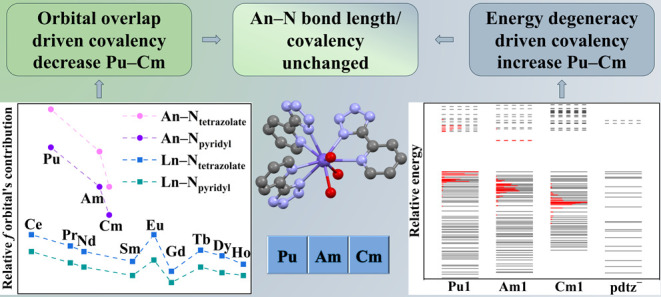 Figure 10
Peer Reviews
No public reviews on file for this paper yet. If you reviewed it on a platform where reviews are public (OpenReview, ICLR, NeurIPS, ICML), you can paste yours below so the community can read it here.
Videos
No videos yet. Explain this paper in a talk, walkthrough, or lecture? Add one.
Taxonomy
TopicsLanthanide and Transition Metal Complexes · Organometallic Complex Synthesis and Catalysis · Radioactive element chemistry and processing